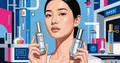
Japan's 2026 Trend: 'Stopping Time' with Reverse Aging
In Japan, the concept of 'Reverse Aging' is replacing anti-aging care. The focus is on epigenetics and the removal of senescent cells (senolytics), which allows not just slowing down but literally reversing skin aging processes, as seen in new serums from Shiseido.
Japan's Revolution: Why 2026 Is the Year 'Anti-Aging' Died and 'Reverse' Was Born
When the world was snapping up anti-wrinkle creams in 2016, the Japanese were already looking several steps ahead. Today, in 2026, we are witnessing a paradigm shift that renders 90% of products on Sephora shelves obsolete. This is the transition from the concept of 'slowing down' (Anti-Aging) to 'reversing' (Reverse Aging). Shiseido and other giants have declared a new era—the era of epigenetics and senolytics.
But glossy magazines are missing the point. They call it a 'new trend.' I say it's a silent nuclear bomb under the injectable aesthetics industry. If senolytics (agents that destroy senescent cells that poison tissues) truly work in topical form as lab tests promise, the need for regular Botox and filler injections will become a thing of the past. We are entering the era of 'biological repair,' and the first shot has been fired in Japan.
[The Core]: What's Really Happening
What's really happening is not just a cosmetic upgrade but a shift to treating the root cause. Until 2025, the entire industry worked with symptoms of aging: wrinkles, pigmentation, loss of firmness. We filled them with hyaluronic acid, paralyzed muscles with Botox, resurfaced with lasers. But senescent cells—zombie cells—remained in place, secreting SASP factors (senescence-associated secretory phenotype) that 'age' neighboring healthy cells.
Reverse Aging aims to find and neutralize these saboteurs. Japanese researchers, followed by Shiseido and KAO, have bet on epigenetic programming. We don't change DNA (that's impossible); we change gene expression—which genes are turned on and which are turned off. New serums contain senolytic molecules (e.g., fisetin, quercetin in liposomal forms, or novel peptide mimetics) that force old cells into apoptosis (suicide), clearing space for new, healthy cells to grow.
The second layer of this revolution is delivery technology. It's useless to have a powerful senolytic if it can't penetrate the deep dermal layers where zombie cells hide. The Japanese solved the problem differently from the Koreans with their microneedles. They use 'phospholipid nanocarriers with pH sensitivity' that only break down in the acidic environment (pH 6.2-6.5) characteristic of inflammation and aging foci. Brilliant engineering.
Timeline and Context: Why Japan, and Why Now?
Japan is the perfect testing ground for this trend. It's the country with the world's oldest population and a cultural code where staying active and looking good at 70+ is the norm, not the exception. The anti-aging product market here was already valued at $7.4 billion in 2025 and is projected to grow to $11.7 billion by 2034.
The development timeline looks like this:
- 2020-2023: Accumulation of scientific knowledge. The 2016 Nobel Prize in Physiology or Medicine (autophagy) and work on senescent cells begin to be commercialized. Western pharma giants try senolytics as pills (e.g., dasatinib, quercetin) but face side effects.
- 2024: Breakthrough in topical application. Japanese scientists find a way to deliver low doses of senolytics transdermally without systemic effects. This moves therapy from 'pharma' to 'cosmetics.'
- 2026: Point of no return. Shiseido releases the first line officially labeled 'Rejuvenating' (not just 'lifting'). Lancôme and Dior open 'Longevity Clinics' following the Japanese. In functional medicine, the term 'pace of aging' begins to dominate over chronological age.
Who Wins and Who Loses
Winners (1) — J-Beauty Giants with R&D. Shiseido, Kao (brands Sensai, Kanebo), and Pola. They hold patents on specific plant-derived senolytic molecules (perilla extract, Japanese willowherb) with proven efficacy. Their new niche—Longevity Beauty—allows them to raise the average ticket to $200-300 per bottle, justifying the price with 'science.'
Winners (2) — Consumers with Early Signs of Aging (30-45). This is the 'sweet spot'—those not ready for injections due to fear of 'frozen face' or filler migration, but already seeing dullness and loss of elasticity. Reverse Aging gives them a legitimate, medically grounded path without a scalpel.
Losers (1) — Aesthetic Medicine Clinics (Botox segment). Not tomorrow, but in 18-24 months, when the efficacy of topicals is confirmed by hundreds of thousands of before/after photos on social media, the flow of clients for 'beauty shots' could drop by 15-20%. Young people will start asking: 'Why inject a neurotoxin when a serum can 'repair' cells on its own?'
Losers (2) — Mass-Market Brands with 'Anti-Wrinkle' Tags. L'Oréal Paris, Olay, and Nivea don't yet have senolytics in the mass segment. Their marketing 'fighting wrinkles' sounds archaic next to promises of 'changing biological age.' They'll either have to buy biotech startups (expensive) or lose market share.
What the Media Isn't Saying: Safety Concerns and Long-Term Risks
Euphoric articles in Vogue and Harper's Bazaar are currently ignoring three 'elephants in the room.'
First: Senolytics are weapons of mass destruction. Yes, they kill bad cells. But how do they distinguish an 'old but harmless' cell from an 'old and harmful' one? In the dermis, senescent cells act as 'sentinels' in early cancer stages, suppressing mutations. Excessive removal could increase the risk of skin neoplasms. No long-term study (5+ years) has examined this. We are experimenting on our skin.
Second: The 'Placebo Reversal' Effect. Most 'reversal' studies measure biomarkers (inflammation markers, telomerase activity). The promise of 'looking 25 at 45' is still marketing. Even the strongest senolytics in a test tube roll back fibroblast biological age by 1-2 years, not 10. The media hyperbolizes results, mistaking statistical significance for visible effect.
Third (and most cynical): Shiseido and others now hold patents on the most effective senolytic peptides. This is a monopoly. Prices for 'anti-aging cream' will be comparable to a course of chemotherapy per gram. The 'Longevity' industry is becoming elitist, inaccessible to the middle class. While the rich buy reversible aging, the poor will use old retinol. No one discusses the ethical aspect of this technological divide.
Forecast: Next 30 Days and 90 Days
Next 30 Days (June 2026):
Following Shiseido, Lancôme will announce the launch of its 'Longevity Serum' line with rosehip extract and exosomes (but it will be a copy, less effective than Japanese developments). A patent war will begin: LVMH (owner of Dior) will try to challenge Shiseido's patents in Europe. Meanwhile, in the US, the first major Consumer Reports investigation into 'reverse cream scams' will show that 80% of products with this label don't contain effective doses of senolytics.
Next 90 Days (End of Summer 2026):
Social explosion. Influencers will start testing these creams on themselves with 3D skin scanners. It will turn out that individual response to senolytics strongly depends on genetics (p53 gene polymorphisms). Personalization will become the key word: 'This cream works for you only if you have mutation X.' Brands without genetic testing will lose trust.
The Japanese market will continue to grow at a CAGR of about 5-6%, but the main driver is exports. Americans and Europeans will sweep 'Reverse Aging' cosmetics off shelves, bringing them back in suitcases from Tokyo. The beauty industry will forever split into 'before' and 'after' 2026. And we are now at the 'after' point.
— Editorial Team