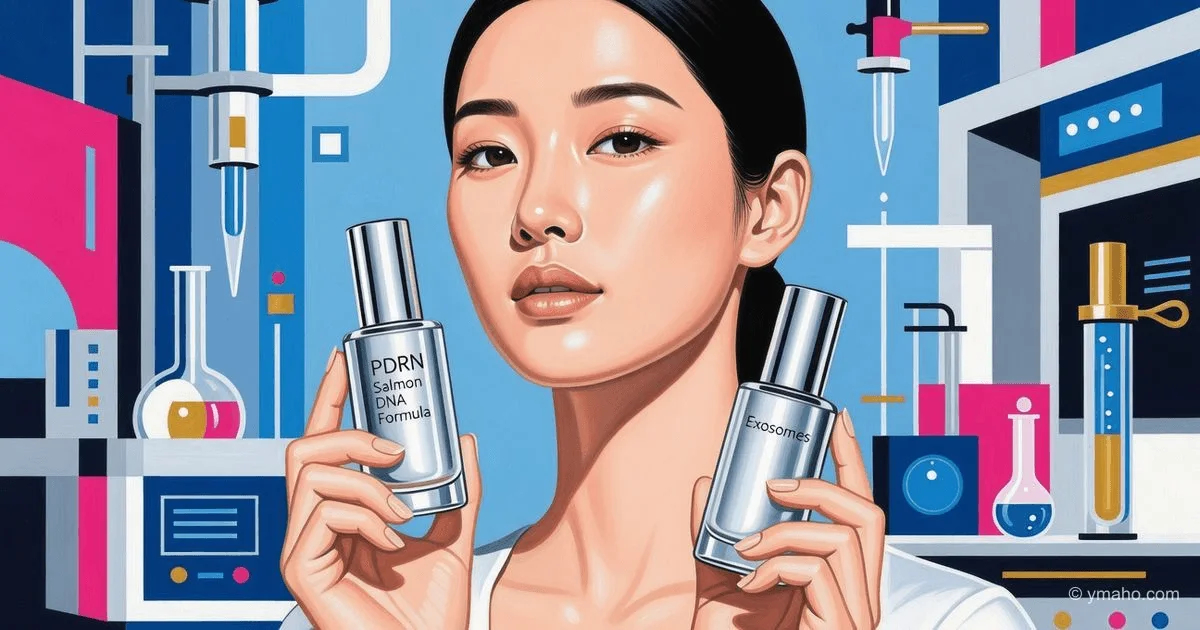
Pharma-Biotics Take Over Korea: Serums with PDRN and Exosomes Are Now Accessible to Everyone
Ingredients previously used only in clinics, such as PDRN (polynucleotides) and exosomes, are massively moving into the mass market and dominating Korean sales rankings. Prices for such products are 6–10 times lower than clinical procedures, making regenerative care accessible, and brands like Medicube and Rejuran are becoming leaders.
Analytical article: Democratization of Regenerative Medicine — How PDRN and Exosomes Cracked the K-Beauty Code
Headline: The End of the "Just Moisturize" Era: Why Brands Without PDRN and Exosomes Will Die in 2026
Insight not found in glossy magazines: What is happening now in Korea is not just "another trend" that will come and go in six months. It is the industry's first legitimate cannibalization of clinical dermatology by the mass market. When APR (owner of Medicube) reports revenue growth of 123% for the quarter and operating profit soars by 173%, that's not marketing. It means they have switched millions of women from "moisturizing concoctions" to real regenerative therapy at the price of a restaurant dinner. Prices for these products are 6–10 times lower than clinical procedures, and this completely reshapes the consumer spending map — people stop saving for injections because a $30 jar solves the same problem as a $300 visit to a cosmetologist.
But there is a quiet, scary detail here: we are moving toward a world where "active" ingredient becomes synonymous with "dangerous without control." When retinol was king, we knew the rules of the game (redness, peeling, adaptation). What happens when 20-year-old girls start rubbing exosomes and salmon DNA fragments into their faces? Medicine does not yet have an answer to this question. We are entering the territory of "smart" biology, where the consequences of interfering with cell signaling pathways can be delayed and unpredictable. But more on that later.
[The Core]: What Is Really Happening
What is really happening is a structural breakdown of the "clinic -> pharmacy -> mass market" business model. If before, innovation went from doctors to cosmetologists and only then to consumers with a delay of 5–7 years, now Korean giants like Kolmar and APR have shortened this cycle to 12–18 months. PDRN (polynucleotides from salmon), which as recently as 2023 was a niche injectable drug Rejuran for millionaires, is now sold in serums on Ozon, Amazon, and in every Olive Young. This became possible thanks to delivery technologies (microneedles, liposomes) that roughly but effectively drag giant DNA molecules through the stratum corneum.
The second layer of reality is synergy. PDRN (structure) and exosomes (signaling vesicles carrying instructions) work in tandem. Clinical studies presented at IMCAS 2026 confirm: exosomes reduce inflammation, and PDRN restores the matrix. Koreans, more than anyone else, understood that you need to sell not a liquid in a jar, but a "bundle." Medicube sells not a serum, but a "system": exosomes are loaded into microneedles (spicules) that physically puncture the skin, creating microchannels. This is genius — a legal way to do "home mesotherapy" without violating medical laws.
And finally, the most important thing happening now is integration. Korean researchers from KRIBB (Korea Research Institute of Bioscience and Biotechnology) already published protocols in April 2026 for loading PDRN inside exosomes using electroporation. That is, we are on the verge of the emergence of "exosomes 2.0," where the carrier and the drug are one. This is such complex bioengineering that Western giants like L'Oreal have no chance of catching this train in the next two years.
Timeline and Context: How Jennifer Aniston's Phrase Exploded the Market
The history of this boom is a perfect example of how pop culture and science collide. The timeline looks like this: 2014 — Rejuran launches PDRN injections for a narrow circle of Korean dermatologists. 2023 — Jennifer Aniston mentions the "salmon" procedure in an interview with the Wall Street Journal. Shortly after, Kim Kardashian shows a PDRN face on her show. Global market demand skyrockets.
2024-2025 — American and European brands panic. They realize they cannot quickly develop a stable PDRN formula due to patents. Meanwhile, Korean conglomerate APR (formerly known as APR Corp) launches a PDRN line in the mass market in 2025. Result: by February 2026, sales of the PDRN line reach 50 million units worldwide. And this is just the beginning.
In May 2026, we see the final chord — APR reports for the first quarter: revenue of 593.4 billion won (~$450 million or ~€410 million), growth of 123%. International sales share reaches 89%. This is not just a brand success; it is the collapse of the "local brand" concept. The world voted with its wallet for regenerative cosmetics against "moisturizing."
Who Wins and Who Loses
Winners (1) — microneedle and biotech manufacturers. In this race, those who have the best extract do not win, but those who deliver it to the cell nucleus. Companies that own delivery technology (like APR with its "spicules," where microneedles literally grow into the serum structure) create vendor lock-in. A brand that wants to launch an exosome serum is forced to buy the technology from them or use less effective liposomes.
Winners (2) — dermatologists who added topicals to the bill. Paradoxically, clinics do not lose income; they transform it. Now, instead of "killed" skin after retinol, patients come with "tuned" skin prepared by home PDRN serums. The doctor simply changes the protocol: a $30 topical that the patient bought themselves removes the inflammation phase, and the doctor can immediately do $500 lasers.
Losers — classic mass brands from Europe and the US (L'Oreal, Estee Lauder, P&G). They are late. Their research on peptides and retinol is morally obsolete. They cannot sell "moisturization" for $80 when Medicube sells "DNA regeneration" for $25. Their R&D centers are tied to chemistry, but here biology is needed. To catch up, they will have to buy a Korean startup (like L'Oreal bought Grown Alchemist), but while they negotiate, the market is already taken.
What the Media Doesn't Tell: The Problem of Sustainability and Ethics
The yellow press writes about miracles, but I see three "red flags" that are kept silent.
First: Stability is low, marketing is high. A scientific article in BMC Biotechnology from April 2026 shows that exosomes are living nanovesicles that degrade at temperatures above 4°C and with shaking. Most brands, including Western imitators, sell "exosomes" in jars that have sat in a hot warehouse for 3 months. In fact, it's already dead protein. The consumer pays for "mRNA instructions" and gets "amino acid soup." The clinical efficacy of mass-market versions has so far only been proven in the manufacturer's test tubes.
Second: The "super-skin" problem. PDRN and exosomes stimulate fibroblast proliferation and collagen production. But in oncology, there is a theory that excessive stimulation of repair mechanisms may be risky for people with a genetic predisposition to certain types of tumors. No cosmetic study looks at the 10-year consequences of such a total "hack" of regenerative signaling pathways in healthy people. We are becoming guinea pigs in a global rejuvenation experiment.
Third (and most cynical): The ingredient PDRN is purified salmon DNA. The environmental burden of such animal farming is colossal. When 50 million jars go into the trash, fragments of foreign DNA enter the water. We do not yet have data on how the industrial scale of using salmon DNA in cosmetics will affect ecosystems and antibiotic resistance in bacteria that feed on these wastes. The industry prefers not to think about it.
Forecast: The Next 30 Days and 90 Days
Next 30 Days (June 2026):
An avalanche of "fake exosomes" will begin on the market. Companies that do not have bioreactors for cultivating stem cells (the only legitimate source of exosomes) will start calling ordinary centrifugates of plant extracts "exosomes." I expect the first class-action lawsuits in the US against brands that promised "signal regeneration" but sold glycerin. The FDA is silent for now, but pressure will grow.
Next 90 Days (End of Summer 2026):
APR will make its next move — announce the launch of an injectable version of its PDRN line for professional use. This will kill two birds with one stone: doctors will stop buying expensive Rejuran (whose market share will drop by 15-20%) and will start using APR. Kolmar, in turn, will urgently bring to market a hybrid of PDRN + exosomes in one capsule (what was written about in the April KRIBB article). This will be a "nuclear bomb" for the anti-aging category.
Summer 2026 will become a point of no return. We will forever say goodbye to simple moisturizing creams. The future is molecular biology in the bathroom. And it is both beautiful and a little frightening.
— Editorial Team