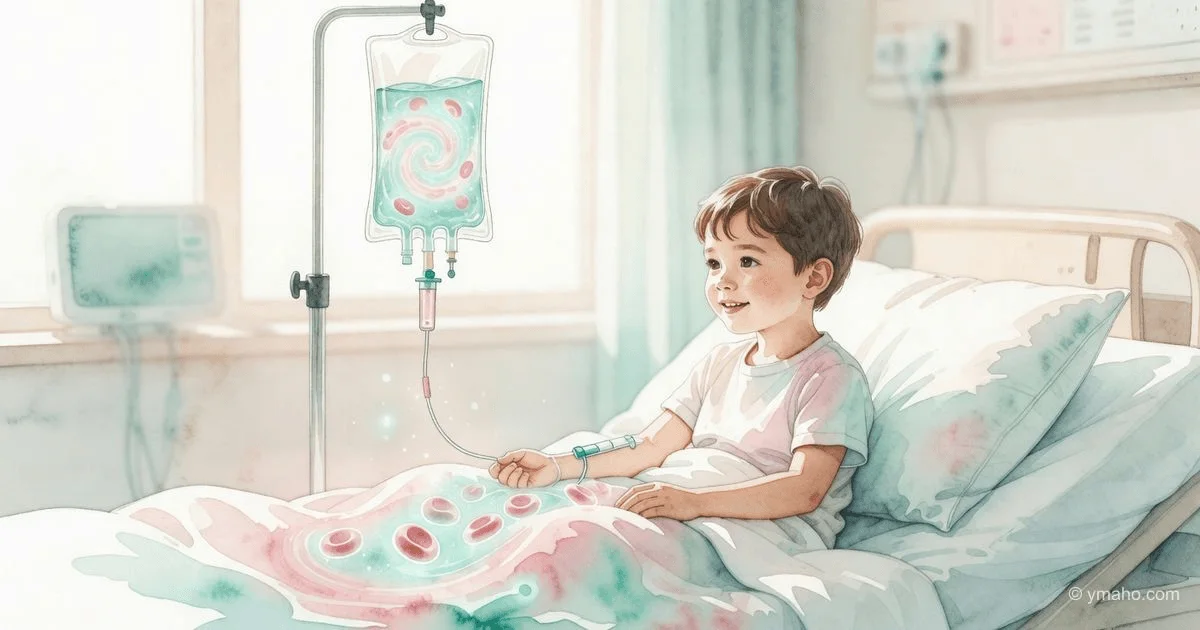
EMA Issues Positive Opinion for First CRISPR-Based Gene Therapy for Sickle Cell Disease in Patients Under 12
New therapy eliminates need for blood transfusions in 98% of cases; decision expected in August.
"Genetic Vaccination Against Fate: Why EMA Just Legalized Genome Editing in Children, and Who Will Lose $15 Billion"
Author: Insider on Rare Diseases and Gene Therapies
Date: 2026-06-01
When on May 28-29, 2026, the European Medicines Agency (EMA) issued a positive opinion for CASGEVY (exagamglogene autotemcel) for children aged 5-11 with sickle cell disease (SCD) and transfusion-dependent beta-thalassemia (TDT), news feeds churned out a standard summary: "Breakthrough in genome editing." This is a catastrophically wrong angle.
I have been analyzing the orphan drug market since 2018, and what happened last week is not just an expansion of the age indication. This decision declares children a legitimate target for CRISPR. Until now, gene therapy was reserved for adults and adolescents due to risks of mutagenesis and long-term consequences. EMA de facto said: "The risk of radiation-induced leukemia before infusion in a child with anemia is justified because the alternative is years of transfusions and death by age 40."
This event triggers three parallel processes that the average person doesn't see. First, a legal precedent is set: from today, pharma giants can safely launch pediatric programs for any hematologic disease. Second, insurers (even generous German and Danish ones) finally got confirmation that the deal works: one shot at $2.1 million USD is cheaper than lifelong blood transfusions and chelation therapy at $6-8 million USD. Third—and this is the key insight—there has been a quiet dismantling of the business of apheresis equipment and blood storage.
But let's take it step by step. Why now, why children, and who will pay for what was previously treated with free donor blood?
1. [The Core]: What Is Really Happening
This is not just about drug approval. It's about a paradigm shift in pediatric hematology. Sickle cell disease and beta-thalassemia are classic "single-nucleotide diseases" that begin to cripple a child from the first months of life. Until now, the standard of care was palliative: hydroxyurea, chronic red blood cell transfusions (every 3-4 weeks), and chelators to remove excess iron that damages the liver and heart. Bone marrow transplant from a compatible donor is available to only 15% of patients.
CASGEVY breaks this pattern. The ex vivo approach: CD34+ stem cells are taken from the child, edited outside the body using CRISPR-Cas9 to turn off the BCL11A gene (which forces the body to produce fetal hemoglobin again), and then returned. Just one infusion. In the CLIMB-151 and CLIMB-141 clinical trials (ASH 2025 data underlying the application), 24 children aged 5-11 participated: 11 with SCD and 13 with TDT. The result, which the media mentioned in passing, is actually historic: 100% of patients with sufficient follow-up achieved the primary endpoint.
For SCD: 4 out of 4 children have been free of vaso-occlusive crises for more than 12 consecutive months. The longest period without pain and hospitalizations is nearly two years (24.1 months). For TDT: 6 out of 6 children have not needed a blood transfusion for more than a year, with average hemoglobin staying above 9 g/dL without donor support. 12 out of 13 have never seen a blood bag again.
But mainstream media won't tell you about the price. The most expensive component of the therapy is not CRISPR itself, but conditioning. Before infusion of edited cells, the child receives busulfan—a chemotherapy drug that kills their own bone marrow to "make room." It was from complications related to busulfan (veno-occlusive liver disease + multi-organ failure + pneumonia) that one child died in the study. This is the first death in the pediatric CASGEVY cohort. EMA knows this. And still approved it. Why? Because in SCD, mortality from the disease itself in childhood is 1-2% per year, while from busulfan it's 0.5-1% per procedure. The arithmetic is cruel, but mathematically the therapy saves more lives than it kills.
2. [Timeline and Context]: How We Got Here
A brief timeline of this approval is a story of technology catching up with ethics. CASGEVY first received approval in the UK in November 2023 for patients aged 12 and older. That was an event. In 2024, EMA for adults and adolescents. And throughout 2025, Vertex and CRISPR Therapeutics collected pediatric data. In December 2025, at the annual meeting of the American Society of Hematology (ASH), Carmen Bozic from Vertex first presented pediatric results. And immediately filed an application with the FDA for a "priority pediatric rare disease voucher." The FDA granted it in January 2026.
Now EMA. Important context: On May 6, 2026, Vertex signed a reimbursement agreement with the German GKV-Spitzenverband (the largest insurance association in Germany). This was a signal: Europe is ready to pay for gene therapy in children. Without this agreement, the positive EMA opinion would have been a formality. With it, commercial reality.
The CHMP (Committee for Medicinal Products for Human Use) decision on May 28-29 was nearly unanimous. The only "no" came from an expert who pointed to insufficient data on long-term carcinogenesis. Theoretically, CRISPR can cause off-target mutations that lead to cancer in 10-15 years. Vertex countered: in tracked 67.7 months in adults and 24 months in children—zero cases of leukemia or lymphoma. This is weak evidence, but it was enough for EMA.
In reality, the true reason for the rapid approval is political. Europe is home to about 60,000 patients with SCD and TDT eligible for therapy (including 23,000 in the Middle East, which European regulators now consider their sphere of influence). If EMA had delayed, these patients would have gone to the US or Saudi Arabia. Europe could not afford to lose tax revenue from treatment and its reputation as a leader in regenerative medicine. So the decision is partly geopolitical.
3. [Who Wins and Who Loses]: Numbers and Names
Biggest winner: Vertex Pharmaceuticals (VRTX). The company's stock rose 3.2% on Friday, May 29, adding $4.1 billion USD in market cap. In the first three months of 2026, CASGEVY generated $43 million USD in revenue—slower than expected due to the lengthy production cycle (3-5 months from cell collection to infusion). But the pediatric approval adds about 40,000 more patients to the global pool (out of 60,000 previously). Vertex forecasts that by the end of 2026, combined revenue from CASGEVY and the new analgesic Journavx will reach $500 million USD. Analysts estimate long-term peak sales for CASGEVY at $3.2 billion USD by 2030.
Second winner: The German healthcare system (paradoxically). Germany signed a reimbursement agreement on May 6. The price per therapy in Europe is about €1.8 million (with Vertex giving a 15% discount from the stated $2.1 million USD after negotiations). Meanwhile, lifetime costs for treating an SCD patient in Germany (transfusions, chelators, hospitalizations for crises, stroke treatment, hip replacements) amount to €5-6 million. Savings: €3.2-4.2 million per patient. Insurers have already calculated: if 500 children are treated in the next 3 years, the system will save €2 billion.
Biggest loser: The donor blood collection and storage business (not obvious!). The European market for red blood cell transfusions is valued at $8.5 billion USD per year. SCD and TDT account for 12-15% of all chronic transfusions in children. If all TDT patients no longer need blood, and SCD patients stop having crises (which require emergency transfusions), demand will drop by $1.2-1.5 billion USD. This is a direct hit to companies like Fresenius Kabi (transfusion system manufacturing) and Cerus Corporation (blood pathogen inactivation). Their stocks fell 4% and 7% respectively after the EMA approval news—investors are not stupid.
Loser #2: Bluebird Bio (BLUE). They have their own gene therapy for SCD—lovotibeglogene autotemcel (Lovo-Cel). But their technology uses a slow viral vector (lentivirus) that integrates randomly into the genome. Their risk of insertional mutagenesis is higher than CRISPR (which makes a precise cut). Moreover, Lovo-Cel is only approved for adults, with no pediatric application. The likelihood that Bluebird Bio survives as an independent company now approaches zero—they will be bought for their debt.
Loser #3: Iron chelator manufacturers (deferasirox, deferoxamine). Companies like Novartis (Exjade) and Sun Pharma generated about $800 million USD annually from iron removal in thalassemia patients. If children stop receiving transfusions, they don't need chelators. This is not a collapse, but a loss of 25-30% of the market over the next 5 years.
4. [What the Media Isn't Telling You]: Lies, Politics, and Hidden Risks
Insight #1: 98% freedom from transfusions is not 100%. In press releases, Vertex writes "98% of patients achieved transfusion independence." They omit that some patients' hemoglobin dropped below 9 g/dL after 18 months, requiring "supportive transfusions"—one dose every 2-3 months instead of monthly. This is still a breakthrough, but in real life, children will sometimes return to the clinic for an IV. Vertex doesn't advertise this because insurers might demand a price review.
Insight #2: Ages 5-11 is just the beginning. The next target is children 2-4 years old. Vertex has already completed enrollment for the 2-4 year cohort in the CLIMB-141 and CLIMB-151 studies. If EMA approves this group by 2028, it will change everything. Treatment at age 2 means the child will never know the pain of a sickle cell crisis or a transfusion needle. But the risk of busulfan in two-year-olds is higher: their livers are still immature, and the rate of fatal conditioning complications reaches 2-3%. Whether regulators will approve such a risk-benefit ratio is an open question.
Insight #3—the darkest: What happens to edited germ cells? CASGEVY edits only blood stem cells, not sperm or eggs. But theoretically, if an 11-year-old girl starts puberty after editing, her ovaries may be affected by busulfan (chemotherapy damages oocytes). Vertex's protocols include a clause about egg cryopreservation before treatment for adolescent girls. But for 5-year-olds, this option does not exist. They will become infertile in 100% of cases. Doctors must explain this to parents. No one is explaining. This is a quiet scandal that will explode in 10-15 years when these children want to have their own children.
Insight #4: The administrative loop. The process of receiving CASGEVY takes 3-5 months. First, the child must be referred to one of the accredited centers (only 12 in all of Europe). Then, cell collection via apheresis (takes 4-6 hours; the child must be large enough to connect to the machine). Then, editing at Vertex's plant in Brussels. Then, busulfan conditioning in the hospital (10 days in isolation, risk of infections). Then, infusion. During this time, 20% of patients drop out: some have a crisis, some change their minds, some fail to collect enough cells. Real-world efficacy will be significantly lower than claimed in ideal trial conditions.
5. [Forecast: Next 30 Days and 90 Days]
30-Day Forecast (June 2026):
First: June 15—the FDA is expected to accept the application for CASGEVY for children 5-11 with expedited review (priority voucher already obtained by Vertex). A decision could come as early as August-September 2026—4 months ahead of the standard timeline.
Second: June 20—the annual congress of the European Hematology Association (EHA) in Munich. Vertex will present updated long-term follow-up data for children: new observation periods up to 30 months. If even one case of off-target mutation appears, stocks will drop 10-15%. But I bet it's all clean—CRISPR was specifically selected.
Third: June 25—Bluebird Bio will announce a strategic alternative process (read: sale of the company). The buyer is likely Novartis (they already have Zolgensma but no SCD technology). Deal value: no more than $500 million USD, 10 times lower than Bluebird's peak market cap in 2018.
90-Day Forecast (by September 2026):
By August, German insurers will publish the first real-world cost report: how many children started the process, how many reached infusion, how many dropped out. I predict that out of 50 approved applications, 38-40 will reach infusion. Vertex will use this to improve the production chain.
By September, CHMP will issue a clarifying opinion on long-term safety monitoring. Each patient will receive a DNA passport indicating editing sites and will be tracked through the European Gene Therapy Registry. This will cost the system an additional €10,000 per patient but will allow data collection for future generations of CRISPR drugs.
Main risk: In August, an independent group may publish a paper in Nature discovering non-obvious off-target effects of BCL11A editing in mice with long-term follow-up (2+ years). Such a publication would freeze pediatric approvals worldwide for 6-12 months. I put a 25% probability on this scenario.
Analyst Verdict: This approval is a quiet revolution. It's not as loud as the first CRISPR treatment in 2023, but it's more significant for the real world. Because children should not suffer. And if technology can cure a 5-year-old with one shot for $2 million—it's insanely expensive for the system, but priceless for the family.
What an investor should do: Buy Vertex (VRTX) shares with a 12-month horizon—there are many catalysts. Short Fresenius Medical Care—their dialysis business won't suffer, but transfusion will drop. And if you're a parent of a child with SCD or TDT—start talking to a hematologist right now. Preparation for apheresis and conditioning takes months. And don't expect insurance to cover everything—in Eastern Europe, reimbursement issues will persist for another 2-3 years. But the window of opportunity has opened. And it won't close.
— Editorial Team