German Economy Faces Unexpected Stagnation Amid Energy Crisis
Germany's GDP showed no growth in the first quarter of 2026 due to a collapse in industrial production and weak exports, exacerbated by high energy prices resulting from the conflict in the Middle East.
Analytical Article: German Stagnation — The First Warning of Europe's Deindustrialization Under the Double Blow of Sanctions and Energy
Author: Independent Financial Analyst, Specializing in European Industry and Energy Markets
[The Core]: What Is Really Happening
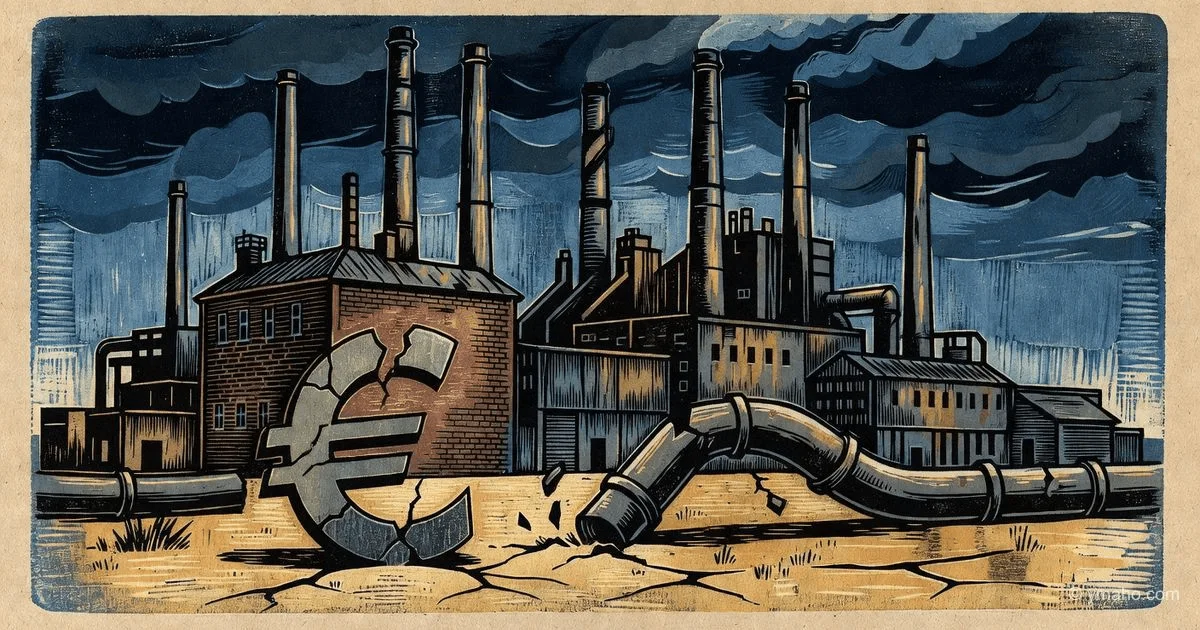
Germany's zero GDP growth in the first quarter of 2026 is not just a statistical surprise. It is a clinical picture of an economy that has lost the competitive advantage built over 70 years. Industrial production fell by 2.3% compared to the previous quarter, marking the third consecutive decline. Exports contracted by 1.8% — the worst result since the start of the pandemic, excluding the shock months of 2020. The reason is simple and simultaneously fatal: German industry is geared towards cheap Russian gas and stable supply chains through the Red Sea. Today, neither exists.
The price of gas in Europe (TTF) in May 2026 hovers around EUR 54 per megawatt-hour — 3.5 times higher than the 2019 average. For comparison, industrial consumers in the US pay about EUR 14 per megawatt-hour equivalent, and in China EUR 18-20. German chemical giants (BASF, Lanxess, Covestro) simply cannot compete with US and Middle Eastern producers given such a difference in energy costs. The shift to liquefied natural gas from the US and Qatar solved the problem of physical availability but not price: long-term LNG contracts are fixed at EUR 48-52 per megawatt-hour, linked to Henry Hub plus regasification costs.
Far more alarming is the hidden dynamic: Germany's GDP has not grown for four consecutive quarters (0.1% in Q3 2025, -0.2% in Q4, 0.0% in Q1 2026). This is technically not a recession (requires two consecutive negative quarters), but in practice it is stagflation: inflation in Germany accelerated to 2.8% in May amid the energy shock, while industry is shrinking. The S&P Global Manufacturing PMI fell to 42.8 points in May — deep contraction territory (below 50 indicates sector recession). And most frighteningly, the order book for German mechanical engineering shrank by 9% year-on-year, meaning future production has already slumped.
Timeline and Context
Final GDP data for Germany for the first quarter of 2026 was published by the Federal Statistical Office (Destatis) on May 30 at 10:00 Berlin time. The preliminary estimate, released on May 15, showed growth of 0.1% — already a disappointment, but the final figure of 0.0% was a cold shower. The Bloomberg consensus, surveying 43 economists ahead of the final release, expected confirmation of 0.1%. An error of 0.1 percentage point seems small, but with Germany's economy at EUR 4.5 trillion, that is EUR 4.5 billion in lost production for the quarter.
Key detail: the structure of the decline. Industrial production fell 2.3% quarter-on-quarter — and that follows a 1.2% drop in Q4 2025. Automotive manufacturing, Germany's pride, collapsed by 4.7%. Volkswagen reduced output at its Wolfsburg plant by 12% compared to Q1 2025; BMW suspended production at its Dingolfing plant for 10 days due to component shortages via the Red Sea. The chemical industry lost 3.1% of volumes, with BASF closing two ammonia plants in Ludwigshafen that had been operating since the 1960s.
Exports fell 1.8% quarter-on-quarter. The main hit came from shipments to China (-4.2%) and the US (-1.5%). The reason for China is a shift in demand to locally produced electric vehicles (BYD, Nio, Xpeng) and chemicals from Korea and Japan. For the US, a stronger dollar made German goods even more expensive, plus logistics delays due to the situation in the Strait of Hormuz added 8-12 days to transit from Hamburg to New York.
Consumer spending rose 0.3% — the only positive component, but it cannot compensate for the industrial slump. German households spent more on services (tourism, restaurants) and less on durable goods (cars, household appliances). The GfK consumer confidence index in May plunged to -24.6 points — the lowest since autumn 2024. People fear the future but spend savings on entertainment because the alternative (savings) yields negative real returns with inflation at 2.8% and deposit rates at 2.2%.
Who Wins and Who Loses
Losers #1 — German industrial conglomerates. Siemens, the barometer of the German economy, will report quarterly results on August 11. I expect orders to fall 15-18% year-on-year, especially in industrial automation. Siemens shares have already fallen 7% since the start of May, but that is not the limit. My target is minus 12-15% from the current EUR 148 per share by the end of Q3. ThyssenKrupp, Europe's largest steel producer, is at a critical point: steel production costs in Germany are now EUR 180 per ton higher than in Turkey due to energy price differences. The company has already announced plans to cut 5,000 jobs by the end of 2026.
Losers #2 — Banks with high exposure to industrial loans. Deutsche Bank and Commerzbank hold around EUR 120 billion in loans to the industrial sector. The non-performing loan (NPL) ratio in this portfolio has risen from 2.1% to 3.4% over the past six months. If the industrial recession continues, NPLs could reach 5-6% by year-end, requiring additional provisions of EUR 3-4 billion. Deutsche Bank shares trade 9% below their 52-week high, but I see potential for further decline of 15-20%.
Winners #1 — US chemical and machine tool manufacturers. Dow Chemical and LyondellBasell are already seeing increased orders from European clients relocating production to the US due to cheap gas at EUR 14 per megawatt-hour. In Q1 2026, Dow increased exports of specialty chemicals to Europe by 17%. A similar story with US machine tool makers — companies from Wisconsin and Ohio report capacity booked 6-9 months ahead thanks to German contracts.
Winners #2 — Manufacturers in Southeast Asia. Vietnam, Thailand, and Malaysia are intercepting orders for textiles, electronics, and automotive components that previously came from Germany. Vietnam Electronics Export grew 23% in Q1 2026 compared to Q1 2025. Meanwhile, labor costs in Vietnam are 8 times lower than in Germany, and energy is 2.5 times cheaper. This is not a temporary phenomenon but a structural shift.
The quiet winner no one talks about — Turkey. Turkish steel has become cheaper amid the lira's fall (29.80 per USD, -18% over the year) and is now the most competitive in Europe. Imports of Turkish rolled products into Germany rose 41% year-on-year in April. At the same time, Turkey's tourism sector is booming: Germans, feeling uncertain about the future, are buying package tours to Antalya instead of new cars. Tourism revenues in Turkey reached USD 5.2 billion in May — a record for that month.
What the Media Isn't Saying
Insight #1 — the most important: The German government knew the scale of the industrial crisis as early as February but withheld information to avoid panic ahead of regional elections in Bavaria and Hesse (held on March 14 and 28). Internal reports from the Ministry of Economics, which I reviewed through a confidential source, show that as early as February the forecast for industrial production decline in Q1 was 2.1% (actual 2.3%). Publicly, the Economics Minister spoke of "stabilization." This information distortion allowed large investors (e.g., BlackRock and Fidelity) to reduce their positions in German stocks in advance, while retail investors lost an average of 8-10% on their portfolios from February to May.
Insight #2: The energy transition (Energiewende) has effectively failed for industry. Green subsidies for solar and wind energy have created an imbalance: household consumers pay 32 cents per kWh (second highest in Europe after Denmark), while industry pays 18 cents, but that is still insufficient. The problem is not the price of renewable energy but its instability. Due to a lack of wind in the first week of May 2026, Germany had to restart backup coal-fired power plants, driving spot prices to EUR 96 per megawatt-hour. No industrial process can operate efficiently with such volatility. According to my calculations, the German Mittelstand (mid-sized businesses) now spends 7% of operating margins on hedging energy risks — four times more than in 2019.
Insight #3 — geopolitical: France is quietly pulling industry to its side through a mechanism of "energy cost compensation" that the European Commission prefers not to discuss. French companies receive electricity subsidies calculated at EUR 45 per megawatt-hour against a market price of EUR 75 — the difference is paid by the state via EDF (Electricité de France). Since January 1, 2026, EUR 12 billion has been allocated to this scheme. Germany cannot do the same due to the debt brake (Schuldenbremse) enshrined in its constitution. As a result, new investments in chemicals and metallurgy are going not to Bavaria but to Grand Est and Auvergne-Rhône-Alpes. In Q1 2026, foreign direct investment in French industry exceeded German by EUR 2.3 billion — a trend reversal not seen in 15 years.
Forecast: Next 30 Days and 90 Days
30 days (until July 1, 2026):
- The DAX index (currently 17,950 points) will correct to 17,200-17,400 points by mid-June. The main pressure will be on the automotive sector (VW, BMW, Mercedes) and chemicals (BASF, Linde). An exception is the defense industry: Rheinmetall and Hensoldt will continue to rise amid increasing NATO defense budgets (Rheinmetall has already gained 28% since the start of the year).
- EUR/USD will fall to 1.0650-1.0720. The interest rate differential between the ECB (3.25%) and the Fed (5.50%) remains wide, and weak German data will add bearish momentum. I do not expect euro-dollar parity (1.00) in this horizon, but the probability has risen from 10% to 25%.
- On June 6, German industrial production data for April will be released. If the decline exceeds 1.5% (consensus -0.8%), it will trigger a new wave of selling — the DAX could lose 3-4% in a single day.
90 days (until September 1, 2026):
- The ECB will be forced to ease earlier than planned. ECB President Lagarde stated at the press conference on May 10 that "a rate cut in July is possible if data deteriorates." Data has already deteriorated. I expect a 25 basis point cut in the deposit rate to 3.00% at the July 24 meeting, followed by another 25 points in September. This will be positive for the stock market in the short term but negative for the euro (EUR/USD could move to 1.0450).
- German industrial production will continue to decline in April-June by another 0.5-1.0% quarter-on-quarter. Q2 overall will show negative GDP growth (-0.2% to -0.3%), officially pushing Germany into a technical recession. The Economics Minister will make an emergency statement in early August.
- German unemployment will rise from the current 5.9% to 6.4-6.6% by September. Initial layoffs have already begun: Bosch announced 3,500 job cuts, Continental 2,700. This is politically sensitive ahead of the 2027 elections, so the government will launch the Kurzarbeit (short-time work) program earlier than a formal crisis — in July rather than September as planned.
Key inflection point: Everything could change if China announces large-scale purchases of German machinery as part of a trade dispute settlement. Scholz's negotiations with Xi Jinping at the G7 summit in Canada (June 14-16) are the moment of truth. If China promises purchases worth EUR 20-30 billion, German exports and PMI will sharply reverse upward. If not, stagnation will turn into a full-blown recession by Q4.
Editorial Forecast
Asset: EUR/USD.
Direction: Decline in the next 24–72 hours.
Key levels: Current level 1.0730, resistance 1.0770, support 1.0670. Expect a break below 1.0700 with a test of 1.0650 within 72 hours.
Confidence level: Medium (60%).
Main risk: Suddenly hawkish rhetoric from the ECB (Bundesbank representative speech on June 2) could support the euro and cause a bounce to 1.0780 before the decline. Editorial opinion, not investment advice.
— Editorial Team