OpenAI Discusses Adding Citi and JPMorgan as IPO Bankers
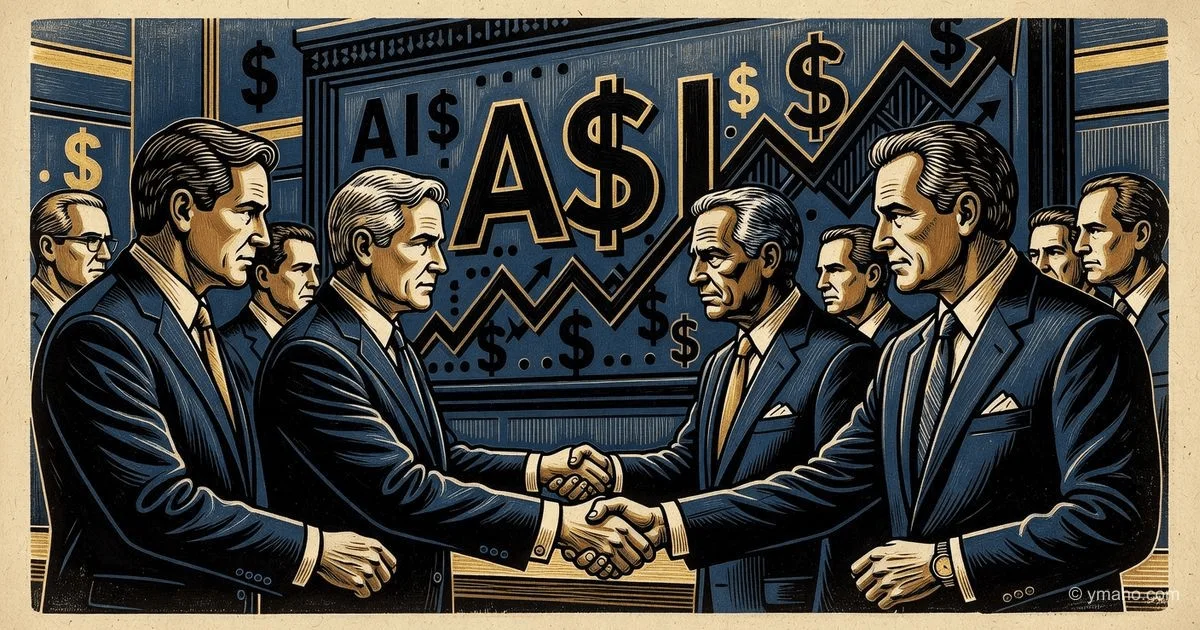
OpenAI is in talks to add Citigroup and JPMorgan Chase to its lineup of banks in preparation for an initial public offering. This would expand the pool of underwriters as the company gears up for its stock market debut.
Author: Independent Financial Analyst, specializing in IPOs and technology
The Bottom Line: What's Really Happening
OpenAI is expanding its IPO banker pool by adding Citigroup and JPMorgan to the already engaged Goldman Sachs and Morgan Stanley. On the surface, this is standard practice: the larger the offering, the more underwriters needed to distribute the workload. But in reality, this isn't just a technical expansion of the syndicate. It's a signal that internal conflicts within OpenAI have reached a point where the founders can no longer control the process.
Notice the composition. Goldman and Morgan Stanley are the elite, the "white shoes" of Wall Street, classic banks for tech IPOs. Citigroup is a bank with a massive balance sheet and retail network, but less prestigious. JPMorgan is a universal giant that can provide not only underwriting but also credit lines. Adding Citi and JPMorgan suggests that OpenAI is preparing not just for a stock market listing, but for a massive debt raise immediately after the IPO. Because the money is needed yesterday.
The essence of what's happening is simple, though the media skirts around it: OpenAI is not ready for public markets. The company loses $1.22 for every dollar it earns. Its competitor Anthropic, on the other hand, has shown operating profit for the first time. And Anthropic just raised $65 billion in a private round at a $965 billion valuation, surpassing OpenAI's $852 billion. OpenAI is forced to go public not because it's the best moment, but because private capital is no longer willing to provide money on the same terms.
Timeline and Context
On May 20, 2026, SpaceX officially filed for an IPO, targeting a record $75 billion. The same day, news broke that OpenAI was preparing a confidential SEC filing within weeks. The market perceived this as a declaration of war: the two most anticipated IPOs in history (SpaceX and OpenAI) would compete for the same institutional dollars in the same narrow window.
On May 21, Deutsche Bank issued an analytical note forecasting that OpenAI could raise about $600 billion at a valuation of over $1 trillion. This would make OpenAI's IPO the second largest in history after SpaceX, but at a valuation 50 times annual revenue (about $20 billion per month at that time). For comparison, Apple, with its stable $200 billion quarterly revenue, trades at a P/S ratio of about 8-9.
On May 29, Bloomberg reported on talks with Citi and JPMorgan. That same day, financial details for the first quarter of 2026 emerged: OpenAI's revenue was $57 billion (still more than Anthropic's), but operating margin was -122%. Meanwhile, Anthropic's annual revenue had already reached $450 billion, surpassing OpenAI's $300 billion.
A crucial context missing from most publications: on May 18, 2026, a federal court in California dismissed Elon Musk's lawsuit against OpenAI. This removed the legal uncertainty that could have blocked the IPO. Musk had sought to have OpenAI declared "captured" by Microsoft and return it to a non-profit model. Musk's loss cleared the path to the stock exchange, but also confirmed that OpenAI is now definitively a commercial entity.
Another hidden factor: on March 26, 2026, OpenAI closed a $122 billion funding round from Amazon, Nvidia, SoftBank, Microsoft, and others. These investors received their stakes at an $852 billion valuation. Now, just two months later, the company is going public with a target valuation of $1 trillion. This means private investors stand to gain a potential 17% return in two months. But for new shareholders on the exchange, it means buying shares at a price that already factors in this recent growth.
Who Wins and Who Loses
Winners: Goldman Sachs and Morgan Stanley. They have already secured lead roles. For them, this is the most prestigious tech IPO since Facebook and possibly the largest in many partners' careers. Underwriting fees for such an offering (standard 2-4% of the $600 billion raised) would total $12-24 billion. Even split among four banks, each would earn billions in fee income.
Winners: Citi and JPMorgan. They enter the deal at a late stage but gain access to OpenAI's clientele and the opportunity to lend to the company post-IPO. JPMorgan is particularly interested: OpenAI will need billions in credit lines to pay for Nvidia servers and electricity. These loans will generate interest income for the bank for years to come.
Winners: Existing private investors. SoftBank, a16z, Thrive Capital, Microsoft, Nvidia. They bought stakes at an $852 billion valuation. At an IPO of $1 trillion, their paper profit is 17%. But they won't be able to sell shares immediately (lock-up period of 6 months). By then, the market may revalue OpenAI downward.
Winners: Anthropic (relatively). The competitor just raised $65 billion at a $965 billion valuation. It can afford to wait and watch as OpenAI tests the waters on the public market. If OpenAI's IPO succeeds, Anthropic will follow with an even higher valuation. If it fails, Anthropic can delay its plans.
Winners: Corporate litigation lawyers. Any major IPO is followed by lawsuits from shareholders who bought at the peak and lost money. OpenAI, with its losses and uncertain business model, will be a goldmine for class-action lawyers. Expect at least three lawsuits within the first 90 days after the IPO.
Losers: Retail investors who buy at the open. Historically, the most hyped IPOs (Facebook 2012, Snap 2017, Uber 2019, Rivian 2021) traded below the offering price a year later. Facebook fell 50% in the first two months, Snap 40% in the first quarter. OpenAI, with its losses and competition from Anthropic, will repeat this pattern. "Smart money" sells at the IPO; "dumb money" buys.
Losers: OpenAI employees with options. Many expected to sell shares on the secondary market or during the lock-up period. But IPO terms may include an extended lock-up (up to 12 months) for insiders to avoid a price collapse. Additionally, tax implications: with option strike prices set years ago and an IPO price of $1 trillion, the tax burden could be fatal for employees who lack cash.
Losers: Sam Altman personally. He is not a majority shareholder (OpenAI's structure still limits his stake). But his reputation is on the line. If the IPO fails (price drops more than 20% in the first month), his position as CEO will be questioned. The board, which he helped shape, may demand his resignation.
What the Media Isn't Saying
Insight number one, which you won't find in Bloomberg or WSJ: OpenAI's IPO is not growth financing. It's an existential lifeline. Without it, the company will go bankrupt within 18-24 months.
Look at the numbers. OpenAI has $57 billion in quarterly revenue. But operating expenses are about $125 billion per quarter (since -122% margin means costs are 2.22 times revenue). That's a quarterly net loss of about $68 billion. Annually, $272 billion in losses. The company has $122 billion from the last round, but that money will be burned in less than two quarters if the trajectory doesn't change.
Money goes to two things: compute (renting Nvidia servers) and personnel (10,000+ employees with above-market salaries). Nvidia doesn't offer discounts—demand exceeds supply. Employees won't accept pay cuts. The only way to survive is to raise new capital. The IPO will provide $600 billion, funding 8-10 quarters of operations (2-2.5 years). Without it, OpenAI is finished.
Insight number two: the real battle isn't between OpenAI and Anthropic. It's between OpenAI and Microsoft.
Microsoft is OpenAI's largest investor, but relations have become strained since OpenAI started developing its own direct enterprise sales, bypassing Azure. Microsoft also invests in other AI companies (Mistral, Inflection) and develops its own models (MAI-1). When OpenAI goes public, Microsoft will have the opportunity to gradually sell its stake without raising suspicions of a "conflict of interest." I expect Microsoft to reduce its stake from the current 49% to 20-25% within 12-18 months after the IPO. This would give Microsoft $200-300 billion in liquidity, which would be used for share buybacks and investments in other AI projects.
Insight number three: the $1 trillion valuation is a marketing gimmick to overshadow SpaceX's buzz. No one expects the IPO to actually price at that level. Typically, bookbuilding results in a valuation 15-25% below preliminary indications. OpenAI's real valuation at IPO will likely be $750-850 billion—roughly the same as in the last private round. The difference is that private investors paid $852 billion, while new public investors might pay $750 billion—a down round. This has happened before: in 2022, Stripe conducted a down round from $95 billion to $50 billion. OpenAI could repeat this scenario.
Forecast: Next 30 Days and 90 Days
30 days. The key date is mid-June 2026, when OpenAI is expected to file a confidential S-1 with the SEC. At that point, real financial details for the last 12 months will become known. I expect that after the filing, shares of related companies (Microsoft, Nvidia, SoftBank) will dip 3-5% short-term as investors reassess risks.
As for direct competitors: Anthropic will likely try to accelerate its own IPO or delay it depending on market reaction to OpenAI's filing. Anthropic has an advantage: it is already profitable (for the first time in history). This could make it more attractive to conservative investors.
As for the broad market: Deutsche Bank estimated that OpenAI's IPO alone could create downward pressure on the S&P 500 of about 1% due to liquidity outflows. Three IPOs (SpaceX, OpenAI, Anthropic) total $2 trillion. This is a massive withdrawal of money from the market. I expect an S&P 500 correction of 3-5% within a month of OpenAI's trading start date, rumored to be September.
90 days. By late August 2026, it will be clear whether the IPO will happen at all. OpenAI CFO Sarah Friar, according to WSJ, opposes the rush, insisting on a delay to 2027. Sam Altman, on the other hand, wants to go now while the market is hot. This internal conflict could lead to top management leaving if their position isn't accepted. I put a 30% probability that Friar will leave before September.
If the IPO happens in September, the offering price will depend on three factors: (1) OpenAI's quarterly results for April-June, (2) Nvidia's stock performance (if Nvidia falls, OpenAI will have to lower its valuation), (3) SEC decisions on the company structure (will the non-profit controlling shareholder remain?).
My base case: pricing at $850-900 billion, raising $500-550 billion (below Deutsche Bank's forecasts), first trading day up 5-10%, then decline during the lock-up period. Target price 90 days after IPO: 15-20% below the offering price.
The main risk to this forecast is if Anthropic announces its own IPO for the same September window. Then both offerings would compete for the same pool of capital. In that case, I expect one of them to be delayed (more likely Anthropic, as it needs money less).
The second risk is geopolitics. If the US imposes new chip export restrictions to China (under discussion in Congress), Nvidia will fall, and with it the entire AI sector, including OpenAI.
Editorial Forecast
Microsoft (MSFT) shares over the next 24-72 hours: sideways with a downward bias in the $420-435 range. The news of OpenAI's banking syndicate expansion is already priced in. The main move will come after OpenAI's S-1 filing (expected in 1-2 weeks). Confidence level: medium (60%). Main risk: if Microsoft makes an unexpected announcement about reducing its stake in OpenAI before the IPO, it could crash MSFT shares 5-7% in one day.
— Editorial Team