Korean Trend 'Nostalgia' and 'Emotional Care': Beauty for Mood
In response to information overload, Korean consumers are choosing 'nostalgia' and emotional care. Trends include old-school formulas, analog packaging aesthetics, and products designed to boost mood, not just efficacy.
Analytical Digest: 'Nostalgia' and 'Emotional Care' — Why K-Beauty Is Burying the 'Fix Imperfections' Concept
The Korean beauty industry is making its most profound philosophical shift in the last decade. What analysts call the 'nostalgia and emotional care trend' is actually an acknowledgment of the collapse of the 'performance-centric' model that dominated the past five years. Consumers no longer want to 'fix' their imperfections — they want to feel good here and now, and beauty becomes a tool for that feeling.
A key insight that Western observers miss: this trend isn't about 'cute packaging.' It's about a fundamental shift in the very definition of cosmetic 'efficacy.' According to data from Cosmetotest 2026, held in Lyon in March 2026, global cosmetic science officially recognizes that product efficacy is now measured not only by clinical parameters but also by emotional response, which can be measured through brain reactions. Korea, as always, is one step ahead — and this trend has already materialized in specific products and collaborations.
[Essence]: What's Really Happening
At the center of this movement is the concept of 'Early Wellness,' which Olive Young, Korea's largest beauty retailer, identified as the top trend for 2026. The essence is simple: Koreans aged 15-24 are starting to care for their physical and mental health a decade earlier than previous generations. But they do so not through strict diets and grueling workouts, but through 'Healthy Pleasure' — small, accessible joys that require no effort but provide instant emotional payoff.
Simultaneously, there is a scientific validation of what the industry always knew intuitively: sensory experience matters. According to a report by Cosmetics Inspiration & Creation (February 2026), 73% of Americans say small pleasures are important for their quality of life, and 62% consider 'little treats' critically important for self-care. Consumers are investing in 'comfort capital' — small restorative pleasures that provide long-term emotional relief.
But the most interesting twist is nostalgia. Amid information overload and turbulence, consumers seek comfort in the familiar, safe past. Credo Beauty predicts a wave of nostalgic formats in 2026: squeezable lip gloss tubes, collaborations with childhood brands. And the Korean market has already responded with a series of high-profile launches, which we break down below.
Timeline and Context
This trend has been brewing for the past two years, but its materialization into specific products occurred in the first half of 2026. Key points that media miss:
- 2024-2025 (Emotional Turn in Science): Research on the Skin-Brain Axis gains momentum. At Cosmototest 2026, scientists officially declare: the future of cosmetic science lies in neurocosmetics, where efficacy is measured through brain activity and emotional experience.
- January-February 2026 (FULLMOON by Olive Young): Olive Young publishes its annual trend report, choosing the keyword 'FULLMOON,' symbolizing wholeness, balance, and integration of beauty and health. The report's eight directions include 'Feel-good wellness' and 'Unwind to win' — both directly pointing to emotional care.
- April-May 2026 (Trend Materialization): Amorepacific relaunches the Etude brand, returning to the 'princess' concept abandoned eight years ago. In May, dasique announces a collaboration with Polly Pocket — the 90s return to beauty literally.
- June 2026 (Current Moment): The trend peaks. Amid information overload and global turbulence, Korean consumers en masse choose products that 'heal' not the skin, but the mood.
Who Wins and Who Loses
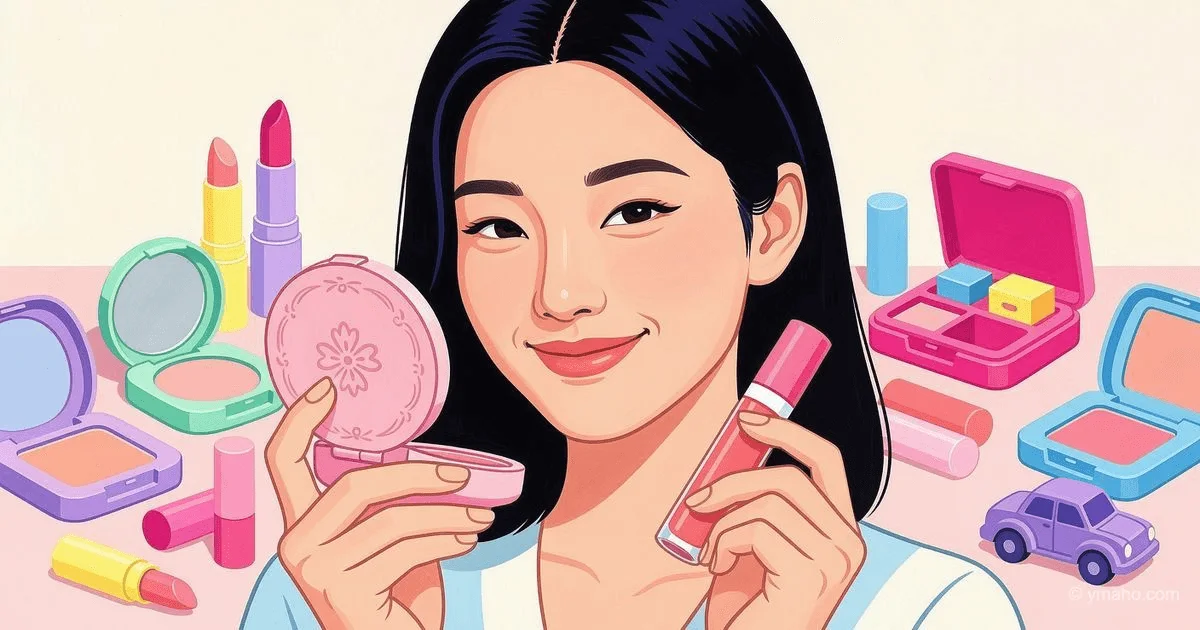
Winners #1: Brands with nostalgic collaborations. dasique × Polly Pocket is a perfect example. The limited edition series, launching May 31, 2026, includes 3 heart-shaped eyeshadow palettes and 2 dual-color blushes in cases that exactly replicate classic 90s toys. This is not just makeup — it's a time machine that sells memories at $25-35 per product.
Winners #2: Brands returning to their 'original' identity. Etude, a subsidiary of Amorepacific, after eight years of 'minimalist' positioning, returned to the 'princess' concept with the launch of Etude Princess from Pink Land. A full line of color cosmetics and basic skincare in pink, decorative design, with collectible accessories. Target audience: Gen Z, who, oddly enough, vote for 'fairy tale' with their wallets.
Winners #3: Manufacturers of 'sensory' textures and fragrances. Prada's banana lip balm (June 2025, USA) is an example of a product going viral not for efficacy but for an unexpected sensory trigger. Bright yellow tube, banana scent, warm golden finish — pure 'vibe.' Lidl US turned a 49-cent croissant into a limited-edition fragrance Eau de Croissant — the smell of fresh baked goods sells nostalgia and humor.
Losers: Brands that continue to sell 'fixing imperfections' through aggressive, clinical marketing. The 2026 consumer is tired of feeling 'not good enough.' If your brand only talks about 'what problem the product solves' without an emotional layer, you lose the young audience. The 'clean girl aesthetic' has reached peak saturation, and the market demands a 'bolder and bigger' approach that lifts the mood, not suppresses it.
What Media Aren't Saying
Insight #1: 'Neurocosmetics' is not futurism; it's already reality, and Korea leads.
Cosmotest 2026, the largest scientific symposium in the cosmetics industry, officially recorded a shift from 'functions and sensitivity' to 'biology and data.' One of the five key future directions is the Skin-Brain Axis: research into how cosmetics affect the brain and emotions.
Korean scientists participating in the symposium directly stated: 'The usage and emotional experience, which until now were considered K-beauty's strengths, are now also subject to scientific verification.' This means 'nostalgia' and 'emotional care' are not just marketing concepts. They are scientific categories measurable via EEG (electroencephalography), heart rate variability analysis, and oxytocin biomarkers. Brands that can prove their product actually boosts mood (not just promises it) will gain a huge advantage.
Insight #2: 'Nostalgia' in 2026 is the 90s and early 2000s, not the 80s as one might expect.
Note the objects of nostalgia: Polly Pocket (peak popularity in the 90s), Etude with its 'princess' aesthetic (peak late 90s to early 2000s), lip gloss in a squeezable tube (2000s), banana flavor (reference to 90s Lip Smacker banana balms).
Why is this important? Because the target audience for this trend is Gen Z (15-25). Their childhood spanned 2005-2015, but the 'golden era' of their older sisters and idols (millennials) is the 90s and early 2000s. The nostalgia they consume is 'secondary nostalgia': longing for a time they didn't experience but which is romanticized through pop culture (2nd generation K-pop, 2000s dramas, movies like 'Mean Girls'). Brands that understand this choose the right references. Brands that 'age' to the 80s will miss the mark.
Forecast: Next 30 Days and 90 Days
Next 30 Days (June 2026):
The launch of dasique × Polly Pocket (May 31) will go viral on social media. Expect thousands of 'unboxings' and reviews where the key words are not 'pigmentation' but 'nostalgia' and 'vibe.' Olive Young, exclusive distributor of many of these products, will use its TikTok and Instagram channels for maximum reach.
Also in June, we will see the first 'neurocosmetic' studies from Korean labs proving that certain sensory profiles (textures, scents, packaging colors) objectively increase oxytocin levels and reduce cortisol. This will become a 'gold mine' for marketing — the first brand that can say 'our product scientifically reduces stress' will win the race.
90 Days (by Fall 2026):
The 'emotional care' trend will spread beyond K-beauty. Western brands will start copying the model, but likely with a lag and less precision. Successful collaborations will not be with 'cute toys' (because Western audiences have a different childhood culture) but with local nostalgic objects — for example, 90s brands like Tamagotchi, Furby, or even old video games.
In Korea, the trend will evolve toward 'personalized emotional care.' Mood diagnostic apps will recommend products not based on skin type but on current emotional state. Sad? Here's a blush in bright, sunny packaging. Anxious? Here's a shower gel with calming lavender scent and a 'hug-like' texture.
Final forecast: By the end of 2026, the 'fix imperfections' concept will be dead in K-beauty. It will be replaced by the concept of 'emotional regulation through beauty.' Consumers will choose products not because they 'remove wrinkles' but because they 'make me happier.' And this is the most radical shift in the industry in 30 years. We stop 'fixing' ourselves and start 'pleasing' ourselves. And that is perhaps the healthiest revolution in beauty market history.
— Editorial Team