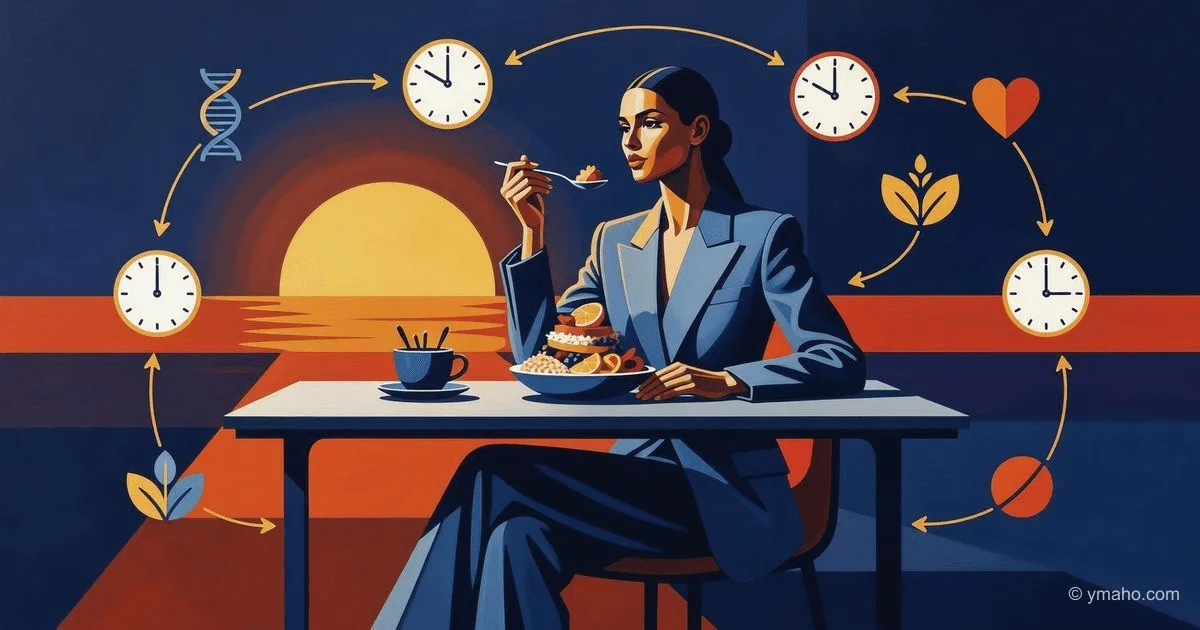
Innovation in Dietetics: 'Chrononutrition' or Eating by Your Biological Clock
Glamour UK calls chrononutrition the main trend replacing complex evening rituals. The essence of the method is synchronizing meals with circadian rhythms to improve sleep quality and hormonal balance.
Analytical Digest: Chrononutrition — Why Big Food Is Stealing Your Circadian Rhythm While You Sleep
The food industry is undergoing a paradigm shift that few realize. What Glamour UK presents as yet another "main trend replacing evening rituals" is actually the first serious challenge to traditional dietetics in 30 years. Chrononutrition is not just "eat by the clock." It is the recognition that a calorie is not just a calorie. 500 kcal eaten at 8 AM and 500 kcal eaten at 10 PM are metabolically two different products.
The key insight that glossies miss: this trend is not about "healthy lifestyle," but about a corporate war for your dinner. Data from a Spanish prospective cohort study (April 2026, 6,858 participants, 6 years of follow-up) are unequivocal: each hour shift of the first meal to a later time reduces the risk of type 2 diabetes by 18%, while a later dinner increases the risk by 34%. This is not marketing. This is science. And Big Food is already preparing its response.
[The Gist]: What Is Really Happening
The publication that Glamour cites (but probably hasn't read fully) is based on data that change the rules of the game in food marketing. A study of 6,858 Spaniards (aged 40-65) showed that joint analysis of chrononutrient variables provides a much stronger association with diabetes risk than any single factor. Nighttime fasting contributed the most to overall risk reduction.
But behind the numbers lies a reality that scares breakfast manufacturers. If "early dinner and prolonged nighttime fasting" is a protective factor, then the entire category of "evening snacks" and "midnight munchies" is under threat. Companies that have profited for decades from what we eat in front of the TV face a collapse of their business model.
Moreover, in May 2026, another important publication came out. Spanish researchers are launching a 12-week RCT on 126 shift workers with prediabetes and type 2 diabetes. They compare three hypocaloric diets with different protein distribution throughout the day: one with a protein-rich dinner (50-60% of daily protein), another with a protein-rich breakfast (10-20% protein at dinner), and a third control. Results will appear in fall 2026, but insiders are already betting that "protein in the morning" will beat "protein in the evening" on metabolic parameters.
Timeline and Context
Chrononutrition as a scientific discipline has existed for a long time, but its transformation into a mass trend has occurred over the past 12 months due to three key events:
- 2024-2025 (Accumulation of Evidence): Numerous studies link late eating with impaired glycemic control, obesity, and cardiovascular risks. But the data remain in academic journals.
- January-February 2026 (Clinical Validation): The PSICRONUT study in Mexico starts to test the combination of time-restricted eating (TRE) with a psycho-chrononutritional intervention in patients with metabolic syndrome. In Jordan, CHRONO-MED begins: resident physicians eat a high-carb or high-protein dinner 3-4 hours before sleep, and their CLOCK and BMAL-1 gene expression is measured. This is no longer "blogger advice" — it's genetics at the RNA level.
- April 2026 (Bifurcation Point): Publication of the Spanish cohort study in ResearchSquare (still a preprint but already peer-reviewed) provides numbers that cannot be ignored: OR = 0.78 per hour of nighttime fasting. Glossy media pick up the topic.
- May 2026 (Big Food Validation): The functional food market, valued at $341 billion in 2026 with a forecast of $498 billion by 2030, officially includes "chrononutrient" claims in its projections. Manufacturers understand: you can sell not just "healthy food," but "food synchronized with your clock."
Who Wins and Who Loses
Winners #1: Manufacturers of "functional breakfasts" and "prebiotic dinners."
The functional food market will grow from $381.5 billion in 2026 to $771.5 billion by 2034. Chrononutrition gives these products a new story: not just "oatmeal is healthy," but "oatmeal eaten before 9 AM activates your fat-burning genes." Already, giants like Nestle, Danone, PepsiCo, and Kellogg's are adapting their lines to "morning" and "evening" formulas. By 2027, expect "nighttime" versions of protein bars with melatonin and L-theanine.
Winners #2: Manufacturers of wearables and nutrition tracking apps.
Integrating chrononutrition into mass consciousness requires technological infrastructure. Apps that not only count calories but analyze the time of eating relative to your chronotype (owl/lark) will become the new standard. Oura Ring, WHOOP, and Apple Health are already integrating "eating windows" into their dashboards.
Losers: The evening snack and nighttime food delivery sector.
The Spanish study data are relentless: late dinner is a risk factor. Companies like Uber Eats, DoorDash, and manufacturers of chips, cookies, and ice cream, whose sales peak after 9 PM, will face negative positioning. Their products will become associated not with "relaxation after work" but with "diabetes and obesity." In response, we will see aggressive marketing of "light evening snacks" (under 100 kcal) labeled "chrono-friendly."
What the Media Aren't Saying
Insight #1: "Nighttime fasting" is not about "not eating after 6 PM," it's about synchronizing with your chronotype.
Glamour and other outlets simplify complex science to a primitive "don't eat late." But the reality is much more interesting and complex. The key parameter measured in clinical trials is not just "time of last meal," but nighttime fasting window duration. In the PSICRONUT study, 8-hour and 10-hour eating windows are compared. There is no ideal window — it depends on your chronotype, genetics (polymorphisms of CLOCK, BMAL-1, PER genes), and even whether you work night shifts.
Moreover, the CHRONO-MED study in Jordan examines not just when you eat, but what exactly you eat for dinner. A high-carb dinner (80% carbs) is compared with a high-protein dinner (38-54% protein) on CLOCK and BMAL-1 gene expression in saliva. Results will be out in December 2026, but it's already clear: a high-protein dinner may be safer for circadian rhythms than a high-carb one. The media are silent about this because it's hard to explain in three sentences.
Insight #2: Clinical application is already here, and it concerns not only diabetes but also sleep quality.
The Spanish clinical trial CHRONO-EN (primary data collection completion — June 2026) studies the effect of enteral feeding timing (via tube) on circadian rhythms of hospitalized patients. They measure not only glucose and insulin but also clock gene expression from oral mucosal cells before and after the intervention. And they add a group with melatonin (0.5 mg sublingually at 8 PM) to test whether biological clocks can be "tricked" by a hormonal signal.
For the industry, this means: chrononutrition is moving beyond "diets for weight loss" and becoming medical nutrition therapy. Treatment protocols for metabolic syndrome, type 2 diabetes, obesity, and even sleep disorders will be rewritten considering meal timing and macronutrient distribution. This creates a huge market for "medical foods" with chrono-labeling.
Forecast: Next 30 Days and 90 Days
Next 30 Days (June 2026):
Expect publication of results from the CHRONO-MED study in Jordan. It started in December 2025, primary completion in January 2026, so data should be ready for publication in the coming weeks. If the hypothesis is confirmed and a high-carb dinner indeed worsens CLOCK and BMAL-1 gene expression, the market for "evening low-carb products" will explode.
Also in June, we will see the first wave of "chrono-diets" in mobile apps. MyFitnessPal, Lifesum, and Yazio will add an "optimal eating window" feature based on your chronotype (determined by your answers to 5 questions).
90 Days (by Fall 2026):
There will be an integration of chrononutrition into corporate wellness. Large companies (Google, Microsoft, JPMorgan) will start including "time-restricted eating training" in their employee wellness programs. This reduces health insurance costs (less type 2 diabetes) and increases productivity (better sleep = better cognitive function). Corporate demand for "chrono-coaches" will grow 3-4 times.
In the functional food market, the first "chrono-brands" will appear — companies that sell not just yogurt or a bar, but a "morning metabolic starter" and an "evening circadian soother." These will cost 2-3 times more than regular products, but consumers will pay for "scientifically backed meal timing."
Final forecast: By December 2026, the term "chrononutrition" will enter the top 5 search queries in the Nutrition & Diet category in the US and Europe. Traditional diets (keto, paleo, Mediterranean) will begin to adapt to chrono-principles. "Chrono-keto" (ketogenic eating window 8:00-16:00) and "chrono-plant-based" (plant-based diet with early dinner) will emerge. And manufacturers of evening snacks will be forced to rewrite their marketing strategies — or exit the market.
— Editorial Team