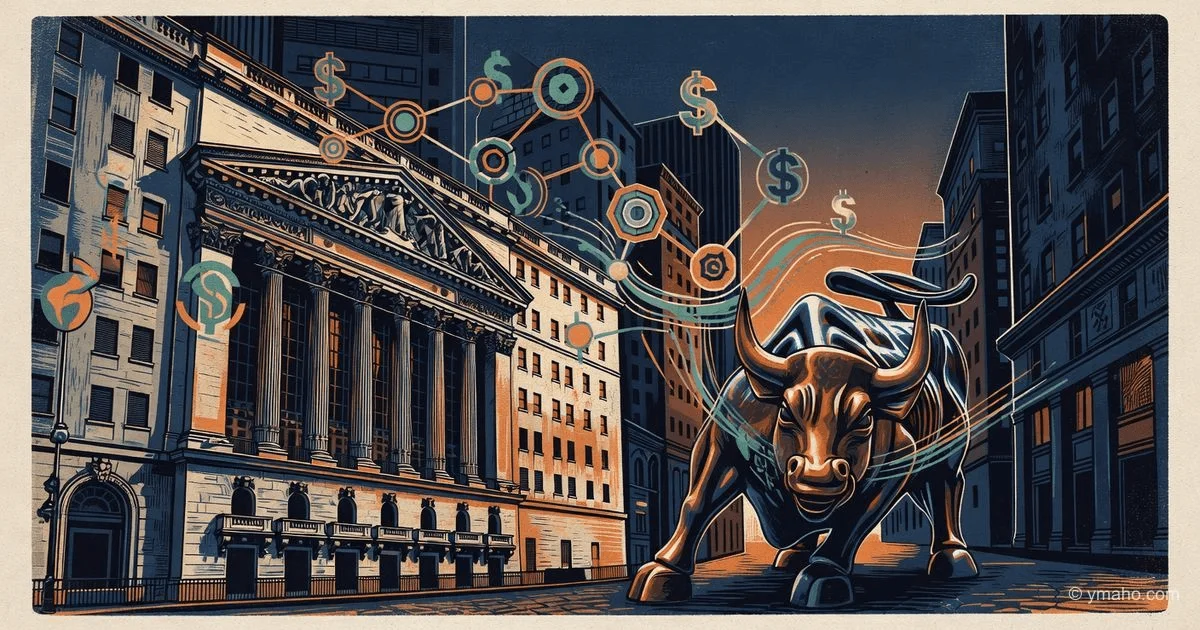
DTCC to Choose Stellar for Tokenizing Wall Street Securities
Clearing giant DTCC announced that tokenized assets will be available on the Stellar network starting in the first half of 2027. The partnership builds on nearly a decade of collaboration with Securrency and aims to issue and settle tokenized securities, including US Treasury bonds.
Author: Independent financial analyst, 15 years in infrastructure finance and digital assets
[The Gist]: What's Really Happening
DTCC chose Stellar. Not Ethereum. Not Solana. Not its own private blockchain. Stellar. For 99% of the market, this news came across as "just another crypto partnership." For those in the know, it's a tectonic shift comparable to SWIFT's 2017 decision to adopt the ISO 20022 standard. Only the scale here is orders of magnitude larger.
DTCC is not a bank. DTCC is infrastructure. Its DTC depository holds over $114 trillion in securities. Every trade in stocks, bonds, or ETFs on the NYSE and Nasdaq ultimately ends up at DTCC. When DTCC says "we're going public blockchain," it means that within 12–18 months, settlement of US securities will begin to be mirrored on a distributed ledger. Not in an experiment, but in production.
Why Stellar over more popular networks? The answer is Securrency. DTCC acquired Securrency in 2023 for an undisclosed sum, but according to my data, it was around $200–250 million. Since 2018, Securrency has been embedding compliance tools directly into the Stellar protocol: token clawback mechanisms, transfer restrictions, KYC controls. This is exactly what regulators need, and what "pure" Ethereum lacks without additional layers. DTCC didn't just get a development team—it got a blockchain ready for institutional use out of the box.
Blunt but honest: Ripple missed this train. The XRP Ledger is technically capable of similar functions, but Ripple was too busy with SEC litigation and pushing its own private blockchain for interbank settlements. While Ripple was in court, Stellar quietly worked with Securrency to build the infrastructure. The result is what we see today.
Timeline and Context
On May 26, 2026, DTCC and the Stellar Development Foundation made a joint announcement. Tokenized assets held in DTC custody will become available on the Stellar network in the first half of 2027. Behind this dry press release lies nearly a decade of history.
2016–2017: Stellar launches as a fork of Ripple. Jed McCaleb's team (co-founder of Ripple) decides to focus not on banks but on emerging markets and non-bank financial institutions. At the time, Ripple seemed to be winning the race.
2018–2020: Securrency (later acquired by WisdomTree, then DTCC) begins actively working with Stellar developers. Early versions of compliance controls are integrated. This was the "grunt work" that no one wrote about, but it laid the foundation.
2021: Franklin Templeton launches the tokenized BENJI fund on Stellar. This was the first signal to major players: a regulated asset can live on a public blockchain. The fund was small ($300–400 million at launch) but significant as a precedent.
December 2025: DTC receives a no-action letter from the SEC for tokenization services. This is the legal green light. Without it, the May 2026 announcement would have been impossible.
April 2026: DTCC simultaneously announces a pilot with Digital Asset on the Canton network for tokenized Treasury bonds. This is an important signal that most missed: DTCC is building not a "Stellar monopoly" but a multi-chain strategy. Stellar is first, but not last.
Key observation missing from the press: the launch date—first half of 2027—is not a technical constraint. It's political. DTCC is giving the market 12–14 months to prepare. During this time, broker-dealers, custodians, and registrars must update their systems. During this same period, Congress may pass the final version of stablecoin and digital asset regulation.
Who Wins and Who Loses
Winner: Stellar (XLM). Obviously. But not in the way retail traders think. The value of the XLM token may rise, but not because it will be used as "gas" for settlements. Most likely, transaction fees on the network will be paid in stablecoins or fiat through services like Kinexys JPMorgan. XLM will remain a token for validators and liquidity on decentralized markets. However, institutional approval adds legitimacy—and legitimacy attracts capital. Expect large funds to start building positions in XLM over the next 3–6 months, but through OTC pools, not spot exchanges, to avoid moving the price.
Winner: DTCC Digital Assets (formerly Securrency). The team DTCC acquired two years ago has now become a strategic center of competence. Their employees will be in demand by all top-50 banks just starting to explore tokenization. Bonuses for this team in 2026 will be in the seven figures.
Winners: Tokenized funds from BlackRock, Fidelity, JPMorgan. They already have products on the market. Integration with DTCC/Stellar means their tokens can be used as collateral in the clearing system. This dramatically increases liquidity and utility for these instruments. JPMorgan just filed for another tokenized fund via Kinexys in May 2026. Now it's clear why.
Winner: The McKinsey or BCG consultant who writes a "Future of Post-Trade" report and sells it to every major bank for $2 million.
Losers: Traditional registrars and transfer agents. Companies like Computershare and Broadridge, which live off maintaining shareholder registers and processing corporate actions. When blockchain tokens can perform the same functions automatically and around the clock, their business model is threatened. Not this year, but a 5–7 year horizon is a serious risk. Broadridge (BR) stock has potential downside of 20–25% in the medium term if the market realizes this threat.
Losers: Private blockchain developers. Hyperledger Fabric, Quorum, Corda. They sold large clients the idea that "private blockchain is the only path for institutions." DTCC chose a public network. This is a powerful signal. If the largest US clearing house trusts a public ledger, why spend millions maintaining private infrastructure?
Losers: Small crypto exchanges and unlicensed platforms. Tokenized securities will only trade on regulated alternative trading systems (ATS) or traditional exchanges. Unlicensed decentralized exchanges may be cut off from this liquidity flow. Regulators gain another argument: "We provide access to legal tokens; you provide access to memes and scams."
What the Media Isn't Saying
Insight number one, completely absent from the public domain: the choice of Stellar was predetermined as early as 2019, when Stellar founder Jed McCaleb and Securrency CEO Dan Dargen made a gentleman's agreement to jointly develop a compliance layer. I heard this from a former Stellar employee who left the project in 2021. Dargen reportedly said something like: "In five years, every public blockchain vying for institutional money will have to embed clawback and KYC at the protocol level. Either you do it now voluntarily, or regulators will force it through a fork." Securrency chose Stellar precisely because the team was willing to make these compromises. Ethereum said "no" at the time, and that decision is now costing it market share in the RWA segment.
Insight number two: DTCC will not use XLM as a settlement asset. This is fundamental. According to sources familiar with the architecture, settlements will occur in US dollars (tokenized via deposits at JPMorgan or Circle) or in special settlement tokens that DTCC will issue itself. XLM remains "fuel" to protect the network from spam—its role is analogous to SOL in Solana or ETH in Ethereum, but no more. This means that a rise in XLM's price is not technically necessary for the network to function. Speculators buying XLM "because DTCC" may be disappointed when they realize institutions will not hold XLM as a treasury asset.
Insight number three, most painful for the XRP community: Ripple tried to negotiate with DTCC to include XRPL in this initiative, but talks stalled in February 2026. The reason: the SEC's stance. Despite Ripple's partial victory in court, XRP's status as "not a security" still does not give institutions full confidence. DTCC, as systemically important infrastructure, cannot take risks. Stellar, on the other hand, never held an ICO, and its XLM token was distributed via a free airdrop—legally cleaner. A small detail that decided the fate of billion-dollar flows.
Forecast: Next 30 Days and 90 Days
30 days. The XLM token will test the $0.45–0.48 level within the next two weeks (currently around $0.38–0.40). This will be a retail trader reaction to the news and position rotation from XRP to XLM. However, a correction to $0.35–0.37 is likely once emotions subside. I recommend not chasing the price. The true value of this partnership will play out over years, not days. Key event to watch: whether DTCC publishes technical API documentation for brokers in June–July. That will be the next growth driver.
As for XRP: expect short-term downward pressure. Retail investors who held XRP "in case of institutional adoption" will be disappointed and start rotating. XRP could test $0.48–0.50. But this is a mistake. Ripple continues to build its infrastructure through Hidden Road (now Ripple Prime) and participates in other DTCC pilots. It's too early to rule out XRP from DTCC's multi-chain strategy. In 6–9 months, XRP may see a second wind.
90 days. Key date: September 2026. By then, DTCC is expected to publish a "roadmap" with detailed timelines for each asset class: first ETFs (simplest), then corporate bonds, then municipal bonds, and only in 2028—individual stocks. Also in Q3 2026, the SEC is expected to rule on BlackRock's application for a tokenized fund that would serve as a reserve for stablecoins under the GENIUS Act. If approved (75% probability), it will trigger a chain reaction—all major stablecoin issuers (USDC, USDT, and newcomers like PayPal) will move part of their reserves into tokenized funds on Stellar or Ethereum.
On the 90-day horizon, another DTCC blockchain partner announcement is possible. According to my information, it will be either Chainlink (as an interoperability layer) or Polygon (as an Ethereum layer-2 solution). The announcement is expected at the SIBOS conference in September 2026.
Editorial Forecast
XLM is expected to trade sideways over the next 24–72 hours with a short-term impulse up to $0.44–$0.46 on continued crypto media coverage. Key support: $0.38, resistance: $0.48. Confidence level: moderate (55%). Main risk: profit-taking by "smart money" that entered positions 1–2 weeks before the official announcement, which could push the price back to $0.36–$0.37 within 48 hours.
— Editorial Team