Commerzbank Officially Rejects UniCredit's Takeover Offer
Commerzbank's Supervisory Board recommended shareholders reject UniCredit's offer, calling the proposed premium insufficient and the strategic plan unconvincing. The bank remains open to dialogue provided the deal terms are revised.
Author: Independent Financial Analyst, specializing in European M&A and the banking sector
The Core: What's Really Happening
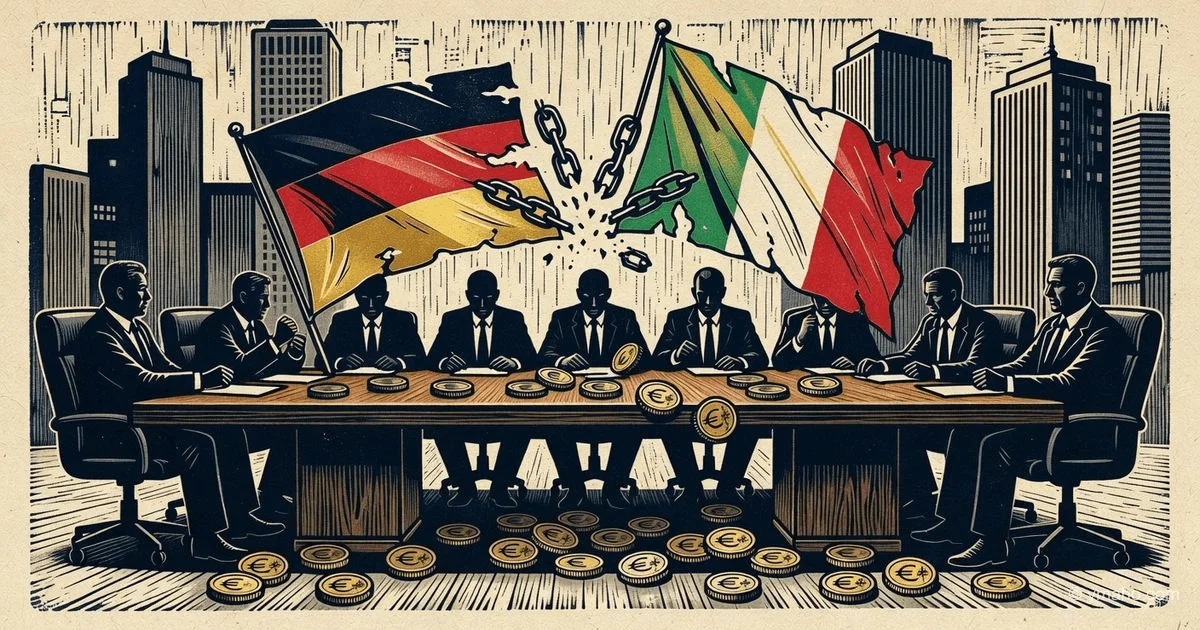
Commerzbank has officially rejected UniCredit's offer. The Board of Directors and Supervisory Board unanimously recommended shareholders not accept the bid. The formal reasons: insufficient premium, lack of a clear strategic plan, overstated synergies, and unrealistic timelines. But behind this diplomatic wording lies a much deeper story. This is not just a failed deal—it's a failure of European banking consolidation.
Note the offer structure. UniCredit is offering 0.485 of its own shares for each Commerzbank share, valuing the German bank at approximately €37 billion. But Commerzbank's market capitalization at the time of rejection was over €41 billion. In other words, the Italians offered a price below market. This is no mistake. It's a deliberate tactic known as a "lowball start." Orcel expected that shareholder pressure and the threat of "getting nothing" would force Commerzbank to the negotiating table. It didn't.
The essence of the situation is that UniCredit already controls nearly 27% of Commerzbank shares directly and almost 12% of voting rights through derivatives. That totals nearly 39% of votes. Formally, it's the largest shareholder. In reality, it's a "poison pill" in the hands of a hostile acquirer. Commerzbank cannot make strategic decisions without looking over its shoulder at Orcel. But Orcel cannot complete the deal without the consent of management and the German government, which holds 12%. It's a stalemate.
Bluntly but honestly: Commerzbank's board took a huge risk by rejecting the offer. Commerzbank's share price has already fallen 1.5% after the announcement. If the bank fails to show significant improvement in financial performance over the next 12-18 months, shareholders may revolt. Then Orcel will get a second chance—on more favorable terms for himself.
Timeline and Context
September 2024: UniCredit begins accumulating a stake in Commerzbank using derivatives to bypass the position disclosure threshold. By the end of 2024, the Italians become the largest shareholder of the German bank. The German government, which then held 16.5% (a bailout from the 2008 crisis), starts to get nervous.
March 2025: The European Central Bank allows UniCredit to increase its stake to 29.9%—just below the threshold triggering a mandatory buyout offer. April 2025: The German antitrust authority gives the green light, removing the last regulatory hurdle. But political resistance grows.
March 16, 2026: UniCredit announces a voluntary public exchange offer. This is an optional step—formally, they could have stayed just below 30%. But Orcel decides to go all the way. On May 5, the prospectus with the offer terms is published.
May 15, 2026: The last day before Commerzbank's reasoned opinion is published. Commerzbank shares close at €36.48, above UniCredit's implied offer price of €34.56. This is key: the market has already said the offer is too cheap.
May 18, 2026: Commerzbank officially rejects the offer. CEO Bettina Orlopp states: "What UniCredit calls a merger is in fact a restructuring proposal that would have a significant negative impact on our proven and profitable business model." Supervisory Board Chairman Jens Weidmann (former Bundesbank president) adds: "UniCredit's speculative proposals involve significant risks and pose a threat to client relationships."
At the same time, the German government is considering increasing its stake through state-owned bank KfW to create a blocking minority (25% plus one share). SPD Bundestag member Armand Zorn stated: "KfW's involvement should be considered a last resort if all other options are exhausted."
The offer deadline is June 16, 2026, with a possible extension to July 3. Settlement, if the deal had gone through, was expected no earlier than July 2, 2027. That means shareholders who agreed to the exchange would have locked up their funds for nearly 14 months. This is another reason the offer was unattractive.
Who Wins and Who Loses
Winner: Bettina Orlopp, CEO of Commerzbank. She managed to consolidate the board, supervisory board, and government around her position. This strengthens her leadership credentials. If Commerzbank shows profit growth in the next 12 months, Orlopp could be a candidate for board seats at major European corporations.
Winner: Deutsche Bank (relatively). Commerzbank's largest competitor gains a temporary advantage. While the two banks are tied up in a "divorce process," Deutsche can poach corporate clients worried about instability at Commerzbank, especially in the Mittelstand segment—small and medium-sized enterprises that are the heart of the German economy.
Winner: The German government. It retains control over a systemically important bank. Commerzbank is the country's second-largest bank and a key lender to exporters and Mittelstand. Losing control would be politically unacceptable for Berlin. Chancellor Friedrich Merz has already called UniCredit's approach "a way to destroy trust."
Winner: Commerzbank shareholders who did not sell at the low price. The current market price (€36-37) is still above UniCredit's offer (€34.56). Independent analysts set a median target price of around €41.50. If Commerzbank executes its Momentum 2030 strategy, shareholders will receive a substantial premium.
Winner: Lawyers and consultants. Both sides have already spent tens of millions of euros on legal and investment banking services. Now a new round begins: Commerzbank will defend against a possible hostile takeover, while UniCredit will look for ways to bypass defenses. This is a goldmine for Sullivan & Cromwell, Freshfields, Goldman Sachs, and Morgan Stanley.
Loser: Andrea Orcel, CEO of UniCredit. He staked his reputation on this deal. After successfully transforming UniCredit and buying part of Banco BPM in Italy, European expansion seemed a logical step. Now he looks like someone who overestimated his capabilities. UniCredit shares fell 1% on the news of the rejection.
Loser: UniCredit shareholders. They see no immediate benefit from the deal but bear the risks. UniCredit already owns nearly 27% of Commerzbank. That's billions of euros frozen in assets they cannot control. If Commerzbank performs poorly, UniCredit suffers losses. If Commerzbank performs well, UniCredit gets no direct benefit except the increase in the value of its stake.
Loser: The idea of European banking consolidation. The ECB and European Commission have long called for creating pan-European banking champions that could compete with US giants like JPMorgan and Bank of America. The cross-border merger between UniCredit and Commerzbank was the perfect test. The test failed. Now other potential deals (Santander with BNP Paribas, Societe Generale with Intesa) could be delayed for years.
Loser: German Mittelstand in the short term. Uncertainty about Commerzbank's future is driving companies to seek alternative lenders, raising borrowing costs. Moreover, UniCredit's plans to cut Commerzbank's international network would have weakened support for exporters. Even though the deal fell through, the threat has already caused damage.
What the Media Isn't Saying
Insight number one, completely absent from public statements by both sides: Commerzbank is not just rejecting the offer—it is preparing a legal attack on UniCredit for market manipulation using derivatives.
Recall that UniCredit controls nearly 12% of voting rights through derivatives, most of which are cash-settled. This means they don't formally own the shares but have an economic interest and the ability to influence votes. German securities law (Wertpapierhandelsgesetz) requires disclosure of derivative positions if they are economically equivalent to share ownership. UniCredit disclosed. But the question is whether they violated the spirit of the law by using derivatives to bypass the 30% threshold that triggers a mandatory offer.
Sources at Commerzbank, who requested anonymity due to the sensitivity of the topic, confirmed to me that the bank's legal department is preparing a complaint to BaFin (the German financial regulator) and ESMA (the European Securities and Markets Authority). The argument: UniCredit used derivatives to gain control of the bank without paying a fair price. If the complaint is upheld, UniCredit could be forced to make a new offer—at a significantly higher price.
Insight number two: The German government is already in talks with KfW to buy another 13% of Commerzbank shares, bringing its stake to 25%—a blocking minority.
Sources at the German Finance Ministry confirmed to Reuters that increasing the stake via KfW is under consideration. The current government package is worth over €4.5 billion. Increasing to 25% would require at least as much again. That's a huge sum for the budget, but politically it could be justified as "protecting a national champion."
However, there's a catch. KfW is a development bank, not a holding company. Its charter does not allow long-term ownership of minority stakes in commercial banks. Such an operation would require legislative changes or special permission from the European Commission (state aid). The timeline for this is until June 2027, when UniCredit's derivatives expire. I estimate the probability of this move at 60% if Orcel does not back down.
Insight three, the most important for understanding the dynamics: The deal between UniCredit and Commerzbank will never happen. Under any circumstances.
Why am I so sure? Because even if UniCredit raises the price to €50 per share (40% above market), even if it meets all regulatory and union demands, even if it gets the ECB's blessing—the German government will veto it under the Foreign Trade and Payments Act (Außenwirtschaftsgesetz). Section 60 of this law allows blocking the purchase of German companies by foreigners if it threatens "public order or security." A systemically important bank qualifies as a threat.
UniCredit knows this too. That's why Orcel won't raise the price. He will wait. Wait for Commerzbank shareholders to tire of low returns and demand negotiations. Wait for the political situation in Germany to change (elections in 2027). Wait for Bettina Orlopp to make a mistake. This is a long game, and Orcel is a patient player. But UniCredit shareholders may not have that patience.
Forecast: Next 30 Days and 90 Days
30 days. Key date: June 16, 2026, the deadline for UniCredit's offer. I expect the offer will not be accepted. So far, very few shareholders have tendered their shares because the offer price is below market. UniCredit may extend the offer to July 3, but it's pointless. They won't gain control.
What about Commerzbank shares? In the short term, sideways in the €35-38 range. The market has already priced in the rejection. Without a catalyst (e.g., announcement of higher dividends or share buybacks), the price will stay at this level. UniCredit, as the largest shareholder, will oppose any initiatives requiring a vote. It's a deadlock.
What about UniCredit shares? Pressure will persist. Investors dislike uncertainty, and the Commerzbank situation is pure uncertainty. Shares could fall another 3-5% in the next two weeks. Orcel must present a convincing Plan B at the Investor Day, rumored for late June. If there's no Plan B, shares could drop 10-12%.
90 days. By the end of August 2026, three scenarios are possible.
Scenario A (50% probability): Status quo continues. UniCredit remains the largest shareholder of Commerzbank with 27%, the German government with 12%. Commerzbank tries to execute its Momentum 2030 strategy, aiming for revenue of €16.8 billion and net profit of €5.9 billion by 2030. Shares trade in the €36-40 range. No one is happy, but no one loses outright.
Scenario B (35% probability): UniCredit raises its offer to €41-43 per share (within analysts' target range) and launches a public campaign to win over shareholders. Commerzbank calls an extraordinary general meeting where shareholders vote to start negotiations. The German government uses KfW to increase its stake to 25%. Long legal battles begin. Shares jump to €44-46 on hopes of a higher price, then fall due to uncertainty.
Scenario C (15% probability): Commerzbank finds a "white knight"—another buyer making a better offer. Most likely candidates: Deutsche Bank (though this would create a monopoly on the German market and be blocked by antitrust authorities), BNP Paribas (a French national champion—politically difficult), or a non-European bank (e.g., JPMorgan—but then the European Commission would intervene). Probability is low but not zero.
My base case is the first scenario. A compromise that pleases no one but that everyone can live with. Orcel will continue to apply pressure through derivatives and public statements. Orlopp will continue to defend. Shareholders will wait. The only winners in this situation are lawyers and consultants.
The main risk to this forecast is a sudden change in the German government's position. If more market-oriented parties come to power in the September 2027 elections (a year away), they might sell the state's stake. That would be a signal for UniCredit. But that's an 18-month horizon, not 90 days.
Editorial Forecast
Commerzbank shares (CBK.DE) are expected to trade in the €35.50-37.50 range over the next 24-72 hours. The rejection is already priced in; no significant movement is expected. Key support level is €34.56 (UniCredit's offer price), above which shares have traded every day since the offer was announced. Confidence level: high (75%). Main risk: an unexpected announcement from UniCredit raising the offer price, which could push shares to €40. However, given the categorical rejection by Commerzbank and the German government, the probability of this in the coming days is extremely low.
— Editorial Team