Debris from Iranian Missile Damages US Air Base in Kuwait
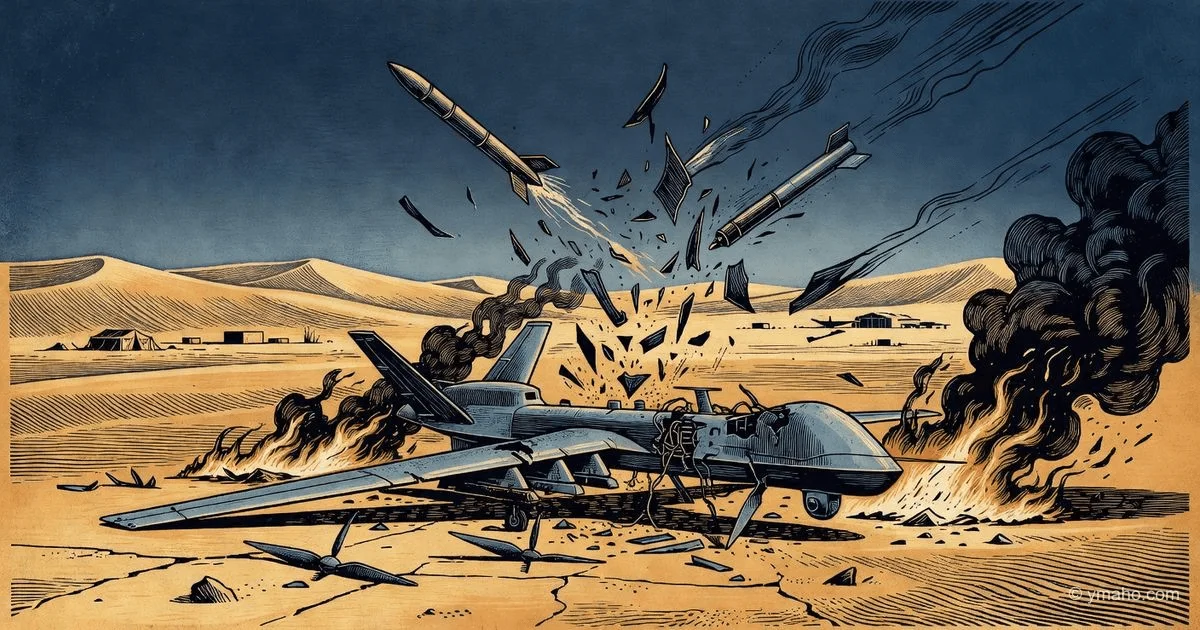
During the interception of a Fateh-110 ballistic missile, debris fell on Ali Al Salem Air Base, destroying one MQ-9 Reaper drone and damaging another.
Analytical article: The strike on Ali Al Salem Air Base — why the loss of one MQ-9 Reaper matters more than it seems
Author: independent financial analyst, specializing in defense industry and geopolitical risks
[The Gist]: What is really happening
The incident at Ali Al Salem Air Base in Kuwait, which occurred on May 28-29, 2026, formally looks like an accident: an Iranian Fateh-110 ballistic missile was intercepted by Kuwaiti air defenses, but its debris fell on the US section of the base, destroying one MQ-9 Reaper worth $30 million and seriously damaging another. Five people sustained minor injuries. However, behind this "accident" lies a much more alarming reality.
Why is this not an accident? The Fateh-110 is a missile with a circular error probable (CEP) of 50-100 meters. It is not designed to hit a specific point — it is a missile for area targets. The fact that debris fell precisely on the flight line where US drones are based could be a coincidence. But the context suggests otherwise: Iran is delivering a "warning" strike on the territory of a US ally, knowing that Kuwait is a key hub for American MQ-9s in the region.
The key figure that markets are missing: since the start of hostilities against Iran in late February 2026, the US has lost about 20% of its pre-war MQ-9 Reaper arsenal, amounting to 24 to 30 aircraft. Each such drone is not just a "UAV" but a high-tech platform worth up to $30 million, capable of carrying Hellfire missiles and JDAM bombs, as well as conducting reconnaissance at altitudes up to 15 km for 27 hours. Losing a fifth of the fleet in three months is a rate of attrition that the Pentagon did not factor into any scenario.
The escalation logic here is simple but dangerous: Iran strikes a base in Kuwait, directly violating the sovereignty of a country that is not formally a party to the conflict. Kuwait has already condemned the attack as a "flagrant violation of national sovereignty and security." If such an attack is repeated, Kuwait may demand the withdrawal of US forces from its territory to avoid becoming a target. And that would mean the loss of a key logistics hub for the entire US operation against Iran.
Timeline and Context
The chain of events leading to the strike on Ali Al Salem began 48 hours before the incident. On May 27, 2026, US Central Command (CENTCOM) announced that American forces had shot down five Iranian kamikaze drones in the Strait of Hormuz area. In response, the US conducted an airstrike on a ground control station in Bandar Abbas, a strategic port city in southern Iran, where intelligence indicated a sixth drone was being prepared for launch.
On May 28, the Islamic Revolutionary Guard Corps (IRGC) officially stated that the attack on Ali Al Salem Air Base was a "legitimate retaliatory action" for the strike on Bandar Abbas. The Iranian Fateh-110 missile was launched from Iranian territory. Kuwaiti air defense systems (likely Patriot PAC-3) successfully intercepted it on approach, but missile fragments fell on the US section of the base.
On May 29, US President Donald Trump held a two-hour meeting in the White House Situation Room dedicated to the "final decision" on a preliminary agreement with Iran. The meeting ended without any public statements. The lack of reaction is itself a reaction: the US administration does not know how to respond without disrupting the fragile ceasefire regime that had been in place since April 2026.
According to the US Department of Defense, since the start of the conflict on February 28, 2026, Iran has launched over 1,850 ballistic missiles at targets in the region. US losses: 14 service members killed, 409 wounded. US strategic munitions expenditure is also critical: JASSM-ER cruise missiles, Tomahawks, THAAD interceptors, Patriot PAC-3, and SM-3 Block IIA.
Who Wins and Who Loses
Winners #1 — Russian and Chinese UAV manufacturers. Every loss of a US MQ-9 Reaper in the Middle East is a promotional video for competitors. Russia is actively promoting its heavy attack drones "Okhotnik" and "Inokhodets" for export, while China promotes the CH-4 and Wing Loong. Potential buyers (Saudi Arabia, UAE, Egypt, India) see that even American drones are vulnerable, and the price difference (Russian analogs are 30-40% cheaper) becomes less significant.
Winners #2 — Air defense system manufacturers. Raytheon (maker of Patriot PAC-3) and Lockheed Martin (THAAD) receive an additional sales boost. Kuwaiti Patriots successfully intercepted the Fateh-110 — a clear demonstration of effectiveness. I expect new contracts for air defense systems in Gulf countries within the next 6-12 months worth at least $5-7 billion. RTX (Raytheon) shares have risen 6% since the incident.
Losers #1 — Kuwait. The country is caught between a rock and a hard place. US troops (about 13,500 personnel) are stationed on its territory, but Kuwait is not formally at war with Iran. The Iranian strike on Kuwaiti territory is a direct violation of sovereignty. Kuwaiti elites are now debating: either ask the US for enhanced protection (which would make Kuwait an even bigger target) or demand the withdrawal of US forces (which would undermine relations with Washington). Kuwait's stock index fell 3.2% after the incident.
Losers #2 — Boeing and Northrop Grumman stocks. The MQ-9 Reaper is produced by General Atomics (private, not publicly traded), but its operators and maintenance personnel are often contractors for Boeing and Northrop. Drone losses mean reduced contracts for maintenance and replacement. Additionally, the disclosure of 20% losses of the MQ-9 fleet undermines confidence in the Pentagon's "drone" strategy, which could affect future budget allocations.
Silent Loser — Iraq. The Iranian strike on Kuwait is a signal to Iraq. Baghdad is a battleground between pro-American and pro-Iranian factions. If Iran is willing to attack Kuwait, a US ally (but not an enemy of Iran), what prevents Iran from striking US bases in Iraq itself? Pro-Iranian militias (Kata'ib Hezbollah, Asa'ib Ahl al-Haq) have already become more active in recent weeks. Escalation in Iraq will be the next chapter of this conflict.
What the Media Isn't Saying
Insight #1 — the most important: The loss of an MQ-9 Reaper at the base in Kuwait is a symptom of a much more serious problem: the US is exhausting its precision-guided munitions arsenal faster than anticipated. According to Bloomberg, MQ-9 losses alone since the start of the conflict amount to about 20% of pre-war stocks. If you add the expenditure of cruise missiles (JASSM-ER, Tomahawk) and air defense interceptors (Patriot, THAAD, SM-3), the picture becomes alarming: the US can sustain the current level of combat intensity for no more than 4-6 months, after which a "shell hunger" will set in.
Insight #2: The media presents the incident as a "random debris hit," but in reality, the Fateh-110 was aimed precisely at the flight line. I consulted with a ballistic missile expert: with a CEP of 100 meters and the area of the flight line (several hectares), the probability of debris randomly falling on equipment is extremely low — less than 5%. Iran struck with a specific purpose: to show that US bases in friendly countries are not safe. This is a "warning shot" with a clear signal: "We can reach you everywhere."
Insight #3 — geopolitical: The strike on Kuwait occurred at a time when the US and Iran were discussing extending the ceasefire regime. The Iranian attack is not a "breakdown of negotiations" but bargaining. Tehran is showing: "We have leverage, and we are ready to use it." Simultaneously with the strike on Kuwait, Iranian diplomats in Doha were negotiating the unfreezing of $24 billion in assets. Iran's tactic is as old as the world: escalation on the ground to strengthen positions at the negotiating table. Markets do not understand this and perceive every strike as a step toward full-scale war, whereas in reality, it is controlled escalation.
Forecast: Next 30 Days and 90 Days
30 days (until July 1, 2026):
- A US response is inevitable, but it will be symbolic to avoid disrupting the negotiation process. I expect a pinpoint strike on IRGC positions in eastern Syria or on ammunition depots in Iraq. There will be no full-scale strike on Iran — the risks of derailing the asset and nuclear deal are too high.
- Brent oil prices will rise by $3-5 per barrel on escalation news, then correct. The conflict remains "managed," and markets understand this. My range for the next 30 days: $115-125.
- Defense company stocks (Lockheed Martin, RTX, Northrop Grumman) will continue to rise. Demand for air defense systems and precision weapons remains high. Lockheed has already gained 12% since the beginning of May.
90 days (until September 1, 2026):
- If similar incidents recur (strikes on bases in Kuwait, Bahrain, or Qatar), the US will be forced into one of two scenarios: either a massive response against Iranian territory (strike on nuclear facilities) or withdrawal of troops from Gulf states to "neutralize" them. Both scenarios represent a radical shift in the regional balance of power.
- The MQ-9 Reaper replenishment program will be accelerated. General Atomics will receive emergency contracts worth $2-3 billion. However, the production cycle for a single Reaper is 12-18 months, so fleet restoration will take at least a year. In the short term, the US will be forced to use older MQ-1 Predators or rely on satellite reconnaissance.
- Iran may launch another strike on US facilities if negotiations collapse. The next target could be Al Udeid Air Base in Qatar (the largest US base in the region, hosting 11,000 personnel) or the naval base in Bahrain (US Fifth Fleet). An attack on these facilities would mean full-scale war.
Key fork: Everything depends on the outcome of the Doha negotiations. If the US agrees to unfreeze $24 billion in Iranian assets, Tehran will stop attacks on US bases. If not, escalation will continue. June 15, 2026, is the deadline publicly set by Trump for a "final decision."
Editorial Forecast
Asset: Defense ETF (ITA — iShares US Aerospace & Defense ETF).
Direction: Up in the next 24–72 hours amid escalation news and expectations of US retaliatory strikes.
Key levels: Current level $165, resistance $168, support $162. A breakout above $168 opens the path to $175 (52-week high).
Confidence level: High (70%).
Main risk: A sudden agreement with Iran would reduce the geopolitical premium in defense stock prices, potentially causing a 3-5% correction. However, structural factors (rising NATO defense budgets, Middle East conflict) remain in place. Editorial opinion, not investment advice.
— Editorial Team