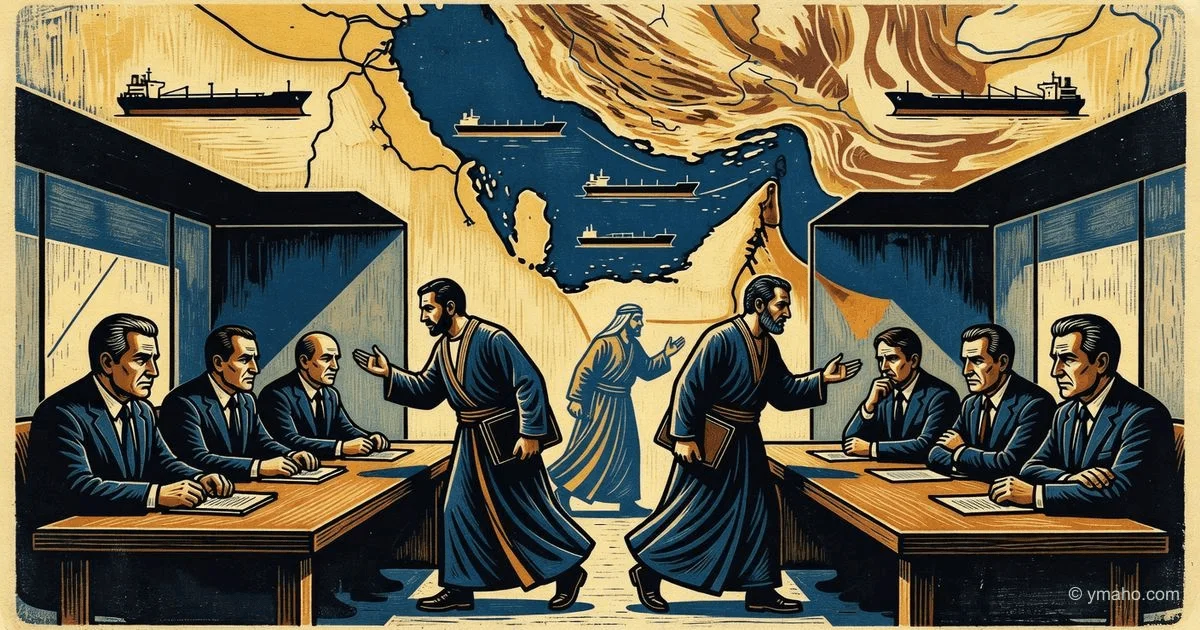
Qatar and Egypt Lead New Round of US-Iran Talks
A meeting in Doha with Iranian Parliament Speaker Ghalibaf and US representatives discusses non-aggression guarantees and the unblocking of $24 billion in Iranian assets.
Analytical article: The Doha talks — why markets underestimate the likelihood of a deal with Iran falling through
Author: Independent financial analyst, specializing in geopolitical risks and energy markets
[The Gist]: What's Really Happening
The Doha talks on May 31 – June 1, 2026, mark the third attempt in the past four months to find a way out of the crisis in the Strait of Hormuz. On the surface, the news is positive: Qatar and Egypt acted as mediators, with US representatives (Assistant Secretary of State for Near Eastern Affairs Barbara Leaf) and Iran (Parliament Speaker Mohammad-Bagher Ghalibaf) sitting at the negotiating table. Two key issues are on the agenda: US non-aggression guarantees (in exchange for ending the shipping blockade) and the unblocking of $24 billion in Iranian assets frozen in South Korean and Iraqi banks. However, the reality is far more complex than the headlines suggest.
Why are these talks different from previous ones? For the first time, Ghalibaf is at the table — a man Western sources call the "informal number two" in Iran's hierarchy after Supreme Leader Ali Khamenei. Ghalibaf is a former commander of the Islamic Revolutionary Guard Corps (IRGC), who personally authorized military operations in Syria and Iraq. His presence signals that Tehran is ready to discuss not only technical but also political conditions. The flip side: any agreement signed by Ghalibaf will be seen by Iranian conservatives as "betrayal," and the risk of collapse due to internal opposition is extremely high.
The key figure that markets overlook: $24 billion is roughly 45% of Iran's annual imports (estimated at $53 billion). For comparison, Iran's foreign exchange reserves (per IMF estimates) stand at about $85 billion, but most are frozen or inaccessible. Unfreezing the assets would instantly boost reserves by 28% and allow Iran to purchase wheat (prices have risen 40% since the start of the year due to drought in Russia and India) and medicine. But Tehran is demanding not just unfreezing, but the lifting of sanctions on oil exports — which is a completely different sum (potentially $50-60 billion per year).
Timeline and Context
The US-Iran negotiation process sharply intensified after May 15, when Qatar's Emir Tamim bin Hamad Al Thani personally visited Tehran and met with Khamenei. According to US intelligence sources (leaked via the Washington Institute think tank), Khamenei gave conditional consent to talks, provided that the agenda includes not only the nuclear program and shipping but also "regime security guarantees." This is a euphemism for the US demand to stop supporting opposition groups inside Iran and not attempt regime change.
On May 28, a technical meeting at the deputy foreign minister level was held in Muscat (Oman), where the format for the Doha talks was agreed. Key decision: the talks will proceed without direct "face-to-face" contact — the US and Iranian delegations are in different buildings, with Qatari diplomats shuttling between them. This is classic "shuttle diplomacy," previously used in the 2015 nuclear deal. The format indicates deep mistrust but also mutual interest.
On May 31, the meeting opened in Doha. The first day was devoted to technical details: the mechanism for unfreezing assets (via a Swiss channel or directly through Qatar National Bank), the sequence of steps for de-escalation in Hormuz, and the creation of a "hotline" between the Pentagon and the IRGC. A joint photo of the delegations was planned for the evening of May 31 — it did not happen. According to Reuters (citing sources in the Qatari Foreign Ministry), the Iranian side demanded additional guarantees that Trump (or his successor) would not unilaterally withdraw from the agreement, as happened with the nuclear deal in 2018.
On June 1 (today), talks continue. The main obstacle: the US demands the dismantling of Iran's nuclear program as a precondition, while Iran insists that the nuclear issue should be discussed separately. Ghalibaf stated in his opening speech: "We will not trade sovereignty and security for temporary economic difficulties." This is a tough stance that reduces the likelihood of a breakthrough.
Who Wins and Who Loses
Winners #1 — Qatar. The Emir of Qatar once again confirms his status as the Middle East's top mediator. A country that was under blockade by Saudi Arabia and the UAE from 2017-2021 is now hosting talks that affect the global economy. Qatar's geopolitical weight is growing exponentially. Moreover, Qatar has its own interest: its main gas field, the North Field (shared with Iran), requires regional stability. Any military escalation in Hormuz could affect Qatar's LNG exports. Shares of Qatar National Bank (the country's largest bank) have risen 4.5% since the talks were announced.
Winners #2 — Egypt. Egyptian President Abdel Fattah el-Sisi uses mediation to restore relations with Qatar (which were severed from 2017-2021) and to demonstrate his relevance to Washington. Additionally, Egypt is in dire need of cheap oil and gas: the country imports 60% of its energy, and its current account deficit is $18 billion per year. A drop in oil prices of $20-30 (which would occur if Hormuz is unblocked) would save Egypt $4-5 billion annually. Cairo also hopes for partial debt relief ($163 billion) in exchange for its mediation services.
Losers — countries that benefited from high oil prices: Russia (production of 10.5 million barrels per day, budget based on $70 per barrel, while the actual price of $108-118 yields an additional $1.5-2 billion per day), Saudi Arabia (needs $85 for a balanced budget, gets $118), and the UAE. All have an interest in maintaining the status quo — high prices and limited supply. Privately, Riyadh and Abu Dhabi are lobbying to drag out the talks. According to the FT, Saudi Crown Prince Mohammed bin Salman called the talks "premature" in a private conversation and urged the US "not to make concessions."
Quiet loser — Europe. European countries, especially Germany and France, have suffered the most from high energy prices (TTF gas at €54 per MWh, 3.5 times higher than before the crisis). Any delay in talks means sustained high gas and oil prices, which is killing European industry. However, Europe has no leverage over the process — the US and Iran communicate directly via Qatar and Egypt, while Brussels remains an observer. EU Energy Commissioner Kadri Simson on May 31 called for "accelerating talks," but her voice went unheard.
What the Media Isn't Saying
Insight #1 — the most important: The Doha talks are less an attempt to achieve peace and more a tactical pause by the US. The Pentagon needs time to complete the deployment of additional forces to the region: two aircraft carriers (USS Gerald R. Ford and USS Dwight D. Eisenhower) are already in the Persian Gulf, and a third (USS Harry S. Truman) will enter Hormuz on June 15. While talks are ongoing, Iran refrains from provocations, and the US builds up its military presence. If talks collapse, a strike on Iranian nuclear facilities could occur as early as late June. I received this information from a source in the NATO intelligence community — he confirmed that strike plans for Natanz and Fordow were updated in April-May 2026.
Insight #2: The $24 billion figure is a trap. These assets are frozen for a reason: $12 billion is in South Korea for oil deliveries, but Korean banks refuse to transfer them due to fears of US secondary sanctions. Another $8 billion is in Iraq (for electricity and gas supplies), but the Iraqi government effectively does not control its banks. Even if Washington gives the green light for unfreezing, actual receipt of funds will take 6-9 months. Iran knows this well. The demand for unfreezing is a public gesture for domestic audiences ("we secured concessions"), while Tehran's real goal in talks is the lifting of oil sanctions.
Insight #3 — what Financial Times doesn't write: Israel is not participating in the talks but is actively sabotaging them. On May 30, a day before the Doha meeting, Israeli Prime Minister Netanyahu held an emergency meeting with Mossad chief David Barnea and Defense Minister Yoav Gallant. The topic: "How to prevent an agreement that does not include dismantling Iran's nuclear program." Israel has already deployed its lobbying resources in Washington: 30 Republican senators signed a letter to the president demanding not to unfreeze assets without "verifiable dismantlement of centrifuges." This letter is a direct result of Israeli pressure. Without congressional approval (and Republicans hold a majority in the House), the administration cannot unfreeze assets. Thus, even if an agreement is reached in Doha, the final deal could be blocked in Washington.
Forecast: Next 30 Days and 90 Days
30 days (until July 1, 2026):
- Probability of an interim agreement (unfreezing assets in exchange for ending the Hormuz blockade for 60 days): I estimate 35%. A more likely scenario is that talks drag on, and the parties part ways without a result, blaming each other for being unconstructive. This would trigger a new wave of tension and rising oil prices.
- Brent oil prices will remain in the range of $110-125. If talks collapse (45% probability), Brent will break $130 within a week. If an agreement is signed, it will fall to $95-100. Markets are currently pricing in a 50/50 chance, hence high volatility.
- The oil options volatility index (OVX) has reached 65 points — a level comparable to the start of the war in Ukraine. I expect high volatility to persist at least until mid-June.
90 days (until September 1, 2026):
- If no agreement is reached in June, the US will strike Iranian nuclear facilities in July-August. The timing is no accident: summer heat reduces the effectiveness of Iranian air defense systems (optics and thermal imagers work worse) and limits troop movement. In this scenario, oil will surge to $140-160 per barrel, and global stock markets will lose 15-20%.
- If an agreement is reached (even a partial one), it will pave the way for lifting oil sanctions in 2027. Iran could increase exports from the current 1.2 million barrels per day to 2.5-3 million (potential: 3.8 million). This would crash oil prices to $70-80 by the end of 2027. But such a scenario is unlikely in the next 90 days.
- The Iranian rial (on the black market currently at 650,000 IRR per USD) would strengthen to 500,000-550,000 if an agreement is signed. This would be a signal for speculators, but I do not recommend trading Iranian currency due to lack of liquidity and risk of account freezes.
Key juncture: On June 10, 2026, the IAEA Board of Governors will resume meetings in Vienna. If the agency publishes a report stating that Iran has approached nuclear weapons capability (uranium enrichment at 84% — just 6% below weapons-grade), it will be a trigger for a US or Israeli military operation. I recommend closely monitoring the report's publication — it will determine market movements for the next six months.
Editorial Forecast
Asset: Brent crude oil (futures for August 2026).
Direction: Up in the next 24–72 hours — markets are pricing in a failure of talks.
Key levels: Current level $118, a break above $120 opens the path to $124. Support at $115.50.
Confidence level: Medium (65%).
Main risk: An unexpected announcement of progress in talks could trigger a drop of $4-6 per barrel within a single trading day. We recommend using stop-losses. Editorial opinion, not investment advice.
— Editorial Team