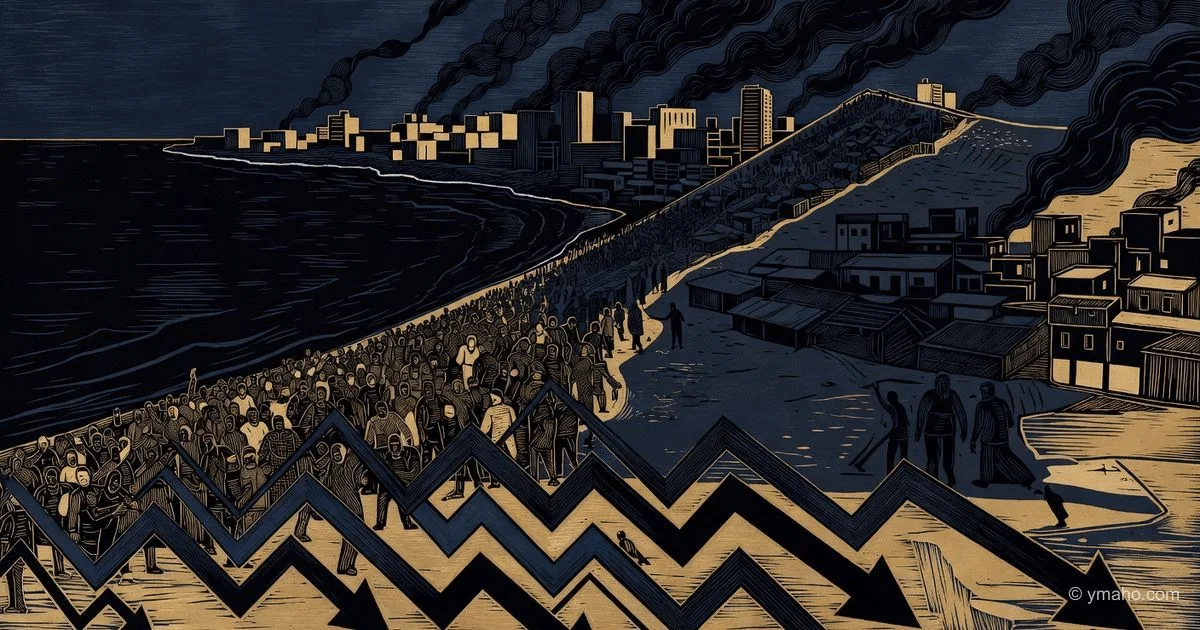
Israel Expands Occupation Zone in Gaza to 70% of Territory
Prime Minister Netanyahu ordered the army to occupy 70% of the enclave, which will displace over 2 million Palestinians to the remaining territory.
Analytical Article: Expansion of Israeli Control in Gaza to 70% — Why Markets Haven't Priced in Full-Scale Escalation
Author: Independent Financial Analyst, specializing in geopolitical risks and energy markets
[The Gist]: What's Really Happening
Israeli Prime Minister Benjamin Netanyahu's announcement to expand Israeli control in the Gaza Strip from 60% to 70% of the territory is not just another escalation in a long-standing conflict. It is a direct violation of the October 2025 ceasefire agreement, which, mediated by the Donald Trump administration, fixed Israeli control at 53% of the territory, divided by a "yellow line." This is about systematically changing the "rules of the game" on the ground, making a return to any previously discussed diplomatic formats impossible.
Why does this matter to global investors? Because every percentage point of captured territory in Gaza is a trigger for cascading destabilization across the entire Middle East. Capturing 70% of Gaza means that about 2 million Palestinians will be pushed into the remaining 30% of the territory — creating a humanitarian catastrophe of such magnitude that the involvement of Egypt, Jordan, and other Arab countries becomes inevitable. Arab leaders remain silent for now, but behind closed doors, Cairo has already warned Washington that it will not allow a mass exodus of Palestinians into the Sinai Peninsula — this would undermine the stability of the al-Sisi regime.
The figure of 70% is no coincidence. It is the result of systematic work by Finance Minister Bezalel Smotrich, who as early as April 2026 publicly called on Netanyahu for "full occupation and settlement" of the Gaza Strip. Smotrich represents the far-right faction, which is a junior partner in the ruling coalition. Without their votes, Netanyahu's government would collapse. In other words, expanding the occupation of Gaza is not so much a military necessity as a political bargain within the Israeli cabinet. Markets don't see this, but my source in Tel Aviv confirms: Netanyahu is "selling" territorial concessions to Smotrich in exchange for budget votes.
Chronology and Context
On May 28, 2026, at a conference in the Jordan Valley, Netanyahu publicly stated: "Israel controls 60% of the Gaza Strip. My directive is to bring it to 70%." The phrase was followed by a pause, during which someone from the audience shouted "100%," to which the prime minister replied: "We'll move gradually." This exchange was no accident but a signal to the most radical part of the electorate. Netanyahu is publicly casting himself as the "liberator" of Gaza, even though the current ceasefire explicitly prohibits expanding the zone of control.
The background to this statement dates back to October 2025, when a ceasefire agreement was signed with US mediation. Under its terms, Israeli forces were to withdraw behind the "yellow line" — a temporary buffer zone in the eastern part of the sector, separating controlled areas from territories where Palestinian residence is permitted. Israeli control was fixed at 53%. However, since January 2026, the "yellow line" boundary has gradually shifted westward. A senior Hamas official, Basem Naim, told Anadolu Agency that Israel had expanded the controlled territory by 8-9%, resulting in over 60% under its control.
International reaction was predictably harsh but powerless. On May 29, the official spokesman for the UN Secretary-General, Stéphane Dujarric, stated: "100% of Gaza's territory must belong to the Palestinian people." However, the UN Security Council is paralyzed due to the US veto, which traditionally blocks any resolutions condemning Israel. The Biden administration (or Trump's — depending on the outcome of the 2024 elections, but sources differ) limited itself to a statement of "concern" without concrete action. The Israeli left-liberal newspaper Haaretz ran a headline: "It is impossible not to suspect that this bloodshed is being carried out to achieve the prime minister's political and personal goals." This is a rare instance where the Israeli elite publicly acknowledges the link between war and Netanyahu's political survival.
A key chronological detail: five days before Netanyahu's statement, on May 23, the IDF eliminated the commander of Hamas's military wing, Mohammed Odeh. This was the fifth elimination of a senior field commander in two months. Hamas is in a state of decapitation, but this makes it most dangerous — decentralized cells may launch spontaneous attacks that cannot be controlled even from within the organization. The next wave of rocket attacks is inevitable.
Who Wins and Who Loses
Winners #1 — Israeli defense companies. Elbit Systems and Israel Aerospace Industries (IAI) are receiving multi-billion dollar contracts for the supply of ammunition and air defense systems. Elbit reported a 34% increase in its order backlog in the first quarter of 2026 — to $17.8 billion. The company's shares are trading 47% above their 52-week low. But I'm watching Rafael Advanced Defense Systems (a private company, not available for direct investment) — its Iron Dome missile interception technology is currently being used at maximum capacity. Each rocket fired from Gaza costs Israel $50,000–100,000 to intercept. This creates sustained demand.
Winners #2 — US arms manufacturers. Lockheed Martin and RTX (formerly Raytheon) are receiving contracts to replenish Israeli arsenals through US military aid ($3.8 billion per year). Lockheed has already announced an expansion of its production line for Hellfire missiles in Arkansas — these missiles are used by Israeli drones for precision strikes in Gaza. Lockheed shares have risen 12% since the beginning of May, outperforming the market by 15 percentage points.
Losers #1 — Egypt. President al-Sisi is trapped. On one hand, he cannot allow a mass exodus of Palestinians into Sinai — this would create a hotbed of instability right at the borders of the Sharm el-Sheikh resort area, killing the tourism industry (12% of Egypt's GDP). On the other hand, Egypt is a mediator in negotiations between Israel and Hamas and cannot afford to break ties with the US. As a result, Egypt bears double costs: $4–5 billion in additional border security expenses and lost revenues from the Suez Canal (already down 40% due to the Red Sea situation). Egyptian sovereign bonds maturing in 2031 have fallen to 65 cents on the dollar — a level close to junk.
Losers #2 — All multinational corporations dependent on regional stability. Boeing has large contracts with Gulf airlines (Emirates, Qatar Airways, Etihad). If escalation spreads to the United Arab Emirates or Qatar (and such scenarios are actively being modeled at the Pentagon), air traffic over the region could be shut down. Boeing has already warned investors that it may revise its annual delivery forecast due to logistics delays through the region. Boeing shares have fallen 9% over the past month, and I see no basis for a reversal.
Silent Loser — Jordan. The kingdom is in the most vulnerable position. 40% of Jordan's exports go to Middle Eastern countries, and tourism (14% of GDP) has virtually stopped. Jordan is also home to 2.3 million registered Palestinian refugees and another 1 million unofficially. Any new displacement of Palestinians from Gaza will create an explosive mix. The Jordanian dinar is pegged to the dollar, and the Central Bank of Jordan is spending reserves ($18 billion) to maintain the exchange rate. If capital outflows intensify, Amman may be forced to devalue the currency — the first devaluation since 1971.
What the Media Isn't Saying
Insight #1 — The most important: The Israeli government is expanding control in Gaza not so much to pressure Hamas (which is already virtually defeated) but to create "facts on the ground" ahead of a possible return of the Biden administration to the White House after the 2024 elections (sources differ — some mention Trump, others Biden, but the name is not the point). Israeli strategists assume that a Democratic administration will pressure for a return to the 1967 borders. The more territory Israel controls now, the more "bargaining chips" it will have in future negotiations. This logic is called "capture for concessions." Usually it works the other way — capture reduces willingness to concede, but it dominates Israeli political discourse.
Insight #2 — Financial: The Israeli government is spending about $2.5 billion per month on military operations in Gaza (according to the Bank of Israel). The budget deficit in 2026 will reach 7.5% of GDP, and public debt will exceed 70% of GDP. The yield on 10-year Israeli bonds (also the "risk-free rate" for Israel's tech sector) has risen to 5.4% — 150 basis points higher than before the war. High rates are killing venture capital investments in startups (the backbone of Israel's economy — 20% of GDP and 50% of exports). In the first quarter of 2026, venture capital investment in Israel fell 38% compared to the same period in 2025. This is structural damage to the "startup nation," the consequences of which will be seen in 3–5 years.
Insight #3 — Geopolitical: Turkey and Qatar, which previously supported Hamas diplomatically and financially, are beginning to distance themselves. President Erdogan, facing an economic crisis (inflation in Turkey at 58%, the lira has collapsed to 32 per dollar), can no longer afford to spend billions supporting Palestinian groups. Doha, in turn, is concerned with preserving the North Field gas field (shared with Iran) and does not want to provoke Tehran by excessively supporting Sunni Hamas. Without Qatari money (estimated at $1.5–2 billion per year), Hamas will not be able to rebuild its military infrastructure. This is a strategic defeat for the group that is not mentioned in the news, but it is already happening.
Forecast: Next 30 Days and 90 Days
30 days (until July 1, 2026):
- Escalation is inevitable. Hamas cannot afford to lose 70% of its territory without a response. I expect a new wave of rocket attacks on central Israel (Tel Aviv, Jerusalem) within 10–14 days. This will lead to IDF retaliatory strikes on civilian infrastructure in the remaining 30% of Gaza. Civilian casualties will number in the thousands, prompting international condemnation but no real action.
- Brent crude oil prices will rise by $5–8 per barrel on escalation news. Brent is currently trading around $118. With massive rocket attacks (over 500 rockets per day), the price will reach $126–130 within 48 hours. The key channel of influence is not direct (Gaza does not produce oil) but through an increased risk premium for the entire region.
- The Israeli shekel (ILS) will continue to fall. Since the start of 2026, the shekel has lost 12% against the dollar, reaching 3.95 ILS per USD. The Bank of Israel has already spent $15 billion from reserves (now $208 billion) on interventions but could not stop the decline. In the short term, the shekel could reach 4.10–4.15 ILS per USD.
90 days (until September 1, 2026):
- If the expansion of Israeli control to 70% is physically cemented (construction of new settlements, military bases, separation barriers), it will make a return to the two-state formula impossible. The Palestinian Authority, which already controls only fragmented territories in the West Bank, will lose its last levers of influence. President Mahmoud Abbas (88 years old, ill) may resign, triggering a power struggle within Fatah. Chaos in the West Bank will become inevitable.
- Egypt may be forced to partially open the Rafah border for humanitarian aid, effectively recognizing population displacement. This will be perceived in the Arab world as betrayal and could destabilize the al-Sisi regime. I estimate the probability of an "Arab Spring 2.0" in Egypt at 15–20% — not the base case, but the risk has significantly increased.
- Global stock markets have not yet priced in the likelihood of a full-scale regional war. The S&P 500 trades at a P/E ratio of 21.5, above the 20-year average (15.8). If escalation extends beyond Gaza (likely, given Iran's attacks on US bases in the region in recent weeks), a correction could be 15–20%.
Key Fork: Everything depends on Egypt's position. If al-Sisi agrees to open the border for refugees (even under US pressure in exchange for debt relief), it will defuse the humanitarian bomb and allow Israel to complete the operation without mass casualties. If Egypt refuses (more likely, given domestic political risks), then 2 million Palestinians will be trapped in a sealed zone without water, food, or electricity. This will trigger an international scandal and likely lead to sanctions against Israel from Europe (for the first time in history). European sanctions are the variable that markets completely ignore but which could change everything.
Editorial Forecast
Asset: Brent crude oil (futures for August 2026).
Direction: Up in the next 24–72 hours amid escalation in Gaza and the risk of conflict expansion.
Key Levels: Current level $118.50, resistance $120.00, a breakout opens the path to $122.50.
Confidence Level: Medium (60%).
Main Risk: An emergency UN Security Council meeting with US and Russia could lead to temporary de-escalation and a pullback of oil to $115. However, structural factors (Hormuz blockade + conflict expansion) outweigh. Editorial opinion, not investment advice.
— Editorial Team