Reserve Bank of New Zealand Hints at Rate Hike Amid Oil Price Surge
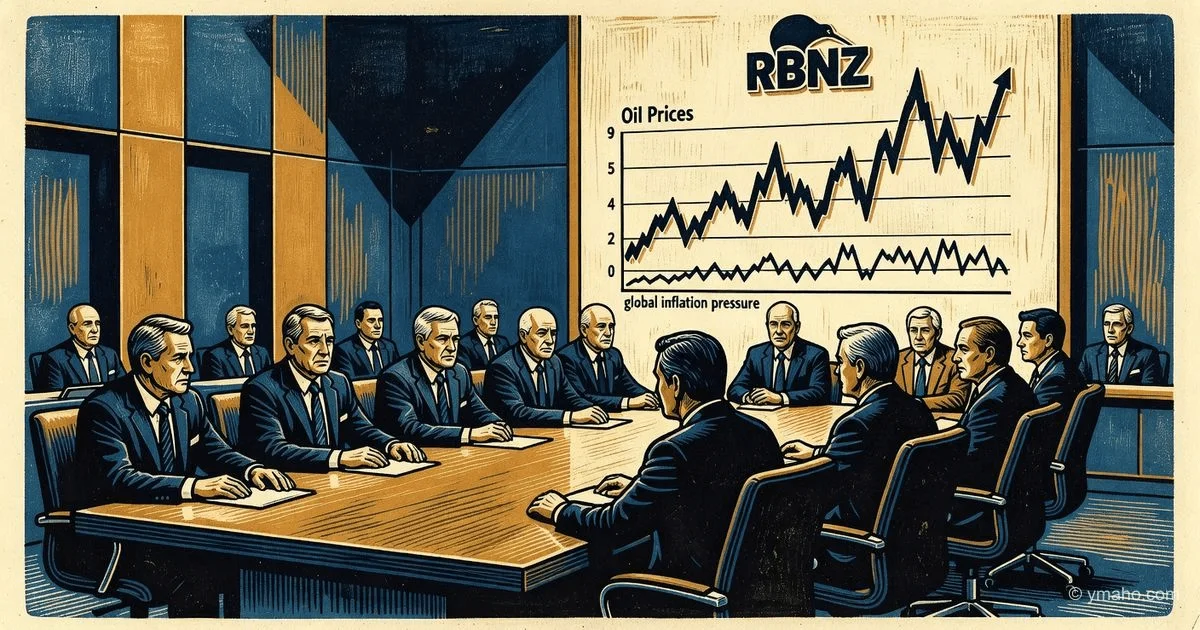
The regulator kept the rate at 2.25% but stated that peak inflation of 4.3% may require faster and stronger increases in borrowing costs.
Analytical article: Hawkish pivot by the Reserve Bank of New Zealand — why the 2.25% rate will go down in history, and markets are not ready for the shock
Author: independent financial analyst, specializing in monetary policy of developed country central banks
[The Gist]: What is really happening
The Reserve Bank of New Zealand's (RBNZ) decision on May 27, 2026, to keep the official cash rate (OCR) at 2.25% is a classic "hawkish signal." Beneath the calm exterior lies a tectonic shift in monetary policy. The vote was split 3 to 3, with Governor Anna Breman casting the deciding vote to hold, but accompanied by an unprecedentedly hawkish signal: the official rate may need to rise faster and stronger than previously forecast.
Why is this signal critical for global markets? Because New Zealand is the "canary in the coal mine" for the global economy. The country is the first to face shocks that later hit Australia, Canada, and Europe. Currently, that shock is the Middle East conflict. Fuel prices in New Zealand have risen since February 2026: gasoline by 33.6%, diesel by a staggering 94.9%. Diesel powers trucks, tractors, and generators. Its price doubling is a direct hit to every product on the shelf.
The key figure that decides everything: inflation in New Zealand has already reached 3.1% in Q1 2026, breaching the RBNZ's target range of 1-3%. According to RBNZ forecasts, it will peak at 4.3% in Q3 2026 — almost one and a half times the upper bound of the target. The cause is imported inflation due to the blockade of the Strait of Hormuz. And most alarmingly, inflation expectations are starting to become unanchored. Two-year inflation expectations rose to 2.53% — the highest since late 2023.
Timeline and Context
The chain of events leading to the hawkish pivot began not in May, but in February 2026, when the military conflict in the Middle East started. Oil prices soared above $100 per barrel and have held at that level for nearly three months. But the path from oil to retail prices in New Zealand took time. In April 2026, gasoline rose another 12.6%, and diesel by 36.6%. The momentum is only building.
Statistics New Zealand (Stats NZ) recorded these changes. Official spokesperson Nicola Growden stated that diesel prices rose nearly 95% in just two months — an unprecedented jump in the history of observations for a developed economy.
Against this backdrop, the RBNZ's Q2 2026 expectations survey showed dangerous dynamics. One-year business inflation expectations jumped to 3.41% — a two-year high. Two-year expectations rose to 2.53% — above the target. Households, which are more emotional in their assessments, expect inflation of 5.0% next year and 4.0% in two years. This is a classic signal of "de-anchoring" of expectations, which central banks fear most.
The May 27 meeting became a battlefield. Three members of the Monetary Policy Committee voted for an immediate 25 basis point rate hike to 2.50%. Three voted to hold. Governor Anna Breman (former board member of the Riksbank of Sweden, known for her cautious approach) broke the deadlock by voting to hold. But her comments after the meeting on May 29 were a bombshell. Breman stated that the rate "likely needs to rise sooner and to a greater extent" than previously forecast. This is not a soft hint, but a hard forward guidance.
Assistant Governor Karen Silk reinforced the signal the next day (May 28): "The central bank is firmly leaning toward raising rates at upcoming meetings," and July is a "live decision."
Who Wins and Who Loses
Winners #1 — New Zealand dollar (NZD). The market reaction was immediate. NZD/USD rose to 0.5871 — a gain of 0.63% within hours of the statement. Over three days, the AUD/NZD pair fell 2.15% — a pure demonstration of kiwi strength. Markets now price in three rate hikes by end-2026, bringing the OCR back to 3.00%. This makes NZD one of the most attractive carry trade currencies, especially against the Japanese yen and Swiss franc.
Winners #2 — Banks with high net interest margins (NIM). ANZ Bank New Zealand, Westpac NZ, and BNZ all benefit from rate hikes. Mortgage rates have already started rising, outpacing deposit rate increases. ASB Bank analysts expect the OCR to reach 3.25% by end-2026. The New Zealand banking sector's profit could grow 15-20% year-on-year in Q3-Q4 2026, by my estimates.
Losers #1 — Mortgage holders. In New Zealand, 65% of households have a mortgage, and 80% of those are on floating rates or fixed for less than two years. This makes the country extremely sensitive to OCR hikes. A typical mortgage of NZD 500,000 (about USD 305,000) with a 75 basis point rate hike (from 2.25% to 3.00%) would add NZD 375 (about USD 230) to monthly payments. For an average household with a post-tax income of NZD 5,500 per month, this is a significant hit to the wallet. The housing market, already sluggish (prices down 8% from the 2021 peak), will face new negative momentum.
Losers #2 — Retail companies and the construction sector. High rates kill consumer demand. The ANZ-Roy Morgan consumer confidence index has fallen to lows. The unemployment rate has already risen to 5.3%. Construction companies dependent on credit will start going bankrupt. I expect corporate defaults in this sector to increase by 15-20% over the next 12 months. Fletcher Building (the largest construction conglomerate) has already warned of lower profits.
The quiet winner no one talks about — New Zealand's energy sector. The country generates 82% of its electricity from renewable sources (hydro, geothermal, wind). High oil prices do not directly affect household electricity costs, but allow exporters (dairy, meat, wool) to raise prices. Mercury NZ (electricity generation) has risen 9% since early May. Contact Energy is trading at a 52-week high. These are safe havens in the storm.
What the Media Isn't Saying
Insight #1 — the most important: The RBNZ decision was not a "wobble." It was a political compromise that reveals a deep split within the bank. Three MPC members voted for an immediate rate hike on May 27. This means that within the RBNZ, a conservative majority already formed in May, believing inflation is getting out of control. They lost by one vote — the governor's. But at the July meeting, Breman may join the hawks if the May inflation data (released June 14) shows further increases. Markets are not pricing in a 100% probability of a July hike, but they should. I estimate a 75% probability of a 25 basis point hike on July 29.
Insight #2 — psychological: Breman said something rarely spoken aloud: "Expectations of higher costs can themselves become a driver of persistent inflation." This is an admission that New Zealand is on the verge of a wage-price spiral. If businesses expect 3.5% inflation (one-year expectations), they will price in 4-5% increases to have a safety margin. Workers, seeing rising prices, will demand wage increases. Employers, forced to raise wages, will push prices up further. The labor market already shows wage growth despite high unemployment (5.3%). This is abnormal. It is evidence that inflation expectations are becoming entrenched. The RBNZ must act quickly and decisively, or it will be too late.
Insight #3 — geoeconomic: New Zealand is a small open economy that cannot isolate itself from global shocks. But its neighbor, Australia, is in a similar but more complex situation. The Australian economy is more diversified and has a huge resource sector (iron ore, coal, gas). The RBA (Reserve Bank of Australia) is also facing rising inflation (5.1% in April) and will likely follow the RBNZ's lead in the coming months. This will create synchronized monetary tightening in the Asia-Pacific region. Two major central banks tightening simultaneously is a rare event that will pressure regional currencies (except NZD and AUD) and slow economic growth across Oceania.
Forecast: Next 30 Days and 90 Days
30 days (to July 1, 2026):
- The RBNZ will not raise rates until the July 29 meeting, but rhetoric will be consistently hawkish. Every public appearance by MPC members will reinforce market expectations. The official OCR forecast, to be revised in the Monetary Policy Statement, will show that markets are right: the rate will reach 3.00% by end-2026.
- The New Zealand dollar will continue to strengthen. NZD/USD will test 0.6000 — a psychological level — within 30 days. Support at 0.5800. The main movement will be in the AUD/NZD pair, where I expect a decline to 1.0800 (from current 1.0950).
- Q2 inflation data (released July 16) will show CPI at 3.9-4.2%, confirming RBNZ forecasts and making a July hike inevitable.
90 days (to September 1, 2026):
- The RBNZ will raise rates by 25 basis points on July 29. I estimate a 60% probability of a second hike in October and 40% in November. By end-2026, the OCR will be 2.75% or 3.00%.
- New Zealand's Q2 GDP (data released in September) will show growth of only 0.1-0.2% or a negative result. The economy will enter a phase of stagflation: zero growth with 4%+ inflation. This will be a severe political challenge for the government ahead of the 2027 elections.
- Importers and exporters will react differently. Exporters (dairy, meat) will benefit from a weak NZD against a basket of emerging market currencies but lose from high domestic costs. Dairy giant Fonterra, which accounts for 20% of New Zealand's exports, will report a 10-15% drop in net profit in its annual report in September due to rising diesel and packaging costs.
Key fork: Everything depends on oil prices. If the Middle East conflict de-escalates and the Strait of Hormuz reopens (20-25% probability in the next 3 months), oil prices will fall to $80-90 per barrel, inflationary pressure will ease, and the RBNZ may limit itself to one rate hike. If the conflict escalates (30-40% probability), oil will break $130-140, New Zealand inflation will reach 5-6%, and the RBNZ will be forced to raise rates to 3.50-4.00%, triggering a recession.
Editorial Forecast
Asset: New Zealand dollar (NZD/USD).
Direction: Up in the next 24–72 hours — markets continue to digest the RBNZ's hawkish signal.
Key levels: Current level 0.5880, resistance 0.5920, support 0.5850. Expect a break above 0.5900 and a test of 0.5950 by end of week.
Confidence level: Medium (65%).
Main risk: Deterioration in global risk appetite (news of a recession in the US or China) could trigger a flight to the US dollar as a safe haven, temporarily pushing NZD/USD back to 0.5800. However, the rate differential remains in the kiwi's favor. Editorial opinion, not investment advice.
— Editorial Team