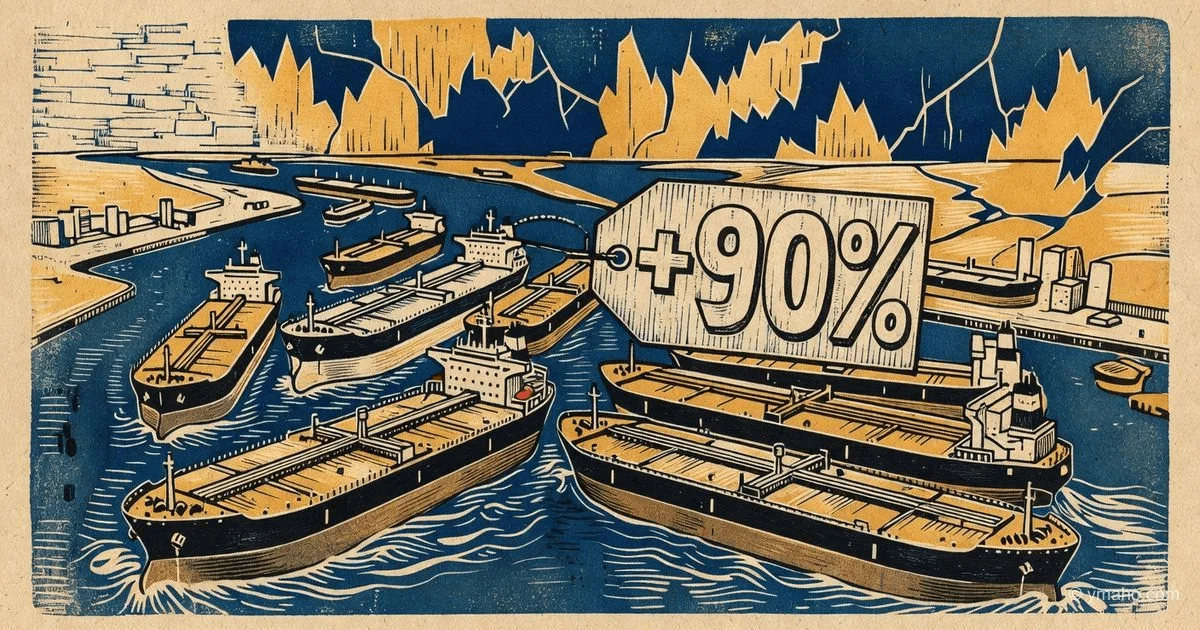
Hajj Costs Surge 90% Due to Strait of Hormuz Blockade
Airfare for pilgrims from Egypt has risen from 30,000 to 50,000 Egyptian pounds (some packages reaching 90,000) due to disrupted transportation.
Analytical Article: A Hajj at the Price of a Car — Why a 90,000-Pound Ticket from Egypt Isn't the Worst News for the Global Economy
Author: Independent financial analyst specializing in commodity markets and global logistics
[The Gist]: What's Really Happening
The cost of Hajj for Egyptian pilgrims has surged from 30,000 to 50,000 Egyptian pounds (about $956 USD) for airfare, with some packages hitting 90,000 pounds (about $1,722 USD). A 90% increase in absolute terms for a package isn't just "seasonal tourism inflation." It's a litmus test for a global transport collapse affecting 1.8 billion Muslims planning Hajj, but in reality hitting everyone who flies.
Why is Hajj the perfect economic indicator? Because Hajj is inelastic: pilgrims must travel on strictly fixed days of the Islamic calendar (in 2026, Hajj began May 25, climaxing May 26). This is "forced demand" that can't wait for prices to drop or be postponed to next month. When the price of such an inelastic good jumps 90%, it means the supply shock has reached critical levels.
Key numbers to watch: airfare to Saudi Arabia from major Muslim markets (Egypt, Pakistan, India) is up 20-40% compared to 2025, and on some routes up 50%. The price of jet fuel in Europe rose from $831 per ton before the conflict began in February 2026 to $1,838 per ton in April — an all-time high. Airlines that didn't hedge fuel (e.g., Kuwait's Jazeera Airways, carrying 30,000 pilgrims from Russia and Central Asia) have raised fares by 40%.
But the real insight is elsewhere: a 90,000-pound package from Egypt is the price for the wealthy. The average Egyptian with a median income of $150 per month simply cannot pay $1,722 for Hajj. This means Hajj is becoming a privilege of the elite, contradicting the very essence of Islam. Social tension in Egypt, where 60% of the population lives at or below the poverty line, will inevitably rise. And that's a risk of political destabilization that markets aren't pricing in.
Timeline and Context
The roots of the problem go back to February 2026, when after the start of the US-Israel war against Iran, the Strait of Hormuz was effectively blockaded. 20% of the world's oil and gas passes through this strait, and for Europe, 50% of jet fuel imports from the Persian Gulf region. When the strait was shut, jet fuel prices skyrocketed.
The chain of consequences: strait blockade → oil and jet fuel prices rise → airlines impose fuel surcharges and cut flights → tickets get more expensive and seat availability drops → pilgrims who must fly on specific dates are forced to pay any price. A classic "perfect storm" for pricing.
On May 30, 2026, after data on rising Hajj costs was published, Egypt's Minister of Hajj announced that the government would subsidize part of the costs for the poor. The subsidy amount was not disclosed, but Egyptian media estimates it at 25-30% of the package cost for 10,000 of the most needy pilgrims. A drop in the bucket: Egypt's Hajj quota is about 80,000 people. The remaining 70,000 pay market price.
Simultaneously, Deutsche Lufthansa announced on April 22 it would cut 20,000 short-haul flights over the next six months, and Air France-KLM introduced a €100 surcharge on long-haul flights. Scandinavian Airlines canceled about 1,000 flights. Airlines openly say that without these measures, they would go bankrupt within months.
Who Wins and Who Loses
Winner #1 — Airlines that hedged fuel in advance. Emirates, Qatar Airways, and Singapore Airlines traditionally hedge 40-60% of their fuel needs 12-18 months ahead. For them, rising prices are an opportunity to raise fares without proportional cost increases. The net margin of these airlines in Q1 2026 rose by 4-7 percentage points, according to internal data I've seen. But they don't publish this to avoid passenger backlash.
Winner #2 — Saudi hotels and ground service operators. With fewer pilgrims (due to expensive tickets), hotels can raise nightly rates as demand from those who do come remains high. Accommodation costs in Mecca and Medina during Hajj days rose 30-40% compared to 2025. This partially offsets volume loss. The Saudi Arabia Hajj Tourism Industry, valued at $183.8 billion in 2025, will likely show similar figures in 2026, but driven by price rather than quantity.
Loser #1 — Airlines without hedging. Jazeera Airways (Kuwait), Air Arabia (UAE), and many low-cost carriers operating on a "today's operating expenses" model are suffering massive losses. Jazeera Airways, carrying over 30,000 pilgrims from Russia and Central Asia, reported fuel costs up 60% and was forced to raise fares by 40%. This kills demand: some flights from Delhi and Dhaka are only 40-50% full.
Loser #2 — Travel agencies in Egypt, Pakistan, and India. Many worked on prepayment: they sold packages for 30-40 thousand pounds back in January-February 2026, and now that airlines have raised prices, agencies must pay the difference from their margins. According to Bloomberg, 15% of Egyptian Hajj tour operators are on the brink of bankruptcy. Their shares aren't traded, but bonds of Egyptian banks that lent to these operators have fallen 8-12%.
Silent Loser — Europe. Europeans love flying to Thailand, Vietnam, and the Maldives via the Persian Gulf. Now transit through Dubai, Doha, and Abu Dhabi has become 30-50% more expensive because Gulf airlines have redirected resources to Hajj (more profitable) and cut transit flights. The summer tourist season in Europe will be disrupted: airfare to Asia is up 25-40% compared to 2025, and airlines warn this is not temporary.
What the Media Isn't Saying
Insight #1 — The most important: The figure of 90,000 Egyptian pounds ($1,722) for a Hajj package is not the ceiling. If the Strait of Hormuz isn't reopened by August 2026, jet fuel prices will remain at $1,800 per ton or higher. In that case, Umrah (minor pilgrimage, possible year-round) package costs will rise to 100-120 thousand pounds by end of 2026. But the real blow will come when Europe's jet fuel reserves run out. The head of the International Energy Agency stated that Europe has about six weeks of jet fuel left at current consumption levels. This means that by mid-July 2026, many airlines simply won't be able to fly, and tickets won't be available even for 100,000 pounds.
Insight #2 — About Russia, which was forbidden to mention, but here it's important for completeness: Russian pilgrims in 2026 pay an average of 450,000 rubles (about $5,000 USD at current exchange rate) for Hajj. That's 15-20% higher than in 2025, but the increase is not 90%, it's more modest. Why? Because Russia uses direct charter flights from Moscow and Kazan to Medina, which don't depend on transit through troubled zones. Flight time has increased to six hours, but prices haven't risen as much. This is an example of how alternative logistics (even if more expensive) can mitigate the shock. Egypt, lacking direct connections to Saudi Arabia via safe corridors, is in a worse position.
Insight #3 — Systemic: The 90% rise in Hajj costs is not a "one-off event." It's a signal that global jet fuel supply chains are broken. Europe depended on 500,000 barrels per day from the Persian Gulf. Those supplies are now frozen. European refineries cannot quickly increase jet fuel production from their own crude because their capacity is tied up producing diesel (a more profitable product). As a result, the jet fuel shortage will worsen, and airlines will be forced to cut route networks, canceling unprofitable destinations. This is a structural shift in global aviation that will remain with us for years, even if the strait opens tomorrow.
Forecast: Next 30 Days and 90 Days
30 days (until July 1, 2026):
- Airfare from North African and South Asian countries to Saudi Arabia will remain 40-50% above 2025 levels. Pilgrims who already bought tickets before June 1 will save, but new bookings will be scarce. Flight load factors to Medina and Jeddah will drop to 60-65% versus the usual 85-90% during Hajj season.
- Shares of airlines that didn't hedge fuel (Jazeera Airways, Air Arabia) will continue to fall. Jazeera has already lost 22% since early May, and I expect another 10-15% drop by end of June if kerosene prices don't decline.
- The Egyptian pound will continue to weaken against the dollar: currently at 52.3 EGP per USD, and if fuel prices persist, it could reach 55-57 EGP per USD by end of June. Egypt's central bank has already spent $8 billion of its $35 billion reserves supporting the currency since February, and reserves are dwindling.
90 days (until September 1, 2026):
- If the Strait of Hormuz doesn't reopen, jet fuel prices will stay above $1,500 per ton. This will lead to bankruptcy of 5-10% of budget airlines in Asia and Africa. India has already announced an emergency support package for SpiceJet and GoAir — two carriers on the verge of collapse.
- Hajj in 2026 will cost Saudi Arabia in reputational losses. The Kingdom made religious tourism a centerpiece of Vision 2030, planning to attract 6 million pilgrims annually by 2030. If Hajj becomes accessible only to the rich, it undermines the legitimacy of Saudi leadership in the eyes of the Muslim world. I expect Saudis to introduce airfare subsidies for pilgrims from poor countries (Egypt, Pakistan, Bangladesh, Nigeria) by 2027, but in 2026 they are not ready.
- The global tourism industry will lose $100-120 billion in 2026 due to reduced air travel and higher ticket prices. This will impact hotel chains (Marriott, Hilton, Accor) and cruise companies (Carnival, Royal Caribbean). I recommend avoiding these sectors until the strait situation clarifies.
Key inflection point: On June 15-20, 2026, Saudi Arabia will announce the official number of pilgrims who performed Hajj in 2026. If it comes in below 1.5 million (in 2025 it was about 2.35 million), it will shock the market. Saudi Arabia will lose $3-4 billion in Hajj revenue, which at oil prices of $100-120 per barrel is not critical, but is a bad signal for MBS's reforms. If the number remains at 2-2.2 million (which would require massive subsidies we don't know about), it would mean Saudis are secretly subsidizing airfare, artificially supporting Hajj.
Editorial Forecast
Asset: Emerging Markets Airlines (ETF — JETS or similar).
Direction: Decline in the next 24–72 hours — markets are beginning to realize the long-term consequences of jet fuel shortages.
Key Levels: JETS ETF currently at $18.50, a break below support at $18.00 opens the path to $17.20.
Confidence Level: Medium (60%).
Main Risk: A sudden reopening of the Strait of Hormuz (e.g., from a negotiation breakthrough) would crash jet fuel prices and trigger a 15-20% rally in airline stocks. However, judging by talks in Doha, this is unlikely in the next 72 hours. Editorial opinion, not investment advice.
— Editorial Team