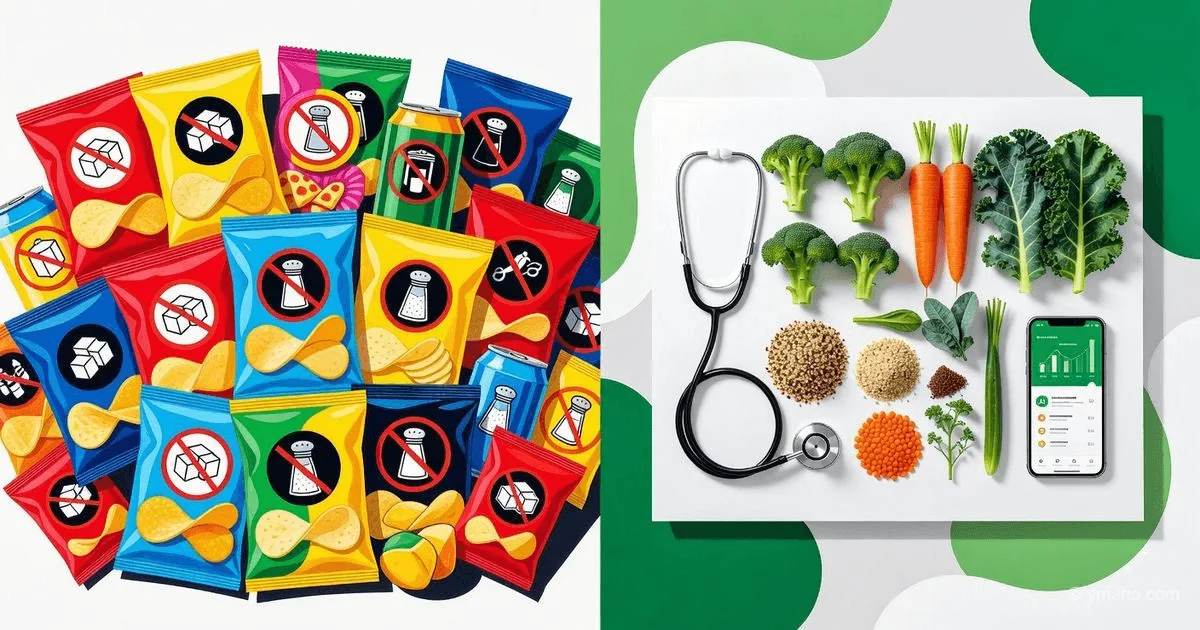
Trend Toward 'Quality, Not Quantity': 2026 vs. Ultra-Processed Foods
U.S. News experts note a paradigm shift: consumers are tired of extreme diets and are focusing on whole foods. The new trend ranking has shifted from finding the 'best diet' toward the concept of 'food as medicine' and integrating AI with gadgets for personalized nutrition.
Headline: The Collapse of 'Weight Loss Diets': Why 2026 Became the Year of 'Food as Medicine' and What AI Will Do About It
If you still think the main nutrition trends are keto, paleo, or intermittent fasting, you are hopelessly out of touch. Yesterday's 'kings' of the rankings, built on restrictions and macro counting, are dying. In their place comes something far more complex, expensive, and politicized—the concept of 'Food as Medicine,' backed by AI and macroeconomic shifts.
What the average person sees as a 'shift to healthy eating' is actually the collapse of the old diet industry and the birth of a new one—clinical nutrition. And there is a non-obvious insight: the main beneficiaries of this trend will not be producers of 'organic buckwheat,' but insurance companies and IT giants.
[Essence]: What Is Really Happening
What is really happening is a paradigm shift from 'losing weight for aesthetics' to 'prevention for survival.' U.S. News experts recorded this in their 2026 rankings: consumers are tired of extreme diets. But the reason is not 'awareness,' as lifestyle bloggers write. The reason is that the healthcare system in the US (and Europe) can no longer afford the consequences of obesity. 90% of all healthcare spending in the US today goes to treating chronic diseases directly linked to diet.
Therefore, a tectonic shift occurred at the political level. The new US dietary guidelines (2026-2030), promoted by the administration through the slogan 'Make America Healthy Again,' have finally officially named ultra-processed foods (UPFs) as the main threat. The DASH diet (developed 25 years ago to combat hypertension) suddenly became the gold standard not because of marketing, but because it is the only one proven to reduce mortality.
But this is just the tip of the iceberg. The industry has realized that 'clean label' is not a niche but the mainstream. The clean ingredients market grew to $62 billion in 2026 and will continue to grow at a CAGR of 10.6% to $93 billion by 2030. This is not just about 'no chemicals,' but about replacing cheap synthetic additives with expensive natural alternatives. This is a revolution in product cost.
Non-obvious Insight #1: The 'food as medicine' trend is killing the dietary supplement industry from within. If before you bought Omega-3 separately, magnesium separately, and turmeric separately, now food should contain these itself. This means a shift from 'pharmacy on the shelf' to 'pharmacy on the plate.' Supplement manufacturers are in panic—their products become an unnecessary intermediate step when health insurance companies start prescribing not bottles of pills but baskets of food.
Timeline and Context: The End of the Food Pyramid Era
This trend has been brewing for several years, but 'exploded' just now for three reasons.
Reason One (Political): In early 2026, the new leadership of HHS (US Department of Health and Human Services) initiated a revision of the 1992 food pyramid, calling it 'corrupt and misleading.' The story came to light: the original recommendations for grain and dairy consumption were pushed through by lobbyists for Kellogg, General Mills, and the dairy industry. Now, for the first time in 30 years, the government has publicly admitted: we were fed misinformation for corporate profit.
Reason Two (Technological): In April 2026, startups and tech giants (e.g., AssureCare with the NutraVance platform) launched the first industrial solutions for integrating Food as Medicine into the work of insurance companies and hospitals. Artificial intelligence made it possible to personalize nutrition not just 'by eye,' but based on biomarkers and genetics. The MyFoodRx app, tested on a sample of patients with diabetes and hypertension (average age 56, 94% women), showed that people are willing to change habits if recommendations are adaptive and consider their budget and kitchen equipment.
Reason Three (Economic): A study by Liberty University showed that ultra-processed foods are 62% cheaper than whole natural foods. This means that the 'quality, not quantity' trend automatically becomes elitist. The fight against UPFs is a fight against poverty. The US government is currently racking its brains over how to define 'ultra-processing,' because without clear criteria (color coding 'red-yellow-green'), the poor will continue to eat cheap chemicals.
Who Wins and Who Loses
Winners (1) — Natural Ingredient Producers (Clean Label). Companies like Givaudan, IFF, and Kerry Group have already restructured production. The market for natural food additives (colors, preservatives, flavors) grew to $50.7 billion in 2026 and will reach $75.2 billion by 2033. The key driver is replacing synthetic BHA, BHT, and sodium benzoate with rosemary extracts and fermented antimicrobials. The winner is the one who first patented a 'clean' preservative with a long shelf life.
Winners (2) — Retail Chains That Switched to a 'Pharmacy' Model. Chains like VkusVill (as a telling example of a global trend) are betting on fiber ('the new protein') and prebiotics. In 2026, demand for high-fiber products is growing faster than for any other functional product. Reason: doctors have finally explained that the gut microbiome controls immunity and mental health.
Losers — Fast Food Giants and 'Empty' Calories. Producers of soda, sugary cereals, and frozen pizzas are trapped. If the administration succeeds in introducing mandatory color coding (like Nutri-Score in Europe), their products will get a 'red' or 'D/E' label, instantly killing sales. They are currently funding lobbying campaigns with the argument 'processed food is also food' and 'you can't ban it without increasing food poverty.'
What the Media Isn't Saying: The Definition Problem and 'New Racism'
The media writes about a beautiful future where everyone eats quinoa and kale. But they keep quiet about three dirty secrets.
First: There is no definition. No one in the world can give a legally clear definition of 'ultra-processed food.' Europe has been struggling with Nutri-Score for years: the system can give an 'A' to Coke Zero (no sugar = good for the algorithm), but a 'D' to olive oil (high calorie = bad). The US administration promised to provide a definition by April 2026, but it's already June, and experts are arguing hoarsely. Without a definition, any law 'banning UPFs' will be swept away in court.
Second: Class warfare. The demand to 'eat whole foods' is impossible for a family where parents work 12-hour days and live in a 'food desert' (an area without supermarkets selling vegetables). RFK Jr. (head of HHS) said on Joe Rogan's podcast: '70% of the food our children eat is ultra-processed, and it's poisoning them.' This is true. But when he says this to the middle class stuck in traffic and feeding their kids McDonald's, it sounds like elitism and blaming parents for intentional poisoning.
Third: The AI now being introduced into personalized nutrition requires data. The MyFoodRx app collects data on your health, genetics, purchases, and even what kitchen appliances you have. This is a goldmine for insurers. Non-obvious risk: in 5 years, an insurance company could raise your premium because your AI dietitian saw that you bought pizza. Integrating 'food as medicine' into insurance workflows (as AssureCare does) means your plate becomes a medical record.
Forecast: Next 30 Days and 90 Days
Next 30 Days (June 2026):
The battle over the definition of UPF will peak. I expect leaks of the final HHS document. Most likely, they will settle on the NOVA model (Brazilian classification), but with adjustments for industry. This will cause a 5-10% drop in the stock prices of sweetener producers (e.g., artificial sweeteners) in the moment. Also, large chains like Walmart and Kroger will urgently begin negotiations with 'clean' ingredient suppliers (Cargill, ADM, Kerry) because they need to change labels before the Christmas season.
Next 90 Days (Late Summer 2026):
We will see the first avalanche of class-action lawsuits from consumers against producers of products labeled 'natural' but containing UPFs. Lawyers are already sharpening their teeth on 'clean labels' that are misleading. Simultaneously, Asian (Korean and Japanese) food giants will launch a 'Food as Medicine' line focusing on fermented products (kimchi, natto, miso), packaging millennia-old traditions in scientific packaging with a QR code leading to a PubMed article.
The market is facing a 'Great Reshuffling' of supermarket shelves. Products will be divided not into 'dairy/meat,' but into 'therapeutic' (functional, with proven efficacy) and 'recreational' (junk food with red labeling). Prices for healthy food will rise another 10-15% because natural ingredients are expensive to produce. We are entering an era where health ceases to be a right—it becomes a luxury good, and this trend will only deepen.
— Editorial Team