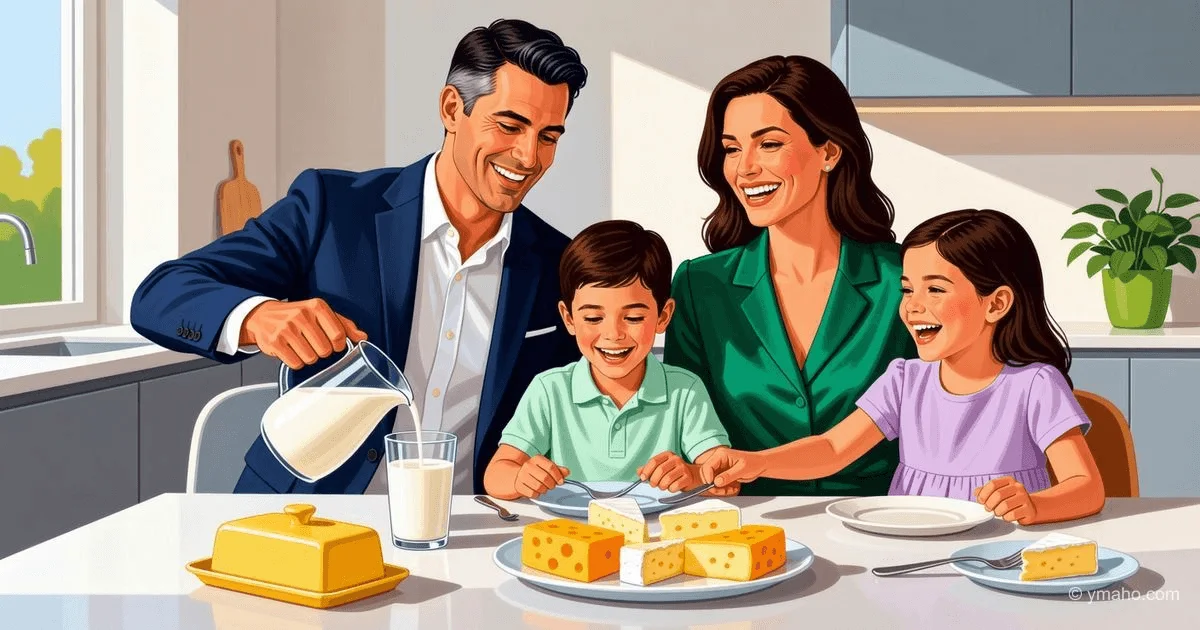
Full-Fat Dairy Makes a Comeback in American Diets
The trend away from fat-free is gaining momentum: new research shows that saturated fats in dairy aren't as harmful to the heart as once thought. This aligns with changes in US dietary guidelines and the growing popularity of ghee and cream over vegetable oils.
Fat is back: how butter and whole milk won the war against fat-free myths
Remember the 1990s and 2000s? Fat-free yogurt was considered the gold standard of healthy eating, and butter was the sworn enemy of slimness and clean arteries. Consumers drank "zero fat," unaware that they were getting sugar and chemical emulsifiers instead of fat. Today, in 2026, that nightmare is over. American dietetics has done a 180-degree turn: whole milk, cream, ghee, and even saturated dairy fats have been officially rehabilitated.
But the scale of change goes far deeper than just "now it's allowed." What's happening in the US market right now is a tectonic shift that combines science, policy, and big money. The key non-obvious insight is that the triumph of full-fat dairy is an indirect admission of the failure of the ultra-processed "diet" food industry and a victory for the concept of "food as a whole matrix" over the simplistic counting of fat grams.
[The Gist]: What's Really Happening
What's really happening is a fundamental reassessment of what we consider "bad fats." For decades, we were scared of saturated fats and urged to replace them with vegetable oils and carbohydrates. But new research, including a massive meta-analysis published in May 2026, reveals a shocking fact: natural dairy fats, including even natural trans fats, are not linked to an increased risk of cardiovascular disease.
Researchers analyzed 10 randomized controlled trials and 12 long-term cohort studies. They found that consumption of dairy trans fats (vaccenic and trans-palmitoleic acids) does not raise levels of "bad" LDL cholesterol, triglycerides, or increase the risk of heart attacks and strokes. Moreover, some of these fats are associated with a reduced risk of type 2 diabetes! The key takeaway from scientists: it's not the isolated fat that matters, but the "food matrix"—the proteins, calcium, probiotics, and bioactive compounds in whole milk and cheese that protect the heart.
The second layer of reality is legitimization at the state level. In January 2026, the new Dietary Guidelines for Americans (DGA) were released, which for the first time in many years clearly stated: focus on whole, minimally processed foods, including full-fat dairy. The American Academy of Pediatrics (AAP) supported these changes, specifically noting that children from 12 months can be given whole milk instead of skim milk.
The third layer is the political victory of the dairy lobby. On January 14, 2026, the US President signed the Whole Milk for Healthy Kids Act, which brings whole and 2% milk back to school cafeterias. Previous restrictions, in effect for nearly 15 years, were deemed mistaken. Dairy producers in Georgia are already celebrating: they expect this decision to increase milk consumption by 5-10% and save the industry from competition with plant-based drinks like almond and oat milk.
Timeline and Context: How the "Bad Fat" Myth Burst
The path to this moment was long, and 2026 marks the culmination.
2023-2024: Accumulation of Evidence. One study after another shows that the link between saturated fats and heart disease is not so clear-cut. It becomes apparent that the demonization of fats in the 1980s was based on selective data and ignored the harm of refined sugar and carbohydrates that replaced fat.
2025: Economic and Scientific Turning Point. The butter market experienced a dramatic crash in 2025: prices fell 22%, and by September a ton cost only $6,892. This was a delayed effect of overproduction, but also a rally in demand for "real" fats. Consumers, tired of fat-free "chemical" products, began returning en masse to butter and ghee.
January-May 2026: Governmental Shift. First, the 2026 DGA are released with a focus on protein and whole milk. Then in January, the school law is signed. In May, the MindBodyGreen meta-analysis is published, finally burying the myth of harmful dairy trans fats. Finally, in late May, analysts at Hoard's Dairyman note that demand for high-protein dairy products (cottage cheese, Greek yogurt, protein drinks) is hitting records, partly due to the popularity of GLP-1 weight-loss drugs that require increased protein intake.
Who Wins and Who Loses
Winners (1) — Producers of whole milk, butter, and cheese. These are the obvious beneficiaries. The return of whole milk to schools means a stable sales channel worth billions of dollars. Ghee producers also benefit: this product has become a symbol of "pure" animal fat without lactose. The global edible oils and fats market in 2026 is valued at $616.8 billion and growing at a CAGR of 5.9%.
Winners (2) — Consumers switching to full-fat dairy. They get not only a tasty product but also, as it turns out, a healthy one. Studies show that whole milk is associated with a lower risk of diabetes, improved gut health, and even a reduced risk of dementia.
Losers — Producers of plant-based milk alternatives (oat, almond, soy). Their marketing for decades has been built on demonizing dairy fat and lactose. Now that science and government say the opposite, their position weakens. The school law is a direct blow: children will again drink cow's milk instead of oat drinks.
Losers (2) — Producers of fat-free and "diet" dairy products. Fat-free yogurts with added sugar, flavorings, and thickeners are now seen as ultra-processed junk. The 2026 DGA directly urge avoiding added sugars and favoring whole foods.
What the Media Isn't Saying: The Dark Side of the Fat Revolution
The euphoria over the "green light" for butter should not overshadow warning signs that glossy magazines ignore.
First: This is not a license for unlimited consumption. The new guidelines clearly limit saturated fats to no more than 10% of total calories. That's about 200-220 calories per day on a standard 2000 kcal diet. Two tablespoons of butter is almost the limit. No one is advocating drinking cream by the liter. The point is not to "eat more fat," but to stop fearing it and replace refined carbohydrates and sugar with natural dairy products.
Second: Individual response. The meta-analysis showed that on average, dairy fats are safe. But in some people with genetic hyperlipidemia (familial high cholesterol), even natural saturated fats can cause a dangerous spike in LDL. The ApoB marker measured in the study did not show an increase, but that doesn't mean "everything is fine for everyone." Patients with a history of cardiovascular disease should still consult a doctor.
Third (and most important for analysts): The economic backdrop. The return of whole milk to schools is not just about science; it's also about powerful lobbying. The US dairy industry has fought for decades to lift restrictions. The studies now being published are partly funded by dairy councils. That doesn't make them false, but it creates a conflict of interest. We are witnessing not just "truth prevailing," but a classic paradigm shift where scientific data align with the economic interests of a huge industry that was losing market share.
Forecast: Next 30 Days and 90 Days
Next 30 Days (June 2026):
A marketing war will begin. Dairy brands will launch "Whole milk is back!" campaigns emphasizing "naturalness" and "scientifically proven." Plant-based alternatives will counterattack: "Our milk is hormone- and antibiotic-free." FDA regulators will watch to ensure neither side oversteps. Butter prices, which fell in 2025, will start to slowly recover as demand rises.
Next 90 Days (Late Summer 2026):
Schools will begin pilot implementation of whole milk. If successful (children drink more, waste less), the law will expand to all states. This will cause a structural increase in demand for full-fat milk, prompting farmers to increase herd fat content. The market for premium dairy products (organic, grass-fed, ghee) will continue to grow at double-digit rates.
We are entering an era where "natural fat" becomes a marker of quality and health. Fat-free is dying. Full-fat is winning. But, as always, the devil is in the quantity and context. Moderation and a holistic approach to nutrition remain the main rules, regardless of what the headlines say.
— Editorial Team