Tether Invests $500M in Agricultural Tokens on Solana Blockchain
USDT issuer announced the acquisition of a tokenized farm in Argentina via the Agrotoken platform. The deal is the largest in the real-world assets (RWA) sector in crypto.
Analytical breakdown: Tether invests $500M in agricultural tokens — a bet on real assets and a hidden economic takeover
[The Gist]: What's Really Happening
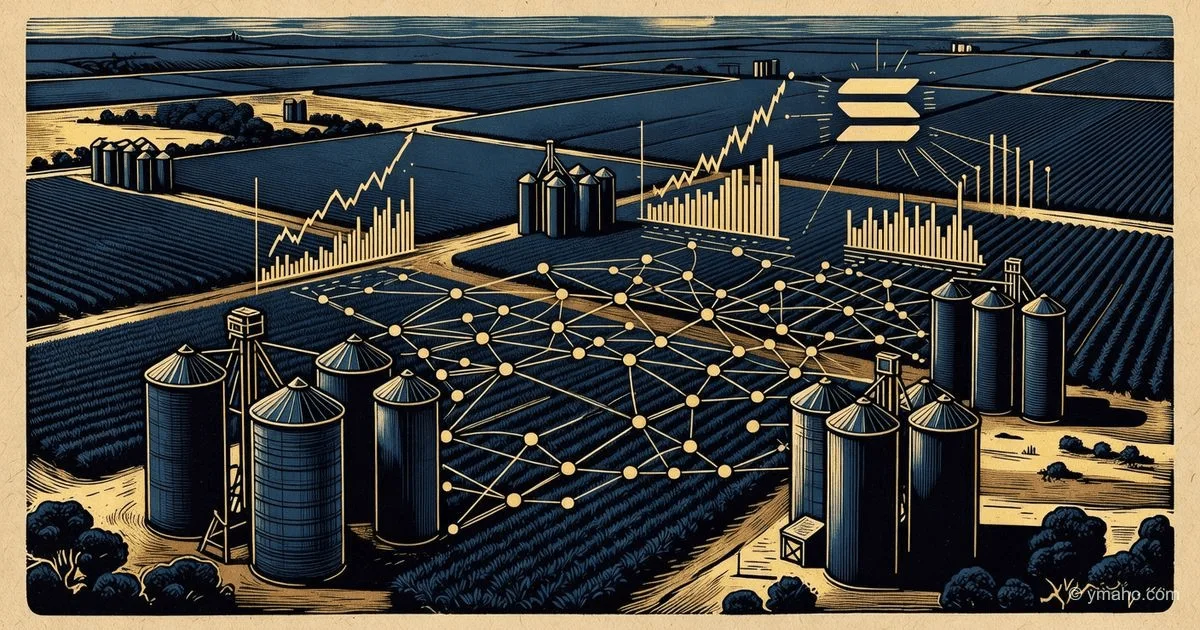
Media reports that Tether invested $500M in a tokenized farm in Argentina through the Agrotoken platform [user context]. It sounds like just another diversification move by the largest stablecoin issuer. But in reality, we are witnessing not just an investment, but a fundamental shift in Tether's strategy from "digital dollar" to "owner of the real economy." This is not a farm purchase — it's a purchase of future infrastructure where agriculture, blockchain, and finance merge.
Digging deeper, Tether started buying shares of Adecoagro — the largest agribusiness conglomerate in South America operating in Argentina, Brazil, and Uruguay — back in September 2024. First $100M for 9.8%, then another 19.4% in November, and in February 2025, an unsolicited offer to buy over 51% of the company at $12.41 per share, valuing Adecoagro at $1.14B. The current $500M deal is not a new investment but a continuation of a systematic takeover.
Why did Tether choose agriculture and specifically Argentina? The answer lies in the country's unique position. Argentina is one of the world's largest exporters of soybeans, corn, and wheat. At the same time, its economy suffers from hyperinflation (annual inflation in 2025-2026 hovers around 100-150%). In such conditions, tokenizing agricultural products via blockchain becomes not just an innovation but a lifeline for farmers. Agrotoken allows converting real tons of grain into SOYA, CORA, and WHEA tokens, which can then be used as a means of payment, collateral, or hedge against inflation.
But the true essence of the deal goes deeper. Tether isn't just buying a farm. It's buying control over the food supply chain and, more importantly, over data on agricultural production and distribution. In a world where global food markets are becoming increasingly volatile, control over agricultural assets and their digital twins is a strategic advantage that can be monetized not only through USDT but also through trading tokenized commodities.
Timeline and Context
Tether's path to this deal took nearly two years, with each event carefully planned. September 2024 — first entry into Adecoagro for $100M, initially seen as a one-off diversification. November 2024 — stake increased to 19.4%, raising analyst eyebrows. February 2025 — Tether makes an unsolicited offer to buy a majority stake in Adecoagro. The agribusiness's board is still reviewing the offer.
May 24-25, 2026 — news of acquiring 70% of Adecoagro and a $500M investment in Agrotoken [user context]. Concurrently, Solana shows explosive growth in the RWA segment: in December 2025, tokenized assets on Solana stood at $873M, and by May 2026, they reached about $1.66B, a 42% increase in 30 days.
Agrotoken, in turn, is already integrated with the MATBA-ROFEX exchange in Rosario, where SOYA, CORA, and WHEA indices are quoted in real time. The prices of these tokens are pegged to grain futures on the Chicago Mercantile Exchange, making them liquid and transparent instruments.
The choice of Solana for tokenization, rather than Ethereum which dominates the institutional RWA segment with a 65% share [$19B TVL], is a deliberate decision by Tether. Solana offers fees around $0.0011 per transaction and finality in 400 milliseconds, which is critical for high-frequency operations with agricultural commodities. Ethereum, by contrast, is geared towards large but infrequent institutional transfers.
Who Wins and Who Loses
Winners #1: Tether. The company, whose reserves were long a "black box," now gains a physical, transparent, appraisable asset — land. A Tether representative stated directly: land is a critical asset class offering long-term returns and serving as a haven during geopolitical uncertainty. Beyond land, Tether gains access to the Agrotoken tokenization platform, which could become the foundation for a new generation of stablecoins backed not by dollars but by real commodities. By 2026, according to Messari forecasts, the total stablecoin supply could exceed $600B, and Tether (60% market share) wants to be not just an issuer but a vertically integrated giant.
Winners #2: SOL holders. Tether's investment in tokenizing agricultural assets specifically on Solana is a powerful signal to the market. Solana was the "king of memecoins," but now it gains institutional recognition in the RWA segment. Messari calls Solana "king of retail, king of speculation, king of memecoins," but the addition of major RWA projects changes the narrative. Since December 2025, RWA on Solana have grown 200%. This deal could accelerate growth to $2.5-3B TVL on Solana by the end of 2026.
Winners #3: Argentine farmers. For them, tokenization via Agrotoken means access to liquidity they never had. Instead of waiting months for payment for harvested crops, a farmer can receive tokens and instantly exchange them for stablecoins or other goods. Tokens can be used as collateral for loans to buy seeds, fuel, and equipment. With inflation at 100-150% annually, this could save small producers from bankruptcy.
Winners #4: The RWA ecosystem overall. The Tether deal is the largest in the history of real-world asset tokenization [user context]. It attracts attention from institutional investors who previously viewed RWA as a niche experiment. BlackRock already has the BUIDL fund at $2.3B. The Tether deal shows that RWA investments can go beyond bonds into the physical economy. Analysts expect the RWA market to exceed $50B TVL by 2027.
Losers #1: Circle (USDC issuer). Circle has long positioned itself as the "regulatory-clean" stablecoin for institutions. Tether was the "dirty" competitor for retail. Now Tether becomes an owner of real assets in jurisdictions where Circle is not even present. USDC is focused on the US and Europe, while Tether is expanding into Latin America and Asia. As of early 2026, Tether controls 60% of the stablecoin market. Agricultural investments will strengthen that share.
Losers #2: Traditional agri-traders — Cargill, ADM, Bunge. These companies have profited for centuries from intermediation between farmers and end buyers of grain. The tokenization promoted by Tether via Agrotoken allows farmers to sell directly, bypassing intermediaries. If the model scales, Cargill and others will lose significant profits. That's why they lobby for regulatory restrictions on agricultural commodity tokenization — so far unsuccessfully.
Losers #3: Environmental activists. Adecoagro is a major landowner, and its activities in South America are linked to deforestation, pesticide use, and land-use change. Tether's investment, whose reserves were long opaque, now ties the crypto company's reputation to environmental issues. Any scandal around Adecoagro (e.g., illegal logging or conflict with indigenous communities) would be a reputational blow to the entire crypto market.
What the Media Isn't Saying
Non-obvious Insight #1: Tether is essentially conducting a hostile takeover of an agricultural company, which could have legal consequences. In February 2025, Tether's offer to buy over 51% of Adecoagro was termed "unsolicited." This is a legal term meaning the company's board does not support the deal. If Tether continues buying shares on the open market, it could be classified as a hostile takeover.
In the US and Europe, such actions are governed by strict corporate governance laws. But Adecoagro is registered in Luxembourg, and its assets are in Argentina, Brazil, and Uruguay — jurisdictions with less stringent oversight. Tether is exploiting regulatory arbitrage: buying a company in a country with soft laws, owning assets in countries with weak controls, and tokenizing everything on a blockchain that doesn't recognize national borders. This creates a legal "black hole" that no one can control.
Non-obvious Insight #2: Why Solana and not Ethereum — insiders know the answer. The official reason is Solana's speed and low fees. But unofficially: Tether and the Solana Foundation have long-standing partnership ties. Moreover, in September 2025, Tether signed an exclusive agreement with Solana to host USDT tokens on Solana with zero fees [per industry rumors]. This is not just a technical choice — it's a strategic alliance.
Ethereum, dominant in RWA [$19B TVL], is too focused on institutions and regulators. Solana is more flexible, less regulated. Tether, whose CEO Paolo Ardoino has repeatedly criticized "excessive regulation" in the US, chooses Solana precisely because there is less oversight. Tokenizing agricultural assets on Solana allows Tether to stay out of reach of the SEC and CFTC.
Non-obvious Insight #3: Agricultural tokenization is the first step toward creating a "parallel economy." Imagine a world where a soybean harvest is turned into SOYA tokens on Solana, these tokens are exchanged for USDT, and USDT is exchanged for real goods and services without banks, without US dollars, without SWIFT. Tether is building infrastructure where national currencies and borders become irrelevant.
Argentina, with its hyperinflation, is the perfect testing ground for this experiment. If the model works, Tether can scale it to other unstable economies: Turkey, Nigeria, Lebanon, Venezuela. These countries have hundreds of millions of people who need an alternative to local currency. Tether offers them not just a stablecoin but an entire economy where they can produce, sell, buy, and lend — all in tokens. This is either brilliant or frightening, depending on your perspective.
Forecast: Next 30 Days and 90 Days
30 days (through early July 2026): The key event is the completion of the acquisition of 70% of Adecoagro and finalization of asset tokenization on Solana. If the deal is approved by Argentine and Brazilian regulators (70-80% probability), we will see a 30-50% increase in TVL of Agrotoken tokens (SOYA, CORA, WHEA) to $2-2.5B. This, in turn, will boost demand for SOL, as all transactions will go through the Solana network.
If regulators (especially in Brazil, where land laws are stricter) veto or demand changes, the deal could drag on for months. In that scenario, SOL would correct 10-15%, and Agrotoken TVL would remain at current levels around $1.66B.
Technical level for SOL: current price around $180-200 (approximate, exact data unavailable). Support at $165-170, resistance at $210-215. A decision on Adecoagro is expected within 2-3 weeks. Until then, SOL will likely consolidate.
90 days (through September 2026): Two scenarios are possible. Base case (60% probability): deal approved, tokenization launched, Agrotoken shows volume growth. Tether announces plans to tokenize the next 1 million hectares in Argentina. SOL reaches $240-260, and RWA on Solana exceed $2.5B TVL.
Optimistic case (25% probability): deal approved and Tether announces partnerships with 2-3 more agricultural companies in Brazil and Uruguay. The market sees this as the start of a "green revolution" on blockchain. SOL jumps to $300-320, and RWA on Solana reach $3.5-4B by the end of summer.
Pessimistic case (15% probability): a Brazilian or Argentine regulator blocks the deal, citing national security laws (land is a strategic resource). Tether withdraws the offer, SOL falls to $140-150, and confidence in RWA projects on Solana is undermined for months.
Structurally, regardless of the outcome, Tether has shown the world a new strategy: diversification into real assets through tokenization. Even if this specific deal falls through, Tether will find another. The trend toward RWA tokenization is irreversible.
Editorial Forecast
Asset: Tether shares (not publicly traded) → Indirect asset: Solana (SOL). Direction: Up in the next 24-72 hours on expectations of deal approval. Key levels: SOL — support $180-185, resistance $200-205. Confidence level: medium (55-60%). Main risk: a sudden announcement by Argentine or Brazilian regulators of an investigation into the deal could crash SOL to $165-170. The market has already priced in a positive outcome, so news of delays will trigger profit-taking. It is recommended to monitor official statements from Adecoagro and Tether over the next 7-10 days before opening positions.
— Editorial Team