Lebanon Says Hezbollah Ready for Immediate Ceasefire with Israel
Parliament Speaker Nabih Berri told the US that the movement agrees to a full truce provided Israeli attacks stop. Meanwhile, Israel strikes Beirut suburbs.
A Dying Ceasefire: Why 'Hezbollah's Readiness' Is a Signal to Flee Risk, Not a Path to Peace
The Gist: What's Really Happening
When on June 1, Lebanese Parliament Speaker Nabih Berri (through his chief advisor Ali Hamdan) told the Trump administration that Hezbollah was ready for a full and immediate ceasefire with Israel, many traders breathed a sigh of relief. It seemed like a chance for de-escalation that should send oil and gold prices tumbling. But don't rush to close your short positions.
In reality, we are witnessing not a 'breakthrough to peace' but a diplomatic charade, where each side speaks a different language. Berri stated readiness to 'fully comply with a ceasefire regime on land, air, and sea.' But the key detail the media omits: Hezbollah demands that Israel stop destroying homes in southern Lebanon. And Israel, according to Netanyahu himself, will continue its ground operation in southern Lebanon 'according to plan.'
The essence of what's happening is bargaining over terms, not agreement to peace. Hezbollah is ready to stop rocket attacks on northern Israel. But Israel is not ready to stop its ground invasion. Moreover, on the same day (June 1), Netanyahu and Defense Minister Israel Katz ordered strikes on Hezbollah targets in the Beirut district of Dahieh. This is not a ceasefire—it's escalation under the guise of negotiations.
And here's what matters for a financial analyst: the market has already been burned. Since April 17, 2026, a formal truce between Israel and Lebanon has been in effect, extended for another 45 days through indirect US-mediated talks. But during this time, hostilities have not stopped for a single day. Hezbollah continues to launch rockets and drones; Israel continues airstrikes. The 'truce' has become a fiction masking the reality of war. Berri's current proposal is not a way out of the deadlock but an attempt to lock in a status quo favorable to Hezbollah.
Timeline and Context
Let's reconstruct the timeline of the last 72 hours—enough to see the full depth of the deception.
May 31 (Saturday): Berri officially states that Hezbollah is ready for a full and immediate ceasefire. He calls on the international community to force Israel to halt military operations, which he says have displaced thousands of Lebanese and continue to destroy villages and homes. The same day, IDF spokesman Avichay Adraee publishes a warning to residents of Dahieh (southern Beirut suburb) urging immediate evacuation. The IDF strikes two villages in southern Lebanon, killing at least seven people.
June 1 (Sunday): The key event occurs. US President Donald Trump makes two seemingly contradictory statements on Truth Social. First, he says he had a 'very productive phone call' with Netanyahu, and Israeli troops will not be sent to Beirut, and any troops already en route have been turned back. Then he writes that through senior mediators, Hezbollah has agreed to a full ceasefire.
However, less than an hour later, Netanyahu's office issues a denial: 'I told the US president that if Hezbollah does not stop attacks on our cities and people, Israel will attack terrorist targets in Beirut.' The IDF officially announces that, by order of Netanyahu and Katz, it will strike Hezbollah targets in Dahieh.
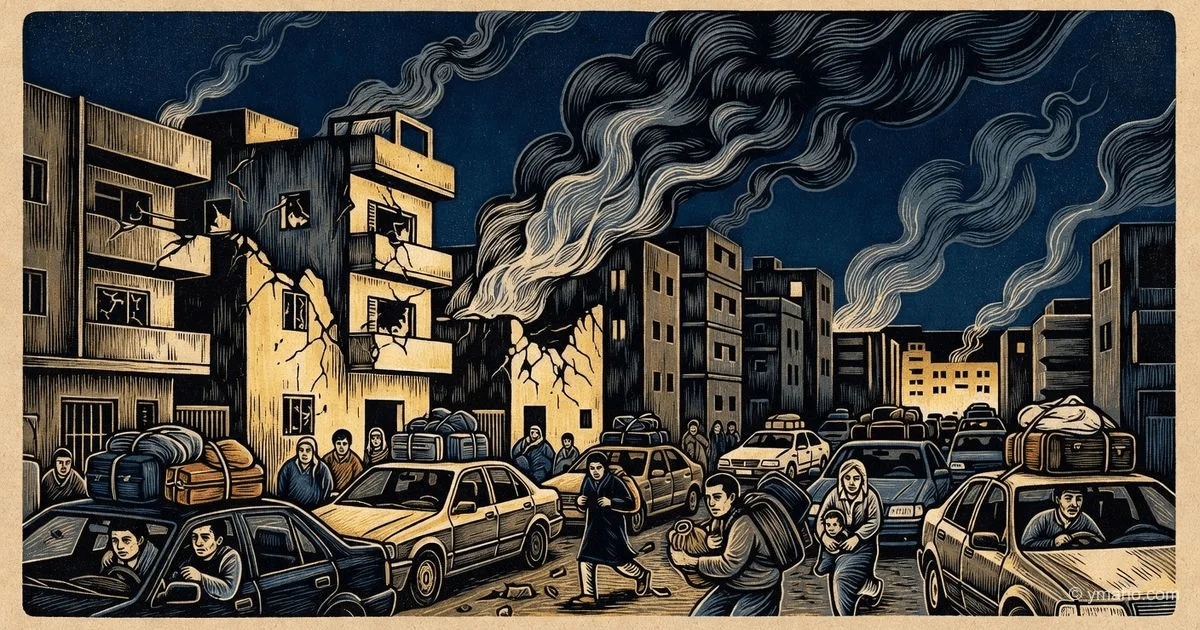
Thousands of residents of Beirut's southern suburbs flee their homes in panic. Families crammed into cars, loaded with suitcases and blankets, create multi-kilometer traffic jams on roads leading to the mountains. According to Israeli media, the strike was temporarily postponed after US intervention, but the threat remains.
June 2 (today): The Lebanese Embassy in Washington confirms that Hezbollah has agreed to a US-backed proposal for a mutual cessation of attacks. Under the agreement, Israel stops airstrikes on Beirut's southern suburbs in exchange for Hezbollah halting attacks on Israel. New indirect talks are scheduled for June 2-3. But Netanyahu has already made clear: the ground operation in southern Lebanon will continue.
Who Wins and Who Loses
Winner #1 — The Trump administration (short-term). Trump gets to claim a diplomatic victory. 'I achieved a ceasefire between Israel and Hezbollah' is a strong campaign talking point. Tellingly, Trump wrote on Truth Social: 'Let's see how long it lasts—hopefully FOREVER!' The capitalization of 'peace' as a political asset is obvious. But informed sources say Trump 'reacted sharply' to Netanyahu, accusing him of sabotaging talks with Iran. The coalition is cracking.
Winner #2 — Hezbollah and Iran. Hezbollah achieved its main goal: strikes on Beirut are halted (at least temporarily). This relieves pressure on its political wing and command centers in Dahieh. Moreover, Berri publicly states that Hezbollah is ready for a truce without demanding an immediate Israeli withdrawal from southern Lebanon. This allows Hezbollah to regroup and build up forces for subsequent attacks. Iran, in turn, gets a breather on the Lebanese front to focus on talks with the US over the Strait of Hormuz.
Loser #1 — Israel (strategically). Israel is cast as the 'bad guy.' Netanyahu is forced to back down from the threat of striking Beirut under US pressure. This demonstrates weakness and an inability to independently determine escalation. Meanwhile, the ground operation in southern Lebanon continues, meaning prolonged losses (one military doctor killed, seven soldiers wounded by Hezbollah drones on June 1 alone) without visible strategic results.
Loser #2 — Civilians on both sides. In Lebanon, since the escalation began (March 2), over 3,370 people have been killed, and over 1.2 million displaced. In Israel, 24 soldiers and 4 civilians have died, and tens of thousands of northern residents remain evacuated. Each day of the 'fragile truce' brings new casualties.
Loser #3 — European diplomats. While Trump (US) and Berri (Lebanon) negotiate directly, France, which tried to mediate and even called an emergency UN Security Council meeting, is sidelined. Europe is losing influence in the Middle East.
What the Media Isn't Saying
First non-obvious insight: Hezbollah does not control the situation on the ground as much as it wants to appear. US and Israeli officials publicly doubt that Berri (and the Hezbollah behind him) can truly guarantee a ceasefire from all field commanders. Hezbollah is not a monolith. Individual units in southern Lebanon may continue attacks for tactical reasons, even if ordered from above. This means the 'ceasefire' could be broken at any moment, not by Israel's fault.
Second insight (key for traders): The ceasefire agreement in Lebanon and the blockade of the Strait of Hormuz are two sides of the same coin. Iran directly linked its talks with the US on the nuclear program and reopening the strait to a ceasefire in Lebanon. As soon as Israel agreed (albeit under pressure) to stop strikes on Beirut, Trump immediately stated that talks with Iran are 'continuing at breakneck speed.' But tellingly, an hour earlier, Trump told CNBC that he 'doesn't care' if talks with Iran fail and that 'everything is getting boring.' Such a discrepancy in public statements in one day is a sign of chaos in the White House and a lack of a unified strategy.
Third insight: Hezbollah's statement of readiness for a truce is a cry for help, not an act of goodwill. The group's losses are enormous. The Israeli army captured the strategic Beaufort Castle, advanced to the Litani River, and continues to clear southern Lebanon. Hezbollah cannot stop the Israeli ground offensive with conventional means. The only way to preserve its remaining forces is to negotiate a ceasefire before it's too late. But Israel is not interested in such a truce because it is winning on the ground.
Forecast: Next 30 Days and 90 Days
Next 30 days (until July 2, 2026):
There will be no sustainable ceasefire. Formally, strikes on Beirut will stop (the US pushed this point). But Israel's ground operation in southern Lebanon will continue. Hezbollah will respond with rocket attacks and kamikaze drone strikes. The truce will turn into a 'war of attrition' with low intensity but regular casualties.
Key indicator for traders: The number of Israeli soldiers killed in southern Lebanon. If this figure continues to rise (already 24 dead), Netanyahu will face a domestic political crisis and will be forced either to escalate (strikes on Beirut) or negotiate a withdrawal.
Next 90 days (until end of August):
If by the end of summer Hezbollah cannot stop the Israeli ground advance, and Israel cannot achieve a military victory (unlikely in a guerrilla war), the sides will find themselves in a positional trap. The US will pressure Israel to agree to a full ceasefire in exchange for concessions on the Iranian nuclear deal. Trump needs peace by the elections. This is the most likely scenario: by August-September, a new, more sustainable truce will be signed, which, however, will not resolve fundamental contradictions.
For the oil market, this means the 'Lebanon premium' in Brent prices (roughly $5-7 per barrel) will persist, but sharp spikes above $115 are not expected unless Iran directly enters the war.
Editorial Forecast
Asset: Brent crude oil (futures) and Gold (XAU/USD)
Direction: Oil — sideways with a weak downward trend ($105-109). Gold — slight correction down ($2,320-2,350). The news of a possible ceasefire temporarily reduces the geopolitical premium, but the market is skeptical.
Key levels: Brent — resistance $110, support $105. Gold — resistance $2,370, support $2,320.
Confidence level: Medium (60%). Too many conflicting signals from Trump and Netanyahu. The market awaits first-hand confirmation.
Main risk to forecast: If Netanyahu does strike Beirut within the next 48 hours (despite the agreements), oil prices will surge to $115+, and gold will break $2,400. If the ceasefire holds and real talks with Iran begin, Brent could fall to $100 within 72 hours.
— Editorial Team