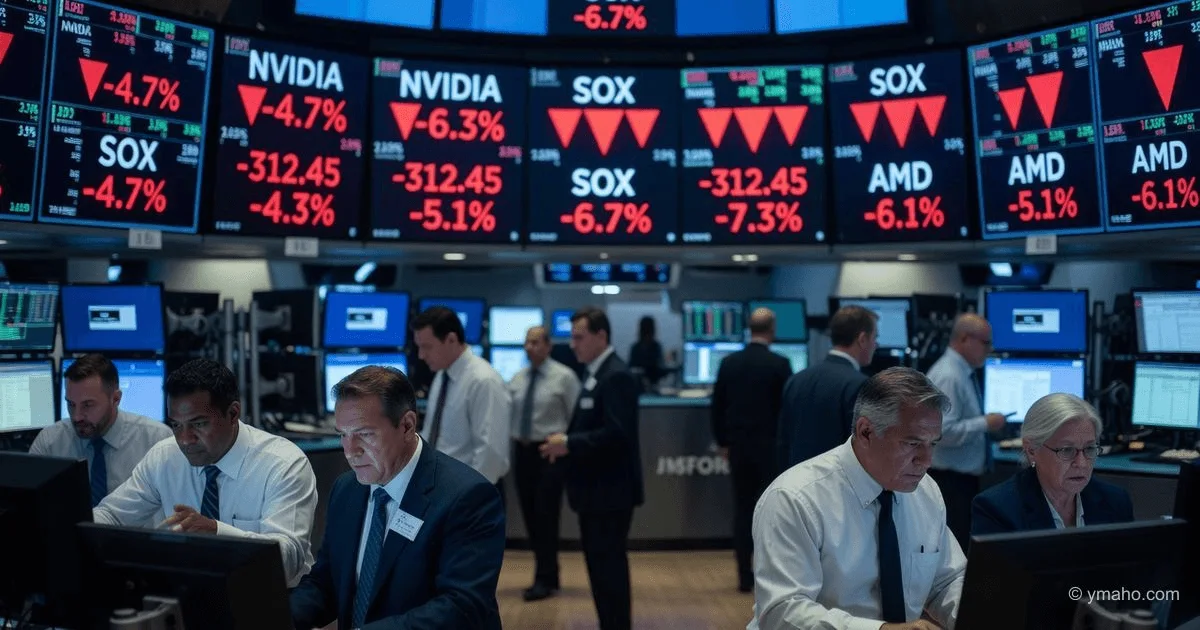
Massive Chip Sector Sell-Off Sends Nasdaq Lower as Investors Lock in Profits After Record Rally
Semiconductor and AI sector stocks came under pressure, dragging the Nasdaq down 0.24% to 25,297.62, while the S&P 500 slipped 0.05% to 7,354.02. The PHLX Semiconductor Index tumbled 5.3%, marking its worst week since April, amid growing doubts about the sustainability of the AI investment boom.
The AI narrative is cracking: why the market is punishing not chips, but the very idea of endless growth
The Core Issue: What's Really Happening
What we're witnessing in the semiconductor market isn't just profit-taking after a rally. It's a structural shift in how the AI investment cycle is perceived. The Nasdaq has fallen for five consecutive sessions, closing at 25,297.62 (-0.24%), while the PHLX Semiconductor Index plunged 5.3%, its worst week since April.
But let's dig deeper. The market isn't punishing semiconductors as a whole. It's punishing companies that can't clearly explain how their product fits into the next phase of AI development — the physical world. ON Semiconductor announced the acquisition of Synaptics for $7 billion, and ON shares cratered 24%. This is a classic reaction to a loss of focus: investors don't believe a company successful in power electronics can seamlessly integrate Edge AI platforms.
Compare this dynamic to what's happening in other sectors. While S&P 500 tech and communication services sectors are down over 5% for the week, Healthcare has surged 7%, and Utilities and Real Estate have each gained 3.5%. This isn't rotation — it's a flight. Institutional money is fleeing AI bets so fast that the S&P 500 has broken below its 50-day moving average for the first time since June.
Timeline and Context
The key moment came on June 25, when ON Semiconductor and Synaptics held a joint conference to announce the deal. On the surface, it's an attempt to create a leader in "intelligent systems" for physical AI: robotics, autonomous vehicles, industrial automation. Beneath the surface, it's an admission that the traditional component business has stopped growing.
| Metric | Value as of June 26 | Weekly Change |
|---|---|---|
| Nasdaq | 25,297.62 | -0.24% (5 sessions of decline) |
| S&P 500 | 7,354.02 | -0.05% |
| PHLX Semiconductor | 13,203.57 | -5.29% |
| Dow Jones | 51,876.11 | -0.09% |
| S&P 500 from YTD peak | — | -3.5% |
Data:
ON CEO Hassane El-Khoury tried to convince the market in a CNBC interview that the deal was a "$30 billion TAM expansion," not an attempt to catch a departing train. But the market heard something else. ON shares dropped 19% intraday, while Synaptics held steady — because the deal is paid for in ON stock. This is a classic signal: the buyer is overpaying, and the seller is getting "paper" that's losing value by the minute.
One overlooked detail: El-Khoury acknowledged the deal won't close until mid-2027. That means regulatory risks, especially in China, are enormous. Even though ON and Synaptics have no product overlap, Chinese regulators could use the deal as leverage in trade disputes. Eighteen months to close is an eternity in a world where the AI upgrade cycle is now measured in quarters.
Winners and Losers
The losers are obvious: ON Semiconductor shareholders, who lost nearly a quarter of the company's value in a single day. But that's just the tip of the iceberg. The real loser is the entire "AI will conquer all" narrative. When a company with a strong foundation in automotive and industrial power solutions (ON) pays $7 billion for an Edge AI chip maker, it signals that organic growth isn't enough.
Look at the Taiwanese market — it fell 4.07% in a single day to 44,571 points, with the tech index down nearly 7% for the week. This is a systemic correction, not a reversal of fundamental trends. But systemic corrections don't kill weak companies — they kill expensive ones. And semiconductors are the most expensive sector in the market.
The winners are those standing outside this race. Healthcare, Utilities, Real Estate — defensive sectors that are rising while tech bleeds. This tells us that large funds are shifting into assets with clear cash flows that don't require explanations about "physical AI."
What the Media Isn't Saying
Now for the non-obvious insight. ON's conference call reveals a detail no one is discussing: Synaptics built its Astra Edge AI platform around Google's Coral NPU. This means ON is essentially buying dependence on Google for a key product. In a world where Google itself hasn't settled on a long-term hardware AI strategy, that's a risk the market is pricing into the discount.
Second point: the transcript clearly states that $200 million in synergies will come from cutting SG&A — meaning administrative layoffs. No product synergies. This isn't a technology merger; it's a merger for scale and cost-cutting. That's exactly why the market reacted so negatively: the deal doesn't create new value, it just shuffles money around.
And third: Wall Street analysts have already started revising their models. Before June 25, no one had priced into ON the risk that the company would spend $7 billion on an acquisition that won't close for 18 months. Now they have to. That puts pressure on the entire sector of similar companies that might be tempted to pursue "strategic" deals to sustain growth.
Forecast: Next 30 and 90 Days
The seasonal pattern for the PHLX Semiconductor Index shows that June through October is the weakest period for the sector. This calculation accounts for the unusually strong 2025-2026 years. Remove that extreme period, and the seasonal weakness is even more pronounced. It's a statistical fact the market is now waking up to.
Over the next 30 days, we'll see further rotation out of tech into defensive sectors. The S&P 500 could test the 7,238 level (the June 9 low) — that's another 1.6% downside from current levels. But the key risk isn't the index itself — it's that the largest tech companies may start reconsidering their AI capital expenditures. If OpenAI delays its IPO, as sources report, that would trigger another wave of selling.
On a 90-day horizon, the picture changes. If ON and Synaptics can convince regulators and the deal looks realistic, the sector could recover some losses. But only if macroeconomic data cooperates. The Fed isn't cutting rates this year, and new tariffs take effect in July. That means any tech rebound will be capped.
Editorial Forecast
Asset: Nasdaq 100. Direction: moderate decline over the next 24-72 hours. Key level: 25,000 — a break below opens the door to 24,800. Confidence level: medium, as the market is oversold in the short term, but seasonal factors and a lack of positive triggers are weighing. Main risk: an unexpected statement from a major AI sector leader about maintaining or increasing CAPEX, which could trigger a speculative bounce.
The editorial opinion is for informational purposes only and does not constitute investment advice.
— Editorial Team