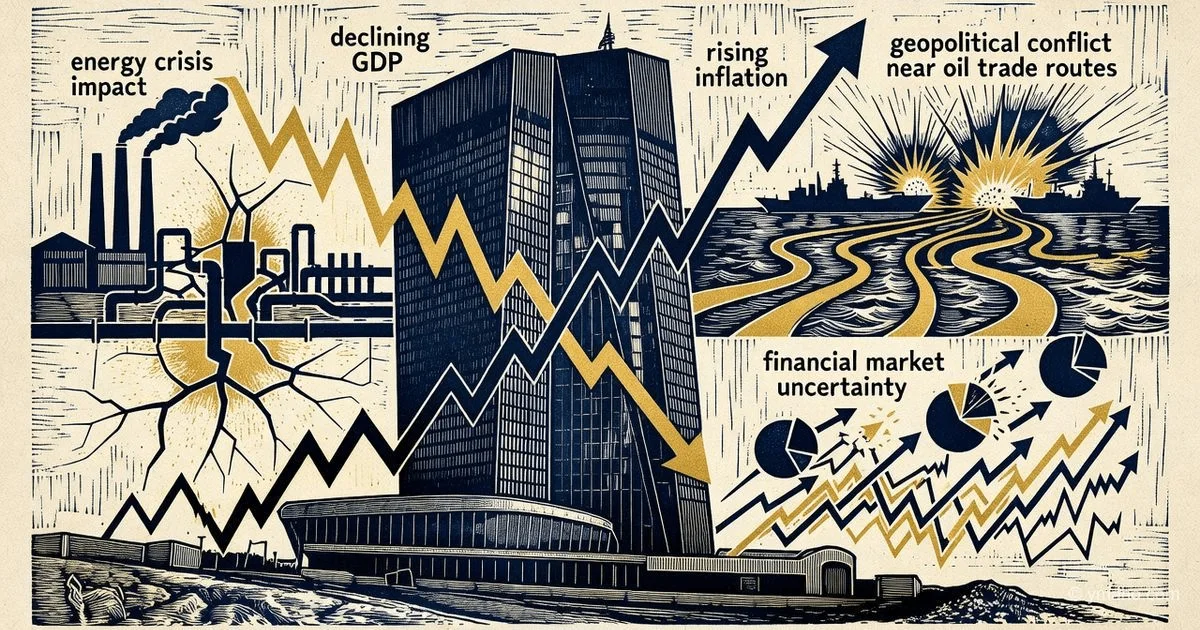
ECB Downgrades Eurozone Growth Forecasts Due to Energy Shock
According to the June Economic Bulletin, the eurozone GDP growth forecast for 2026 has been lowered to 0.8% due to the impact of the conflict on commodity markets, while the inflation forecast has been raised to 3.0%.
Stagflation as the New Mainstream: A Deep Dive into the June ECB Bulletin and Hidden Signals for Markets
An Insider's View: Why the Forecast Revision Isn't Just "Bad News" but a Fundamental Shift in Monetary Policy Paradigm That the News Isn't Talking About
[The Core]: What's Really Happening
The June Economic Bulletin from the European Central Bank, published on June 25, 2026, formally confirmed what had been whispered behind closed doors for weeks: the eurozone economy is entering a stagflationary phase. The GDP growth forecast for 2026 has been cut to 0.8% from March's 0.9%, and for 2027 to 1.2% from 1.3%. At the same time, the inflation forecast (HICP) for 2026 has been raised to 3.0% from 2.6%, and for 2027 to 2.3% from 2.0%.
At first glance, a 0.1 percentage point adjustment for growth and a 0.4 point adjustment for inflation seem minor. But that's a deceptive impression. The revision reflects not just a statistical margin of error, but a fundamental shift in assessing the consequences of the Middle East conflict. This isn't about a temporary shock but a structural change that upends all calculations.
The real essence of the bulletin isn't the numbers themselves, but that the ECB has publicly acknowledged for the first time: the energy shock has already begun feeding into core inflation. The forecast for inflation excluding energy and food (HICPX) has been raised to 2.5% for both 2026 and 2027. This means price growth is becoming a persistent, self-sustaining process, not just a consequence of volatile oil prices. And that changes everything.
Timeline and Context
The key date is June 11, 2026, when the ECB raised key interest rates by 25 basis points at its meeting. But the decision itself was prepared against a backdrop of dramatic events: the war in the Middle East, the closure of the Strait of Hormuz for 103 days, and energy price growth of more than 10% year-on-year.
| Indicator | March 2026 (Forecast) | June 2026 (Forecast) | Change |
|---|---|---|---|
| Eurozone GDP Growth 2026 | 0.9% | 0.8% | -0.1 pp |
| Eurozone GDP Growth 2027 | 1.3% | 1.2% | -0.1 pp |
| Inflation (HICP) 2026 | 2.6% | 3.0% | +0.4 pp |
| Inflation (HICP) 2027 | 2.0% | 2.3% | +0.3 pp |
| Core Inflation 2026 | 2.3% | 2.5% | +0.2 pp |
| Core Inflation 2027 | 2.2% | 2.5% | +0.3 pp |
| Deposit Facility Rate | 2.00% (pre-decision) | 2.25% (post-June 11) | +0.25 pp |
Source: Eurosystem staff macroeconomic projections, June 2026
It's important to understand the timeline: the ECB raised rates before the bulletin was published. So the bulletin wasn't the cause of the decision — it was the post-factum justification. But more importantly, the bulletin includes alternative scenarios showing that even in a "favorable" scenario (rapid normalization of oil prices), inflation in 2027 only temporarily dips below the target level.
In the "adverse" scenario (persistently high energy prices), inflation reaches 5.3% in 2027, and GDP growth falls to 0.4%. This is no longer just stagflation but a full-blown crisis. By publishing these figures, the ECB is effectively telling markets: "We're preparing for the worst, and our policy will align with that scenario."
Who Wins and Who Loses
In classical economics, slow growth and high inflation are a loss for everyone. But in reality, there are always beneficiaries.
Winner #1 — Commodity exporters outside the eurozone. Norway, Saudi Arabia, the UAE — their oil and gas export revenues remain high despite falling volumes. But for the eurozone, this is a pure negative: expensive energy means a transfer of wealth outside the region.
Winner #2 — Companies in the defense and energy transition sectors. The ECB specifically notes in the bulletin that "investment is supported by government spending on defense and infrastructure." This is a clear signal: even under stagflation, there are sectors where money will flow. German defense contractors, renewable energy equipment manufacturers — they will grow amid stagnation in the rest of the economy.
Biggest loser — the consumer. Real disposable incomes are falling due to rising energy prices, while wage growth, according to the ECB, is slowing. The bulletin notes that "services inflation rose to 3.5%." This means services that cannot be imported (restaurants, hairdressers, transport) are getting more expensive faster than goods, hitting all segments of the population.
Second major loser — Italian government bonds (BTPs). With rising rates and a worsening economic outlook, the spread between BTPs and German Bunds will widen. For Italy, with its debt at around 140% of GDP, this means billions of euros more in annual debt servicing costs. The ECB effectively acknowledges this risk in the bulletin, calling for "maintaining the sustainability of public finances" and pursuing "temporary, targeted, and individualized" fiscal policy. Translation: "Don't expect us to bail out your debts with low rates."
Unlikely loser — the tech sector. In March, the ECB expected AI investments to support growth. In the June bulletin, that optimism remained but on the periphery. High energy costs and expensive credit make capital-intensive technology investments less attractive. AI startups that haven't reached profitability will face challenges raising funds in a rising rate environment.
What the Media Isn't Saying
The main unspoken fact of the ECB bulletin is the admission that monetary policy is powerless against structural supply shocks. Raising rates doesn't create more oil. It doesn't open the Strait of Hormuz. It only tries to suppress demand to lower inflation at the cost of economic growth.
Insight #1: The ECB is consciously choosing recession to stop inflation expectations. The bulletin directly states that "short-term inflation expectations have risen significantly." For a central bank, this is the main enemy. If people believe in high inflation, they start acting accordingly — demanding wage increases, accelerating purchases. This creates an inflationary spiral. The ECB is willing to slow the economy to zero just to break those expectations.
Insight #2: The alternative scenarios in the bulletin are not an academic exercise but a political signal. In the "severe scenario," inflation reaches 5.3% in 2027, and growth falls to 0.4%. The ECB publishes these figures to prepare markets for the possibility of maintaining tight policy for an extended period. This isn't a forecast but a warning: "Even in the worst case, we won't back down from the 2% target."
Insight #3: The ECB hints at the need for fiscal support — but with high debt, it's impossible. The bulletin contains an important phrase: "It is imperative to strengthen the eurozone economy while maintaining sustainable public finances." This is a diplomatic way of telling member states: "We've done our part (raised rates). Now it's your turn — stimulate the economy through budget spending. But don't increase debt, because that would create risks for financial stability." This is a logical contradiction, and the ECB knows it.
Forecast: Next 30 Days and 90 Days
Next 30 days (July 2026): The key factor is the June inflation data, to be released on July 1. The ECB forecast is 3.0% annually, but the peak is expected in the third quarter at 3.4%. If actual inflation comes in above the forecast, markets will start pricing in another rate hike at the September meeting. Markets currently estimate this probability at around 50%. I'd put it higher — around 60-65%, given the hawkish rhetoric from Schnabel and the forecast revision in the bulletin.
90 days (September-October 2026): The ECB meeting on September 10 will be crucial. By then, it will be clear how quickly the Strait of Hormuz is reopening and how sustainable the drop in oil prices is. The ECB's baseline scenario assumes oil will decline in line with futures. If that happens and economic data shows further deterioration, the ECB may pause. But if core inflation remains at 2.5%+, another 25 basis point hike is inevitable. The deposit facility rate will reach 2.50% by year-end.
Long-term — by 2028, the growth forecast is 1.5%, inflation at 2.0%. But that's under a relatively peaceful scenario. Any escalation in the Middle East will throw these forecasts out. The ECB itself acknowledges that "the outlook remains highly uncertain."
Editorial Forecast
In the next 72 hours following the bulletin's release and Lagarde's statements to the European Parliament, the EUR/USD pair will remain under pressure due to the divergence in economic prospects between the US and the eurozone: weak growth in Europe versus a relatively resilient US economy. Key resistance level is 1.1050, support at 1.0850. Confidence is moderate; the main risk is an unexpected drop in eurozone inflation or, conversely, an escalation of the conflict that could sharply alter rate expectations. This is the editorial opinion, not an investment recommendation.
— Editorial Team