AI Talent Shortage and SpaceX-Tesla Announcement: Key Events in the M&A and IPO Market
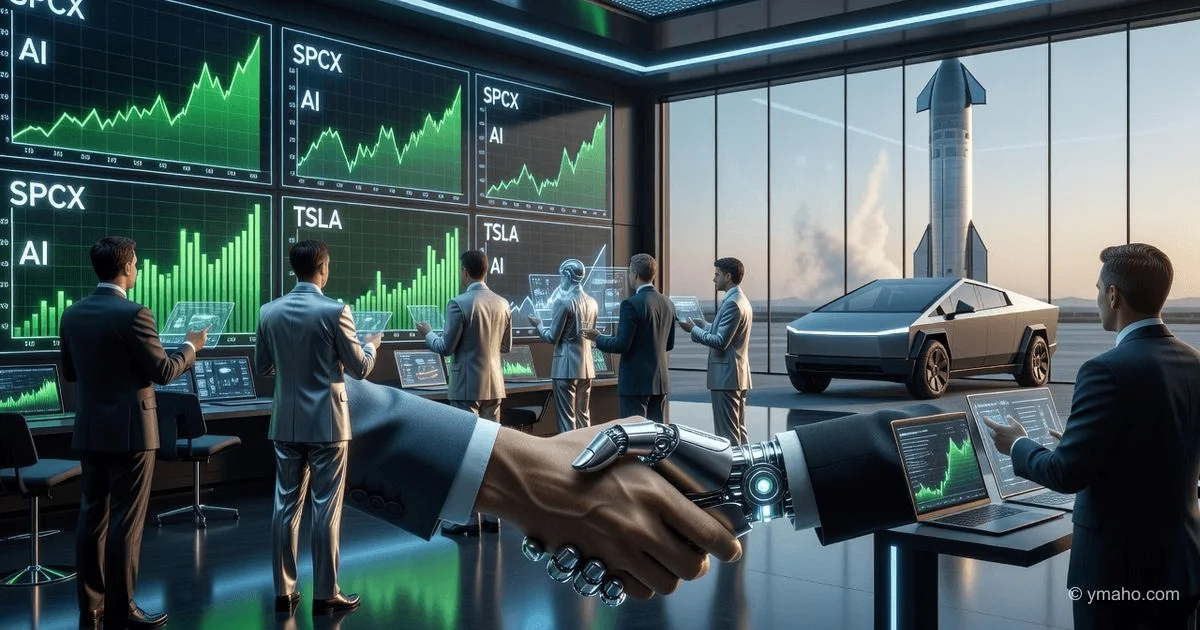
SpaceX successfully listed on Nasdaq with a valuation of approximately $1.8 trillion, and the company's president hinted at a possible merger with Tesla in the near future. Against this backdrop, analysts expect a wave of mega-IPOs, including Anthropic and OpenAI, which is also reviving interest in SPAC deals as an alternative path to the public market for smaller companies.
Analytical Review: The 2026 IPO Boom — Why SpaceX, OpenAI, and Anthropic Are Going Public Simultaneously and What It Means for Investors
[The Gist]: What's Really Happening
On June 12, 2026, SpaceX made its historic debut on Nasdaq, conducting the largest IPO in world history. The company placed over 555 million shares at $135 per share, raising more than $75 billion. Including an option for an additional 83 million shares, the total raise could exceed $86 billion, more than double the previous record set by Saudi Aramco in 2019 ($29.4 billion). SpaceX's valuation reached approximately $1.8 trillion, placing it among the top 10 largest US public corporations — ahead of Tesla, Meta, and Walmart.
But this is just the tip of the iceberg. Within weeks before and after SpaceX's listing, Anthropic (valuation $965 billion) and OpenAI (valuation $852 billion) filed for IPOs. All three companies are highly likely to go public with valuations exceeding $1 trillion, creating an unprecedented concentration of mega-IPOs in one sector and within the same time window.
This is not just a coincidence. The US stock market is in a state where the S&P 500 trades at a P/E multiple of around 22, and the Nasdaq-100 at over 26, significantly above historical averages (mid-to-high teens). The cyclically adjusted P/E (CAPE) has reached 42.7 — the highest level since the dot-com bubble. Venture investors and founders understand that the window of opportunity for exiting at maximum valuation could close at any moment.
A non-obvious insight that most analysts miss: SpaceX's IPO was not just a "listing" — it was a structural reorganization of the entire Musk empire. A few months before the listing, SpaceX absorbed xAI (including Grok and the social platform X), effectively transforming from a rocket-and-satellite company into an AI conglomerate with a space division. This means investors are not just buying "rockets and Starlink," but a bet on a vertically integrated AI ecosystem where data from X, computing power from xAI, and Starlink infrastructure work in a unified cycle.
Timeline and Context
| Date | Event | Significance |
|---|---|---|
| May 2025 | Cerebras Systems IPO at $5.6 billion | First major AI IPO of the current cycle, warming up the market |
| May 27, 2026 | CNBC reports possible Tesla and SpaceX merger | Speculation goes public |
| June 1, 2026 | Anthropic files confidential IPO application | AI giants race for public status begins |
| June 8, 2026 | OpenAI files IPO application | Battle of titans enters final stretch |
| June 11, 2026 | SpaceX announces IPO price — $135 per share | Valuation $1.8 trillion, record demand |
| June 12, 2026 | SpaceX begins trading on Nasdaq (ticker SPCX) | Largest IPO in history, oversubscribed 4+ times |
| June 12, 2026 | Gwynne Shotwell hints at possible merger with Tesla | Mentions synergy and simplifying Musk's life |
Why are all three companies going public simultaneously? The answer lies in the history of IPO bubbles. In 1986-1987, a surge in IPOs preceded Black Monday. In 1999-2000, the IPO peak signaled the dot-com crash. In 2020-2021, a record number of IPOs (including the SPAC boom) turned into the 2022 bear market. Management teams see this historical pattern and are rushing to exit while markets are willing to pay 110 times annual revenue for a company with no net profit (SpaceX).
Who Wins and Who Loses
Winners #1: Founders and early investors of SpaceX. The IPO will create thousands of new millionaires and several billionaires among current and former employees. Musk becomes the world's first trillionaire — his stake in SpaceX (42% equity and about 82% voting rights) at a $1.8 trillion valuation secures this status.
Winners #2: Retail investors gaining direct access to AI stocks. Previously, investments in OpenAI and Anthropic were only available through closed-end funds like Ark Venture Fund (holds both companies) or Destiny Tech100 (18.1% in Anthropic, 5.8% in OpenAI). Now, shares can be bought directly through a brokerage account, significantly expanding the investment universe in the AI sector.
Winners #3: SPAC sponsors and companies considering alternative exit paths. In Q1 2026, 62 SPACs went public, raising $13.2 billion — nearly a fourfold increase from the same period in 2025. Companies like Terra Quantum (quantum computing, valuation $3.25 billion) and Miotal (strategic metals, $10 billion) have already signed SPAC deals, capitalizing on the window of high demand for tech assets.
Losers #1: Shareholders of existing tech giants. Microsoft, Alphabet, Amazon, and Nvidia, which hold stakes in OpenAI and Anthropic, will see their "indirect AI access" premium diluted. Investors will no longer pay a premium for these companies as AI proxies when they can buy the model developers directly.
Losers #2: Emerging markets and small tech companies. The massive IPO volume — SpaceX alone raised $75 billion, OpenAI and Anthropic likely another $100+ billion — sucks liquidity from other segments. Capital concentrates in the largest deals, leaving small and mid-sized companies unfunded.
Uncertainty: Tesla shareholders in case of a merger. If the SpaceX-Tesla merger happens (prediction market Kalshi estimates 49% probability by May 2027, Wedbush estimates 80-90%), valuation will be extremely complex. SpaceX at $2.2 trillion vs. Tesla at $1.5 trillion, with Tesla having profit ($5.8 billion in 2025) and SpaceX a loss of $4.9 billion. How to merge companies with a P/S multiple of 110 vs. 14.6 for Tesla is a puzzle that will determine which shareholders win and which lose.
What the Media Isn't Saying
First: SpaceX is not a "rocket company" but a financial instrument for betting on Musk. In reality, SpaceX is a conglomerate including commercial spaceflight (revenue $18.7 billion in 2025, loss $657 million), Starlink ($11.4 billion revenue, profit $4.4 billion), and xAI (loss $6.4 billion). Investors pay 110 times annual revenue for a business that loses nearly $5 billion a year, hoping Musk will deliver "science fiction promises" — from data centers in space to colonies on Mars. Goldman Sachs forecasts negative free cash flow for SpaceX of $105 billion by 2029. The market ignores these numbers, betting on the personality.
Second: The IPO boom is a bear market signal, but not an immediate trigger. Historical pattern: a surge in IPOs always precedes a correction, but with a 12-24 month lag. In 1987, Black Monday came a year after the IPO peak. In 2000, the dot-com crash came 1.5 years later. In 2022, the bear market came 12 months after the SPAC boom peak. The current surge likely means the market is in the final phase of the cycle, but investors should not flee stocks right now — historically, the correction comes with a delay.
Third: The SPAC market is reviving, but it's "SPAC 4.0," not "SPAC 2.0". Unlike the 2021 boom, when any company with a big name went public via SPAC (and many went bankrupt, including WeWork, Nikola, 23andMe), the current cycle is disciplined. In Q1 2026, 62 SPACs went public — a significant number, but these are mostly deals with experienced sponsors and specific industry focuses, such as AI infrastructure and Israeli technology. The quality of targets is higher, and the "pop" on IPO day is stable around 0.2-0.5% instead of 20-50% in 2021. This indicates a more mature market, not a repeat of old mistakes.
Forecast: Next 30 Days and 90 Days
30 days (through end of July 2026): SpaceX (ticker SPCX) will remain in the spotlight. Volatility is possible in the range of 10-15% from the offering price of $135, as investors digest financials (loss of $4.9 billion in 2025) and compare with competitor valuations. OpenAI and Anthropic will likely file public versions of their S-1s in the coming weeks, sparking additional interest in the sector. Tesla (TSLA) shares will be under pressure amid merger speculation — Tesla shareholders may fear dilution if the deal closes on unfavorable terms.
90 days (through end of September 2026): A more important signal is how the IPOs of SpaceX, OpenAI, and Anthropic affect the rest of the market. If all three show strong post-listing growth (above $150-160 for SPCX), it could trigger a new wave of IPOs from smaller AI companies and intensify overheating in the sector. If SPCX starts declining toward $120-125, it would signal "cooling" and could accelerate a correction in the broad market, especially in tech. Historical precedent: Facebook's IPO in 2012 (flop in the first months) cooled the market for a year; Uber's IPO in 2019 (weak start) was one of the signals of the 2020 bear market.
Editorial Forecast
**Asset: SpaceX shares (SPCX). Direction: moderately negative in the short term. Target: $125–$130 per share in the next 24–72 hours. Confidence level: high. Main risk: the IPO was oversubscribed more than four times, and post-listing corrections often occur in the first weeks as institutional investors lock in profits. The lack of net profit and a multiple of over 110 times annual revenue make the shares vulnerable to any negative macroeconomic signal. We recommend caution in the first weeks of trading — historically, the largest IPOs (Saudi Aramco, Alibaba) corrected by 5-15% within a month after listing before finding long-term support levels.
— Editorial Team