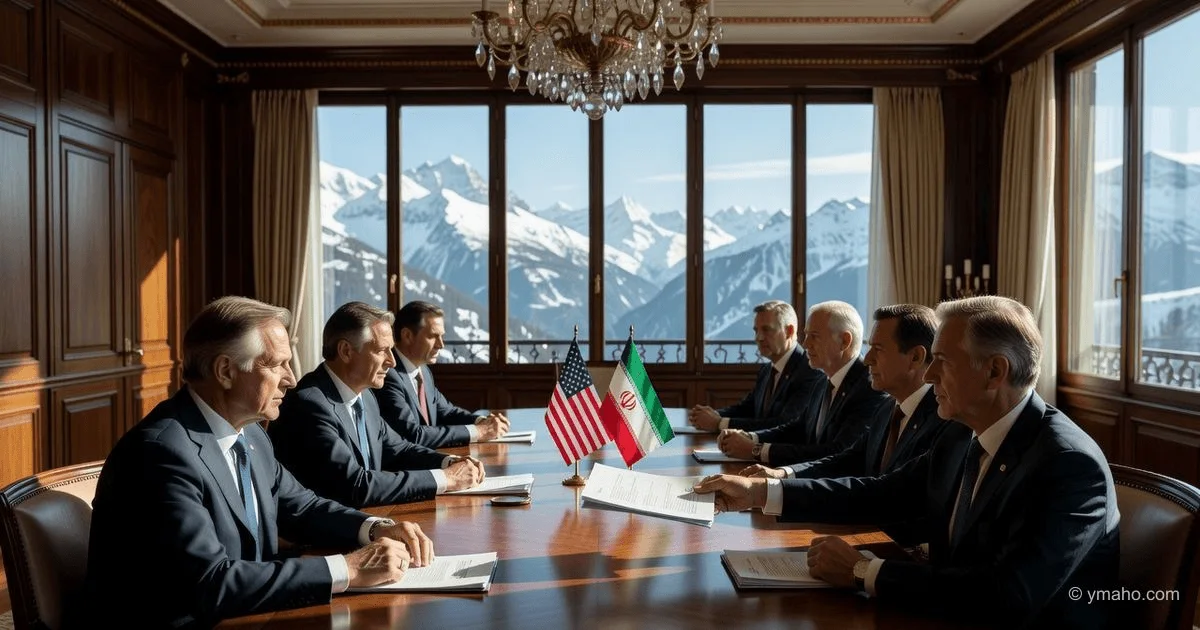
US and Iran Complete First Round of Talks in Switzerland, Agree on Roadmap
With Qatar and Pakistan mediating, the parties agreed on a 60-day plan to reach a final agreement, a ceasefire mechanism in Lebanon, and a communication line for safe passage of ships through the Strait of Hormuz.
Analytical Review: A Jackpot for Iran and an Oil Shock in Reverse
The Gist: What's Really Happening
Markets are wrong to focus on "peace." In reality, the US has just lost the information and economic war to Iran, and this will change the rules of the game in energy markets for years to come. The memorandum, remotely signed by Trump and Pezeshkian, is not just another truce. It is a US capitulation on all key points that Trump himself called "red lines" just a few months ago.
Bloomberg aptly called it a "breakthrough through its own red lines." Trump allowed Iran to enrich uranium, maintain its missile program, and returned frozen assets—exactly what he criticized Obama for and called "the worst deal in history." Federal Reserve Chairman Kevin Warsh has already hinted: rates will rise to curb inflation, even if it means a recession. And Iran just got $300 billion for reconstruction, the lifting of the blockade, and a green light to export 1.5 million barrels per day.
The oil market reacted instantly: Brent fell to $78.89 per barrel, though it had risen to $82.30 before the talks began. But this is just the tip of the iceberg. The real moves will begin when traders realize the scale of the paradigm shift.
Timeline and Context
Understanding the current moment requires a timeline. It all started with the signing of the 14-point "Islamabad Memorandum" on June 17, when Trump and Pezeshkian electronically signed a framework agreement. Oil had already crashed 8% in a week.
Events then unfolded dramatically:
- June 20: Iran closes the Strait of Hormuz again in response to Israeli strikes on Lebanon. Maritime traffic drops from 26 to 5 ships per day.
- June 21: Trump threatens: "If you close the Strait of Hormuz, nothing will be left of your country." The Iranian delegation leaves the negotiating room in protest, with exchanges continuing through mediators.
- June 22 (early morning): An agreement is reached on a 60-day roadmap, a communication line for the Strait of Hormuz, and a ceasefire mechanism in Lebanon.
Why is this important? Iran has demonstrated that it can shut down the world's energy artery at any moment and get not bombs but $300 billion in return. This creates moral hazard on a historic scale. According to Kpler analysts, 25 million barrels of Iranian oil have already passed through the virtual blockade line since last Monday. China, the largest buyer, has cut imports by a third, but its storage is full. The question: when will they start buying again?
Who Wins and Who Loses
Iran wins—and that's no exaggeration. Tehran gets immediate export licenses, removal of banking restrictions, $300 billion for reconstruction, and, most importantly, legitimization of its nuclear program. As analyst Nicoles Grajewski from Sciences Po noted, "the memorandum gives Iran disproportionately more immediate benefits." Now Iran knows: the threat of closing the strait works better than the nuclear program.
China wins—it can buy Iranian oil at a discount, using its full storage as leverage on price. Don't expect a sharp spike in Chinese imports: their tanks are at maximum capacity, and Beijing won't rush purchases to avoid pushing prices up.
The US loses—strategically. Trump has given up ground on all fronts. As former State Department advisor Christian Whiton stated: "This validates much of what Trump criticized Obama for." The US has lost leverage, and any new escalation will cost it even more.
The Gulf states lose—they will have to finance $300 billion of Iran's reconstruction. The Saudis and UAE are effectively paying for the rebuilding of their main regional enemy.
Israel remains a loser—it is not a party to the agreement, and Netanyahu has said he does not feel bound by its terms, maintaining a buffer zone in Lebanon.
What the Media Isn't Saying
The key insight missing from the news: this is not peace, but a regrouping for a larger confrontation in 60 days.
Note point 5 of the memorandum: "free passage of commercial vessels for 60 days." After that, Trump has already threatened that the US may impose its own fee for passage if a peace agreement is not reached. In effect, the parties have agreed that in two months they will either sign a permanent peace or return to blockades and tariffs.
The second hidden risk: the infrastructure of the Strait of Hormuz. According to US military data, on June 21, 55 ships carrying 17 million barrels of oil passed through the strait. But 25 million barrels of Iranian oil have already accumulated in the region awaiting export. Once export licenses are fully processed, this volume will flood the market, creating a surplus of 1.5 million barrels per day.
The third insight concerns the Fed. Warsh took a hawkish stance at his first meeting, and rate forecasts for 2026 were raised to 3.8%. At the same time, falling oil reduces inflationary pressure and gives the Fed more room to maneuver. Markets have not yet priced this in.
Forecast: Next 30 Days and 90 Days
30 days: Technical talks in Bürgenstock this week will be key. Markets will closely watch details on sanctions relief and nuclear inspections. Brent will trade in the $76-82 range, but with high volatility. Gold, which recently exceeded $4,220 per ounce, will price in lower geopolitical risk and the Fed's hawkish stance. We expect a correction to $4,000-4,100.
90 days: If a final agreement is signed, we will see Iranian oil return to the market in full—1.5 million barrels per day on top of current levels. This could push Brent to $70-72. But there is a "black swan": if Netanyahu decides to act alone in Lebanon and Iran closes the strait again (now as leverage), prices could soar to $100+. Remember: Iran now knows the value of this threat.
Editorial Forecast
Asset: Brent (crude oil). Direction: Down to $76-77 in the next 24-72 hours. Key levels: Support—$76, resistance—$80. Confidence: High—a decline of more than 2% has already been recorded after the announcement of the end of talks. Risk: Sudden resumption of hostilities in Lebanon or a new closure of the strait by Iran—then a reversal to $83+. Monitor Israeli statements and maritime traffic data through the Strait of Hormuz.
— Editorial Team