Nvidia Shares Lead S&P 500 Rally as Semiconductor Index Hits Record High
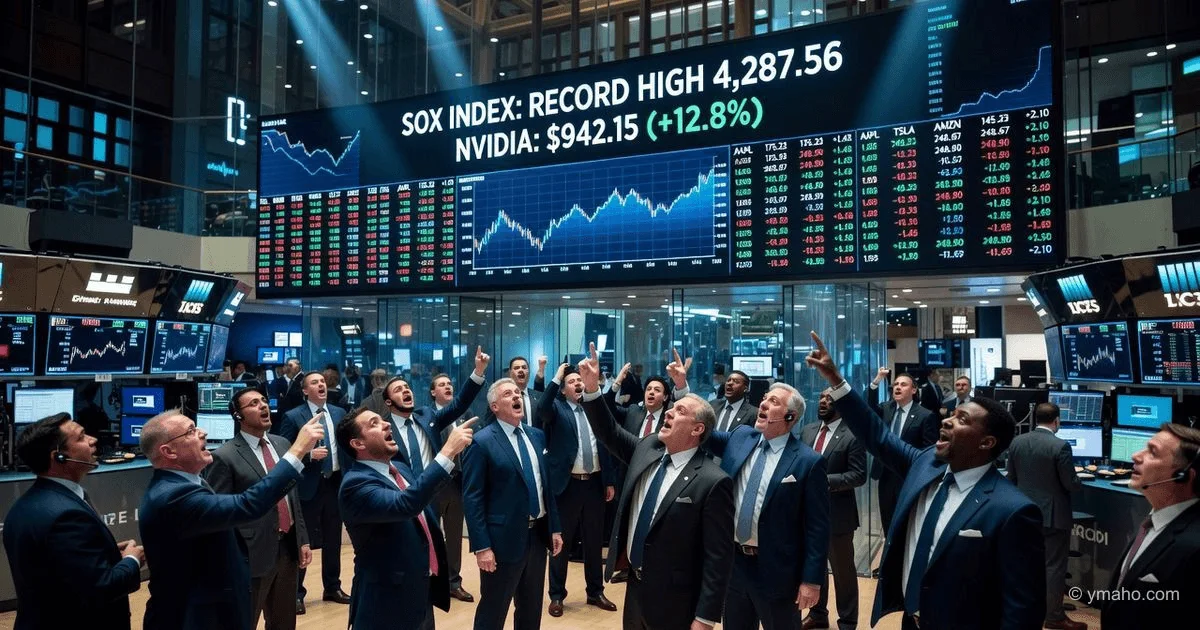
The Philadelphia Semiconductor Index (SOX) surged more than 6%, reaching a record high. Nvidia Corp shares led the S&P 500, which gained 1%, while the Nasdaq 100 rose 2.2%.
Good night. Turn off the morning news feeds and forget about fear and greed indicators. If you're still staring at the daily S&P 500 charts, trying to call the top of this rally, you're missing the big picture. What we've witnessed on U.S. exchanges over the past 48 hours is not just another tech sector bounce. It's a tectonic shift in the structure of global capital markets. When the Philadelphia Semiconductor Index (SOX) breaks through 14,000 points and sets an all-time record with a daily gain of over 6%, and Nvidia becomes the world's most valuable company with a market cap approaching $6 trillion, the market is sending a signal that cannot be ignored.
A tectonic shift is underway: AI is no longer a topic for garage startups. AI infrastructure budgets have moved from pilot projects to "mission-critical spending" for Fortune 500 corporations. Every major cloud provider is expanding CAPEX plans. Demand for HBM memory from Nvidia, Microsoft, and Google is so high that, according to reports, SK Hynix has already fully reserved its HBM capacity for 2026. This is not a speculative bubble—it's a classic supply shortage that is rewriting the balance sheets and financial models of semiconductor giants.
But if you think you can just buy Nvidia and sleep soundly, you're wrong. In today's analysis, I'll break down the mechanics of the move, show who is really making money on this rally and who is being left behind, and explain what happens when this wave of money reaches the next level.
[The Core]: What's Really Happening
The market is at the epicenter of structural demand driven by the AI arms race. The sustainability of this rally is currently supported by money from the largest corporations, which are essentially competing for computing power as a strategic resource. This is no longer a story about expectations—it's a story about real contracts, production capacity shortages, and a re-rating of multiples for the hardware sector.
Key figures from the last 24 hours:
- Philadelphia Semiconductor Index (SOX): Up more than 6% to an all-time high.
- Nasdaq 100: Gained 2.2% on Thursday, showing outperformance.
- AMD: Shares up more than 130% year-to-date, briefly surpassing $558 and reaching a market cap of over $900 billion.
- NVIDIA: Market cap exceeded $5.7 trillion; shares show steady growth even amid news about competitors.
Note this detail: the market ignored direct competition. When AMD announced Ryzen AI Halo, which is cheaper and 14% faster than Nvidia's solution (DGX Spark) on some metrics, Nvidia shares still rose 4%. This is a classic sign that the pie is growing faster than it is being divided. Players understand that on-device AI will not replace cloud infrastructure but complement it, creating a new wave of demand for next-generation chips.
Timeline and Context
To understand the anomaly of what's happening, look at the SOX chart over the past 14 months. During this period, the index has risen more than 230%. In market history, such moves have been seen only twice: during the dot-com bubble (1998–2000) and now. But the difference with the current rally is that it is underpinned not by a paper internet boom but by real profits from the largest manufacturers.
| Period | Key Event | SOX Performance | Market Behavior |
|---|---|---|---|
| 14 months ago | Start of AI capex race | Baseline (100% assumed) | Rise on expectations |
| Early June 2026 | 10.26% drop in one day | Pullback to 13,000 | Profit-taking, fear of overheating |
| June 15, 2026 | US-Iran peace deal | Surge of 5.45% (close at 14,099) | Risk-on rally, lower oil prices |
| June 18, 2026 | Chip rally continues | +6.4% (New record) | Technical breakout, short squeeze |
The key catalyst for the sharp upward move was not just inflation data but also geopolitical détente. The signing of a temporary peace agreement with Iran and the reopening of the Strait of Hormuz sent WTI crude oil down about 3% to $74 per barrel. This instantly lowered inflation expectations and allowed the Fed (even with hawkish signals from new Chair Kevin Warsh) to keep the oxygen flowing to risk assets.
Who Wins and Who Loses
Winners: Shareholders of the "Big Three" (Nvidia, AMD, Broadcom) and memory manufacturers (Micron, SK Hynix, Samsung). Samsung and SK Hynix have shown YTD gains of over 114% and 186%, respectively. Notably, Broadcom's rise is driven not only by AI networking but also by custom chip (ASIC) deals that major cloud providers are starting to order to reduce dependence on Nvidia. Goldman Sachs, which is underwriting the SpaceX IPO and earning hundreds of millions in fees, is also a winner—its shares hit an all-time high.
Relative losers: Traditional consumer sectors and companies dependent on cyclical demand. Kroger shares fell 6.2% due to a weak outlook, and Accenture plunged 17%, showing that investor money is now flowing exclusively into the AI growth story at the expense of traditional retail and consulting. Even Apple, which benefits from its deal with Intel, is forced to raise product prices due to higher memory and chip costs. This means inflationary pressure is ultimately passed on to consumers, which could dampen demand in the future.
What the Media Isn't Saying
The media reports on the rise but overlooks the cash flow. This rally is financed not so much by retail investors as by forced rebalancing of the largest funds. The SOX index has risen so quickly that its weight in benchmark indices (S&P 500, MSCI World) has exceeded allowable limits.
Managers of passive and quantitative funds are now forced to buy more semiconductor stocks, even if their internal models say they are overbought, simply to avoid tracking error. This creates a self-fulfilling prophecy: the higher SOX rises, the more money automatically flows into the same Nvidia and AMD shares, driving them even higher. This is what we have seen in recent sessions, where even without clear fundamental news, shares continued to hit new highs.
Forecast: Next 30 Days and 90 Days
Next 30 days: Expect high volatility but with an upward trend. The market will be jittery on news about TSMC orders, but the fundamental driver (HBM and computing capacity shortage) will not disappear. A 5-7% correction is possible, but it will be bought by investors who missed the previous rally.
90 days: A bifurcation scenario. Shares of companies with real access to production and HBM contracts (Nvidia, AMD, Broadcom, TSMC) will continue to rise, outperforming indices. However, second-tier companies trying to slap on an "AI label" will start to lag. Q3 2026 earnings reports will be a filter: if you don't show real AI revenue growth, the market will punish you harshly, as it did Accenture.
Editorial Forecast
Based on current data and order flow structure, we expect short-term consolidation of the Nasdaq index at current levels before the next leg up. However, AMD (AMD) shares look like the most volatile instrument for trading in the next 72 hours: after the surge to $558 and record market cap, a pullback to the $520 level is possible to close local gaps if no new positive news on Microsoft orders emerges. Confidence level is medium, as the market is entirely dependent on sentiment from large hedge funds locking in quarterly profits. The main risk is an unexpected Fed announcement of more aggressive liquidity tightening, which could instantly cool the appetite for expensive growth stocks.
— Editorial Team