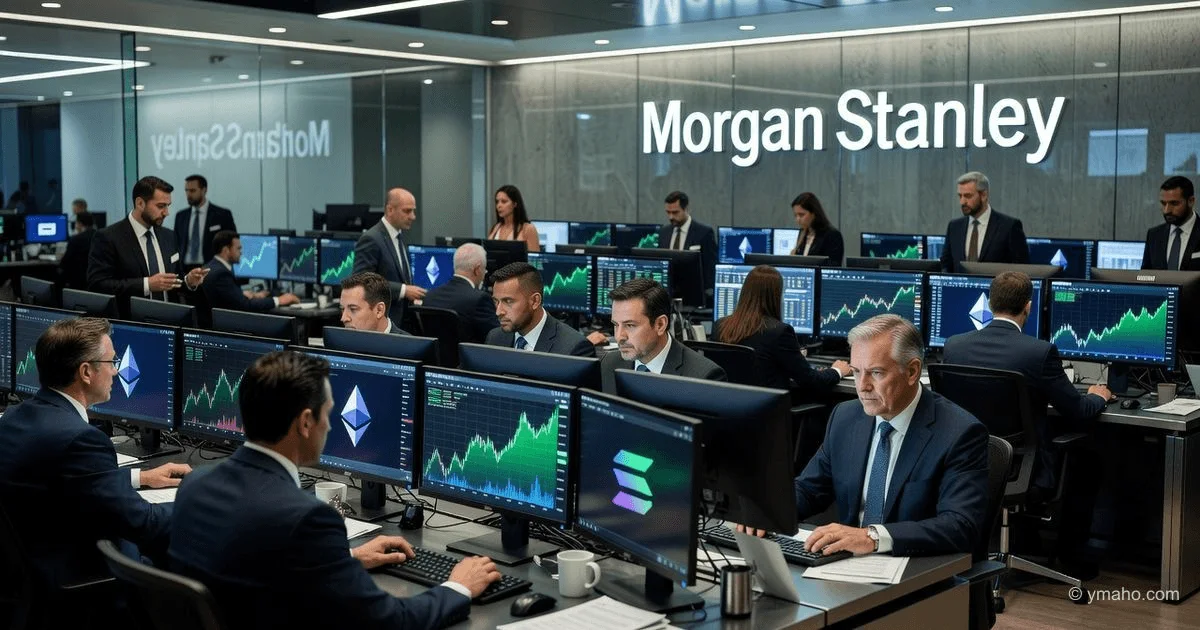
Morgan Stanley Files for Cheapest Ethereum and Solana ETFs with 0.14% Fee
The investment giant filed updated S-1 registration statements with the SEC for ETFs based on Ethereum and Solana, setting a sponsor fee of 0.14%, lower than competitors. The funds also plan to stake assets, returning 95% of rewards to investors.
Fee Dumping and Staking Revolution: How Morgan Stanley Is Changing the Rules in the Crypto ETF Market
The Core: What's Really Happening
On June 18, 2026, Morgan Stanley filed its second amended S-1 registration statements with the SEC for spot ETFs on Ethereum and Solana. Formally, this is a technical step—making clarifications to documents originally submitted back in January. But informally, it's a signal to the market: Wall Street is entering the game in a big way, and it intends to win clients not by brand but by price.
What's been announced? A sponsor fee of 0.14% for both funds. This is lower than Grayscale Mini Ethereum Trust (0.15%) and, more importantly, lower than Franklin Templeton's Solana fund (0.19%). Tickers are already reserved: MSSE for Ethereum and MSOL for Solana. But the main point isn't even that. The main point is that these ETFs will stake a portion of assets, returning 95% of the income to investors.
This is a fundamental shift. Bitcoin ETFs are passive instruments—you buy, hold, and pay a fee. Morgan Stanley's Ethereum and Solana ETFs turn a passive instrument into an income-generating one. Investors get not only price exposure to the asset but also staking rewards. This changes the math on fund attractiveness.
Insider View: Morgan Stanley is deliberately undercutting fees because they don't plan to make money on sponsor fees. Their business model is to attract maximum capital into their funds and then earn revenue from ancillary services: asset management, advisory, and leverage for large clients. The 0.14% fee is a marketing move to break away from competitors and gather a critical mass of assets under their wing.
Timeline and Context
The whole story began in January 2026, when Morgan Stanley first filed for all three crypto ETFs—Bitcoin, Ethereum, and Solana. At the time, it was seen as a standard move by a major player not wanting to fall behind BlackRock and Fidelity. In May, the first amendments followed: tickers were added, but fees were not disclosed. The June filing, however, radically changed the landscape.
| Date | Event | Significance |
|---|---|---|
| January 2026 | Initial S-1 filing for BTC, ETH, SOL ETFs | Entry into the race, no pricing specifics |
| April 2026 | Launch of MSBT (Bitcoin ETF) with 0.14% fee | Test launch, raised $300.7 million in 2 months |
| May 2026 | First amendments for ETH and SOL—tickers MSSE and MSOL disclosed | Technical progress, but no commercial terms |
| June 18, 2026 | Second amendments—0.14% fee and staking details disclosed | Start of price war and staking revolution |
As of June 19, 2026, Ethereum was trading around $1,699, and Solana around $69. Both assets saw slight declines over the day, but amid overall market volatility, this doesn't seem critical. More importantly, while Morgan Stanley was preparing its filings, its Bitcoin fund MSBT with a 0.14% fee attracted about $300.7 million in net inflows. This means the strategy works and will be scaled to Ethereum and Solana.
Bloomberg analyst Eric Balchunas has already called these fees "the cheapest in the US and the world." For context: BlackRock charges 0.25% for its Bitcoin ETF, Grayscale 0.15%. Morgan Stanley isn't just offering a discount—it's making a bid to reshape the market where price becomes the main factor in choice.
Who Wins and Who Loses
Investors win. This is obvious, but the scale matters. Reducing the sponsor fee to 0.14% directly increases net returns for long-term holders. But even more important is the staking component. The funds will stake between 50% and 80% of Ethereum and up to 100% of Solana under normal conditions. 95% of rewards stay in the trust—meaning investors get passive income on top of asset price appreciation. For conservative institutional portfolios, this changes everything.
The Ethereum and Solana ecosystems win. The more assets staked through ETFs, the higher the network demand and the more stable the network. For Solana, where liquidity and staking activity are critical metrics of ecosystem health, capital inflows from institutions could be a fundamental growth driver.
Coinbase Canada, Figment, and Galaxy Blockchain Infrastructure win—they are named in the documents as staking providers. They will receive 5% of staking rewards, and at the scale these ETFs could gather, that means millions of dollars annually.
Grayscale and Franklin Templeton lose. They now have the most expensive products in the segment. Franklin Templeton, with a 0.19% fee on Solana, finds itself at a disadvantage. They will either have to cut prices, hurting their margins, or accept capital outflows. Grayscale on Ethereum (0.15%) loses on price, but they have brand recognition—the question is whether that will work against Morgan Stanley's price dumping.
Small issuers planning launches lose. Now that Morgan Stanley has set the bar at 0.14%, any new player will have to either match this level or have a unique advantage like exclusive access to liquidity.
What the Media Isn't Saying
Almost no one is talking about the 63-day delay described in the Ethereum documents. As of May 18, 2026, about 3.64 million ETH were in the queue for validator activation. At the current rate of new validator entry (~57,600 ETH per day), freshly staked ether could wait two-thirds of a quarter before starting to generate income. This means staking yields from the ETF won't appear immediately—investors will see them only 2-3 months after capital enters the fund.
Second, the slashing risk for the Ethereum fund is being overlooked. The documents clearly state that staked ETH remains subject to slashing—a network penalty for validator violations. Yes, it's a technical risk, but institutional investors accustomed to risk-free instruments may reconsider staking when they see a clause in the prospectus about possible asset losses due to network penalties.
Non-obvious insight: Morgan Stanley isn't just creating a low-fee ETF. It's building a full-fledged crypto banking service within a regulated structure. BNY Mellon acts as custodian and administrator. Coinbase Custody is the second custodian. The entire infrastructure is designed to minimize operational risks and meet the strictest SEC requirements. This isn't just a fund launch—it's building a bridge between traditional finance and DeFi.
And another hidden point: unlike Bitcoin ETFs, this structure allows daily disclosure of the percentage of staked assets. This means unprecedented transparency for an ETF, which analysts and large funds will appreciate.
Forecast: Next 30 Days and 90 Days
Next 30 days (through end of July): The main driver is anticipation of SEC approval. Filing second amendments usually signals the process is nearing completion. If approval comes within the next 2-3 weeks, it will be a strong catalyst for Ethereum and Solana. Target range for ETH: $1,750–$1,820. For SOL: $72–$78. However, there is a risk: if the SEC requires additional clarifications on the staking structure, the launch will be delayed, and the market could react with short-term declines.
90 days (through September 2026): The most important factor is how the staking component performs. If investors see real payouts (even with a delay), it will change the perception of ETFs as an instrument. In the long term, the success of these funds could set a precedent for including staking in other crypto ETFs. This could lead to a reassessment of all current products from Grayscale and Franklin Templeton.
Also, the Solana component cannot be ignored. Unlike Ethereum, the documents do not disclose daily limits on staking volume for SOL, and the trust can stake up to 100% of assets. This makes the Solana ETF more "income-generating" by structure than the Ethereum ETF, where only 50-80% will participate in staking.
Editorial Forecast
Asset: Ethereum (ETH) and Solana (SOL). Direction: moderate growth over the next 24–72 hours on positive ETF expectations, with possible short-term correction if news of delays emerges. Key levels for ETH: resistance $1,740, support $1,680. For SOL: resistance $72.50, support $68.50. Confidence level: medium. Main risk: an unexpected SEC request for additional staking disclosures could shift approval timelines and trigger selling. This forecast is based on historical correlation between S-1 progress and price movement of the respective assets. This opinion is not investment advice.
— Editorial Team