Eurozone Records Industrial Recession: PMI Drops to 45.8 in June
Data published by S&P Global on June 28 showed that the manufacturing downturn in France and Germany deepened, while the services sector contracted for the first time in six months, increasing pressure on the ECB to ease policy.
Analytical Review: The Two-Speed Collapse — Why the ECB Has Painted Itself Into a Corner
Author: Independent Financial Analyst Date: June 29, 2026
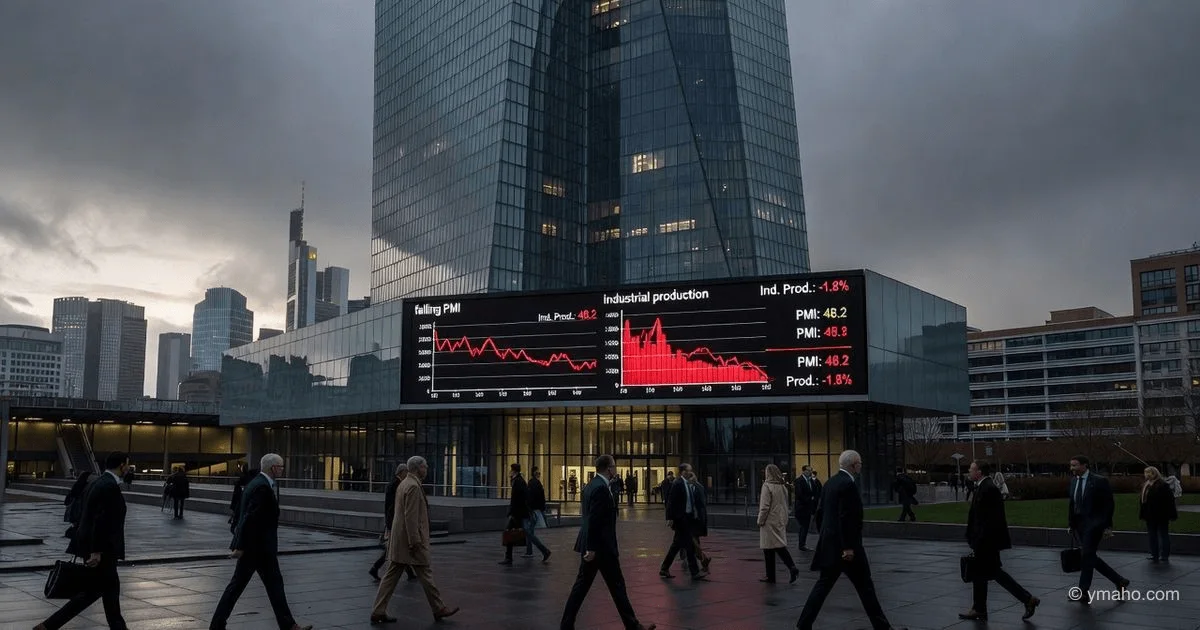
The S&P Global data for June is more than just statistics. The Eurozone manufacturing PMI, which fell to 45.8 from 47.3 in May, is a warning signal that markets have chosen to underestimate. Formally, we are observing a contraction for the 24th consecutive month, but the reality runs much deeper than a simple slowdown.
The media is talking about "pressure on the ECB to ease policy." However, the problem is that the ECB created this crisis itself by raising rates to 2.4% just two weeks ago — the first hike since 2023. The regulator cited inflationary pressure from the Middle East conflict. But now we see an economy cracking at the seams, with inflation rising to 3.2% in May. The ECB is caught between a rock and a hard place, with no way out that avoids serious consequences.
[The Core Issue]: What's Really Happening
In reality, we are witnessing a structural shift, not a cyclical fluctuation. The drop in the manufacturing PMI to 45.8 is no accident; it's the result of years of lost competitiveness. The output sub-index fell to a six-month low of 46.1 points. Export orders have been shrinking for 28 consecutive months, and the June decline was the sharpest since February. This indicates systemic problems.
Germany, the Eurozone's engine, continues to drag the entire bloc down. Its manufacturing PMI stood at 43.5, the worst among major economies, trailing only Austria at 43.6. France is not much better at 45.4. The services sector, which held up for a long time, has also entered contraction territory, signaling that the recession is spreading to related industries.
But the key point is that we are observing a two-speed depression. According to TD Securities' analysis, German manufacturing is stabilizing around the 50 mark (exactly 50.0), but this is an illusion — companies aren't hiring due to uncertainty about the future. The French services sector, on the other hand, is deep in the red (47.4) and relies on discounts, even amid cost pressures. This is not a "fair" slowdown.
Timeline and Context
To grasp the scale of the tragedy, we need to look at the timeline. We have smoothly transitioned from stagnation to recession in manufacturing.
| Indicator | May 2026 | June 2026 (Actual) | Trend |
|---|---|---|---|
| Manufacturing PMI (Eurozone) | 47.3 | 45.8 | Sharp acceleration of decline |
| Output Sub-Index | 49.3 | 46.1 | Six-month low |
| Manufacturing PMI (Germany) | ~47 | 43.5 | Worst in the region |
| Services Sector (Eurozone) | 47.7 | 48.9 | Minimal recovery, but still contraction |
| HICP Inflation (May) | 3.0% | 3.2% | Rise driven by energy and services |
Source: S&P Global, Eurostat
The key date is June 11, when the ECB raised rates. This move was called "prudent" amid the Middle East war. However, this decision deepened the downturn by making credit more expensive precisely when businesses need support. The ECB now faces what is known as "cost-push inflation," which cannot be cured by raising rates — it can only be resolved by ending the geopolitical crisis and lowering energy prices.
Winners and Losers
Losers:
- Industrial Giants: Germany's auto industry (BMW, Mercedes) and chemical sector are losing the competition to the US and China due to energy costs. BMW and Mercedes shares are falling despite rising May sales, indicating investor pessimism.
- European Stock Market: Index declines were swift. The Stoxx 600 fell amid mass sell-offs in the tech sector, with semiconductors losing up to 7% and automakers up to 5.9%.
- Retail Investors: Those who bought into the "European recovery" are now facing the reality of stagflation.
Winners:
- Importers: A strong euro or stable dollar allows for cheap purchases from Asia, but this won't save domestic demand.
- Short-Term Traders: Volatility caused by the divergence between the economy and monetary policy creates opportunities for short selling.
- Defense Sector: As seen with Rheinmetall, which shows profit growth amid geopolitical tensions, "real assets" offer better protection than "paper" ones.
What the Media Isn't Saying
Here lies the main insight. The media writes: "The ECB will be forced to ease policy." This is false.
Insight: The ECB cannot cut rates because they are already at 2.4%, which is still negative in real terms given 3.2% inflation. If the ECB starts cutting rates, inflation would soar to 4% or 5% due to a weaker euro and imported energy price increases. The ECB is trapped: it can't cut, and raising rates would crash the economy.
But there is a second, more subtle reason. TD Securities analysts point out that "confidence is only cautiously recovering with the resolution of the Middle East conflict." Officially, the ECB is fighting inflation. Unofficially, it is building a geopolitical premium into the rate, trying to strengthen the euro to lower import costs. This is a conscious sacrifice of industry for currency stability. The ECB is choosing a strong euro and a weak economy, hoping that overall price growth doesn't spiral out of control. Germany's industrial collapse is the price paid to maintain household purchasing power amid expensive energy.
Forecast: Next 30 Days and 90 Days
Next 30 Days (July 2026): We will see a continuation of "data dependency." If the July PMI shows no improvement and inflation doesn't decline (unlikely given oil prices around $88), the ECB will maintain its hawkish rhetoric. This will lead to further credit tightening in peripheral countries (Italy, Spain), where government bond spreads could widen to dangerous levels.
Next 90 Days (By Fall 2026): The key risk is a trigger for a recession in the services sector. Services have held up thanks to tourism, but the decline in new orders in the services sector (as captured by the PMI) suggests that even consumers are starting to tighten their belts. If we see Q2 GDP data around 0.1% or 0% (which is realistic given a PMI around 49.5), the ECB will face a choice: cut rates to save the economy, losing the euro, or hold rates and watch a recession unfold. I predict the ECB will take a risky gamble: keep rates unchanged, hoping for a drop in oil prices by year-end to let inflation subside on its own.
Editorial Forecast
Based on the current PMI dynamics and the gap between the US and EU economies, we expect downward pressure on the EUR/USD pair over the next 24-72 hours, with a move toward the 1.06 level. Weakness in German industry and the risk of recession will weigh on the euro, despite a hawkish ECB. Confidence level is medium, as the market has already priced in some of the negativity, but fresh German inflation data could trigger a new wave of selling. The main risk: an unexpected statement from the ECB President signaling readiness to discuss rate cuts, which would instantly crash the euro to 1.05, or conversely, an aggressive "hawkish" stance from the ECB that temporarily supports the euro.
— Editorial Team