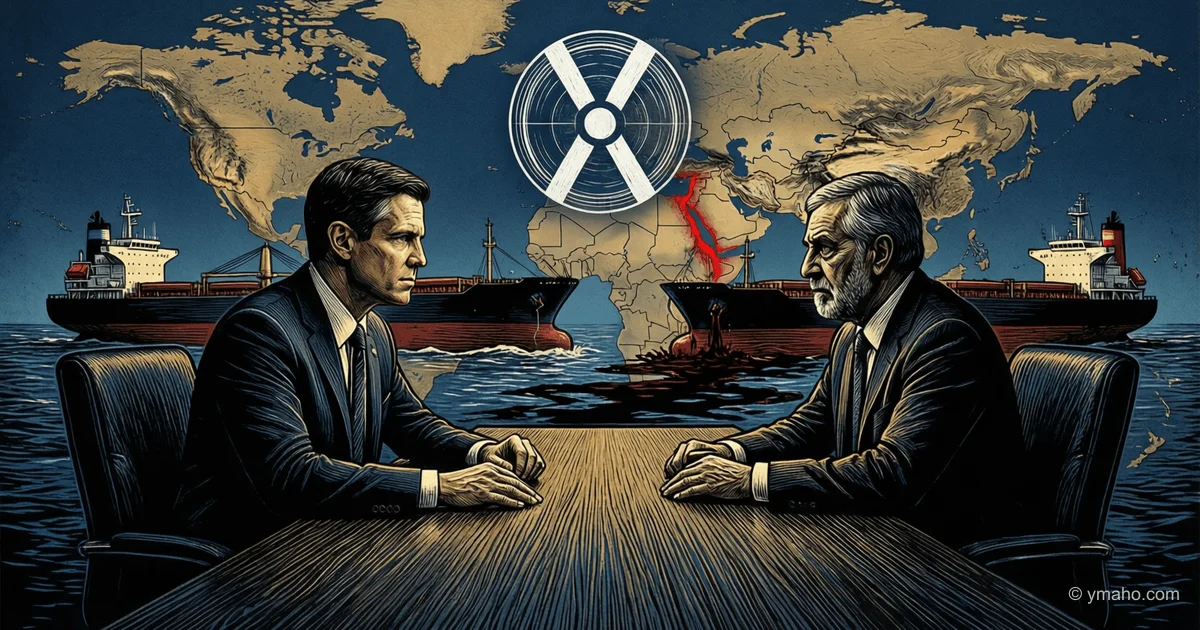
Secretary of State Rubio Reports Progress in Talks with Iran
Marco Rubio reported some progress in indirect negotiations with Iran, but noted that disagreements remain over uranium enrichment and fees for ship passage through the Strait of Hormuz, emphasizing the need for a "Plan B."
Diplomacy on the Brink of War: Why Rubio's 'Progress' in Talks with Iran Is Not a Deal, but a Breather Before a Choice
[The Gist]: What's Really Happening
U.S. Secretary of State Marco Rubio reported "some good signs" in talks with Iran, but quickly added that "we're not there yet." To the uninitiated ear, that's standard diplomatic language. To me, as someone who tracks the real dynamics of behind-closed-doors negotiations, this phrase sounds like an admission that the parties cannot agree on the main issues but are afraid to admit failure.
Rubio talks about progress because he needs to keep markets from panicking. Brent is already trading above $105 a barrel, and any statement about talks collapsing would send prices to $115-120. But the substance of his speech in Helsingborg on May 21-22 suggests otherwise: disagreements are not just persisting—they are fundamental.
The gist is that negotiations have hit a deadlock on two issues that have no compromise solution in the short term. Uranium remains in Iran (Khamenei's directive of May 20), and Iran is not abandoning plans to charge fees for passage through Hormuz. And these are not technical details. They are the foundations of the regime's sovereignty and security. Trump cannot concede on either without political suicide ahead of the November midterms. Khamenei even less so.
Timeline and Context
May 20-21 — a series of contradictory statements. Trump at the White House says the U.S. will obtain highly enriched uranium and likely destroy it. The same day, Reuters publishes information about Khamenei's directive banning the export of uranium.
May 21 — Rubio speaks at the NATO summit in Helsingborg. He confirms that "Plan B" is not empty words. "If Iran says, 'No, we refuse to open the straits,' then someone will have to go there and do something about it," the Secretary of State said. He also reported that there are countries ready to participate in a military operation against Iran.
May 22 — European media report that Trump convened a national security meeting where the issue of resuming airstrikes was considered. The decision was temporarily postponed, but the military and intelligence canceled days off and are on standby.
Meanwhile, mediators are working in Tehran: Pakistani mediator Asim Munir, Pakistan's Interior Minister Mohsin Naqvi, and a Qatari group. Iran presented the U.S. with a new proposal. But according to sources, it repeats demands previously rejected by Trump: control over the Strait of Hormuz, compensation for military damage, lifting sanctions, and withdrawal of U.S. troops.
Non-obvious insight: Iran is deliberately delaying its response to the U.S. proposal. Why? Because time works for Tehran. With each day of the Hormuz Strait blockade, the Iranian Persian Gulf Supervision Authority (PGSA) becomes more established. Insurance companies have already factored in the "Hormuz tax" into premiums. Chinese tankers pay duties to Iran and get oil at a discount. The longer the "negotiations" last, the more the new reality becomes de facto legitimized. Iran doesn't want a deal; it wants recognition of its control over the strait.
Who Wins and Who Loses
China wins. While the U.S. and Iran haggle, Chinese companies buy Iranian oil at a 30-40% discount to the market through a "shadow fleet" that pays PGSA duties. Beijing also watches as the U.S. spends its military and diplomatic resources in the Middle East, diverting attention from the Asia-Pacific region.
Russia wins. Moscow remains the only major player offering Iran an alternative on uranium (export to Russian territory) and not participating in sanctions pressure. This strengthens the Kremlin's position as an "honest broker" and gives it leverage in future negotiations.
Europe loses—and it's getting worse. The EU has imposed sanctions on Iranian officials responsible for the strait blockade. But that's a symbolic gesture. The real EU economy continues to suffer from high energy prices. Wood Mackenzie estimates Eurozone GDP losses in 2026 at -0.5% at current tension levels. If the conflict drags into autumn, a recession is inevitable.
The Trump administration loses—in the public eye. The president promised to open the strait and remove the uranium. Nearly three months have passed since the start of the war (February 28, 2026), and neither has happened. Trump's approval rating is at its lowest since returning to the White House, and gas prices remain high. The November midterms are becoming increasingly problematic.
What the Media Leaves Out
The most important omission in all the news is that Rubio's 'progress' refers not to the content of the deal, but to the mechanism for formalizing it. Sources from Reuters and Gulf News report that the sides are exchanging drafts of a final agreement. An Iranian official said the agreement is "very close." But that is diplomatic optimism concerning procedure (who signs, where, in what format), not substance (uranium and the strait).
The second omission: Rubio's 'Plan B' is not a threat of attack, but an admission of powerlessness. When the Secretary of State says that "the United States could do it" (open the strait by force), but there are other countries that "expressed interest in potentially participating," he is actually saying: "We lack the resources and political will to do it alone." The aircraft carrier USS Harry S. Truman has been in the region since February, but sustained military presence depletes missile stocks. According to The Washington Post, the U.S. has used nearly half of its THAAD and Standard Missile interceptors during the conflict.
Third: Trump has already made a key decision—he will not strike until negotiations end. On May 22, he canceled plans to attend his son's wedding and stayed in Washington, but the convened national security meeting did not result in an attack order. The military canceled days off and are on standby. This means "Plan B" is postponed for at least a week or two. Markets have not yet priced this in.
Forecast: Next 30 Days and 90 Days
30 days: The agreement will not be signed in the form the U.S. wants. Iran will not concede on uranium (the export issue is closed by Khamenei's directive) nor on the strait (PGSA continues operations). The maximum achievable is a technical agreement on "dilution of uranium under IAEA supervision" on Iranian territory, allowing Trump to claim victory and Khamenei to claim sovereignty preserved. But this compromise is already priced into the market.
90 days: If no agreement is signed by the end of summer, Trump will face a choice: either a military operation with unpredictable consequences before the elections, or de facto recognition of Iranian control over the strait with continued high oil prices. The second option is more likely—the administration will prefer to "freeze" the conflict until November and revisit the issue after the elections. This means Brent will remain in the $95-115 range until autumn, and then, if Republicans win the elections, policy may tighten and prices rise.
Editorial Forecast
Asset and direction: Brent crude — sideways with elevated volatility (short-term).
Rubio's statements about "progress" do not mean a real breakthrough, but they keep the market from panicking. Over the next 24-72 hours, Brent will trade in the $103-108 range as the market awaits Iran's official response to the U.S. proposal.
Key levels: Support — 102.50, resistance — 108.30. A break above 108.30 opens the path to 112.
Confidence level: Medium (60%). Too many conflicting signals: on one hand, diplomatic activity and statements about "progress"; on the other, tough public positions from both sides.
Main risk to the forecast: A sudden Iranian response rejecting key demands (especially on the Strait of Hormuz) would crash Brent by $5-7 in 24 hours. If Tehran instead hardens its stance, Trump might order a "police operation" in the strait, causing a price spike to $115-118. Watch Reuters and Bloomberg accounts over the next 48 hours—any insider news from Tehran or Washington could turn the market.
— Editorial Team









