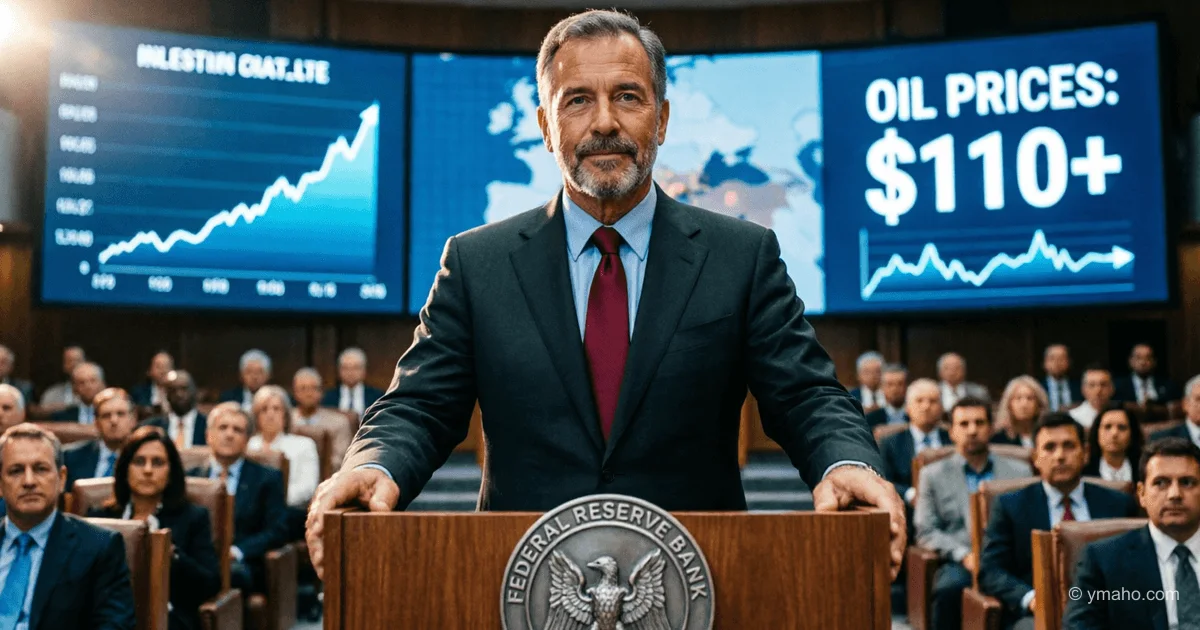
NY Fed Chief Cites Uncertainty Due to War
John Williams noted that Fed policy is "well positioned" for the economic instability caused by the conflict. He warned that US inflation will remain around 3% through year-end and that risks to the economy have increased.
Markets hold their breath: NY Fed chief acknowledges rising risks from war
Introduction
The speech by Federal Reserve Bank of New York President John Williams on May 4, 2026, was one of the most significant signals for financial markets since the start of the Middle East crisis. In his address at the Cynosure Group Spring Symposium, Williams did not just provide a macroeconomic forecast — he outlined a fundamentally new level of uncertainty facing the US regulator. The statement came amid escalation in the Strait of Hormuz and missile strikes on the UAE, lending special weight to the words of one of the most influential FOMC members. Analysis of this speech reveals how the Fed assesses the balance between inflation risks and recession threats when both of its mandates — price stability and maximum employment — are under simultaneous pressure.
Event Details and Timeline
Williams' speech took place on May 4 and was his first public remarks after the April FOMC meeting, where the rate was held at 3.50–3.75%. The timing of the comments was no coincidence — by then, Operation "Project Freedom" had already provoked an Iranian response, and Brent oil prices had surpassed $113 per barrel.
Williams' key points boiled down to several fundamental issues. First, he directly acknowledged that "risks to both sides of the Fed's mandate have increased" — a phrasing rarely heard from the regulator's leadership. "Both sides" refer to inflation and employment, and the concern is simultaneous: rising energy prices fuel inflation, while the supply shock suppresses economic activity.
Second, Williams provided specific figures: inflation will likely be around 3% in 2026 and only return to the 2% target in 2027. Economic growth is expected at 2–2.25%, and unemployment will remain in the 4.25–4.5% range. In other words, a stagflation scenario — albeit in mild form — has ceased to be a hypothetical threat and has become the baseline forecast.
Particularly noteworthy is Williams' warning about excessive optimism in the oil market. He noted that market expectations for the future path of oil prices are "fairly benign," but there are "plausible scenarios" of much more severe supply disruptions and price spikes. This statement can be interpreted as a signal that the Fed is internally preparing for a more adverse scenario than what traders are pricing in.
Impact and Significance
Williams' statement has multi-layered implications for the financial world. On a tactical level, it enshrines a regime of "elevated uncertainty" as the new normal for US monetary policy. The phrase "monetary policy is well positioned" should not be misleading — behind it lies an admission that the Fed has no ready answer to the unique combination of shocks.
For global capital markets, Williams' speech acted as a catalyst for risk reassessment. Federal funds rate futures sharply reduced expected easing: while a week earlier the market priced in a rate cut of about 40 basis points by year-end, that figure has now halved to 18 basis points. US Treasury yields continued to rise, and the S&P 500 lost 1.5% in a single session, which analysts attribute to investors' realization of the prospect of "higher rates for longer."
Crucially, Williams confirmed the existence of "notable" supply chain disruptions. The Global Supply Chain Pressure Index rose to 0.68 in March — the highest reading since early 2023. Although the current level is far from the pandemic peak of 4.49, the trend is concerning, especially combined with tariff barriers and a surge in transportation costs due to the situation in the Strait of Hormuz. Charter rates for a large tanker have risen by about $7.5 million per voyage, which inevitably feeds into final goods prices.
Reaction of Key Players
Williams' speech exposed a serious rift within the Federal Open Market Committee. At the April meeting, four FOMC members voted against the phrase "additional adjustments," which in Fed parlance means a shift toward rate cuts. Three regional presidents — Beth Hammack of Cleveland, Neel Kashkari of Minneapolis, and Lorie Logan of Dallas — issued separate statements on May 1, insisting that the next move could be either a cut or a hike, and that a signal of easing was premature.
Williams tried to downplay these differences in his speech, stating that "there is more agreement on policy than the vote might suggest." However, the fact of four dissenting votes — the highest since 1992 — speaks to deep uncertainty within the regulator. Moreover, the change in Fed leadership adds intrigue: Kevin Warsh, who will soon replace Jerome Powell as chair, is known as a proponent of prioritizing price stability over full employment, implying a potentially more hawkish course.
Institutional investors reacted to Williams' statements with a classic "flight to quality": high-yield bond spreads widened by 17 basis points, and investment-grade spreads also expanded. Goldman Sachs recommended clients increase portfolio quality in equities, credit, and currencies, while analysts at J.P. Morgan Wealth Management stated that the Fed will keep rates unchanged through year-end.
Forecast and Conclusions
John Williams' speech allows several key conclusions about the future trajectory of US monetary policy and global markets. The baseline scenario implicitly adopted by the Fed is to keep rates at the current level of 3.50–3.75% at least through the end of 2026, with a possible start to the easing cycle no earlier than 2027. The CME FedWatch tool shows that traders have pushed back expectations for the first cut to mid-to-late 2027, while Kalshi estimates a 43% probability of a rate hike by July 2027.
The main risk to this forecast is further escalation in the Persian Gulf region, which Williams himself called "a larger supply shock with severe consequences for inflation and economic activity." If the conflict drags on and oil prices settle above $120–130 per barrel, the Fed will find itself in a classic stagflation trap: inflation would demand rate hikes, while slowing growth would dictate cuts.
Williams' speech suggests that the Fed is making a strategic bet on the temporary nature of the supply shock. The regulator expects that de-escalation in the Middle East will allow energy prices to retreat, after which inflation will return to 2% by 2027. However, Williams himself acknowledges the fragility of this assumption, warning that market oil prices may reflect excessive optimism. If his skepticism proves justified, the Fed will have to revise its entire forecast horizon, and markets will have to price in a much longer period of high rates than currently anticipated.
— Editorial Team









