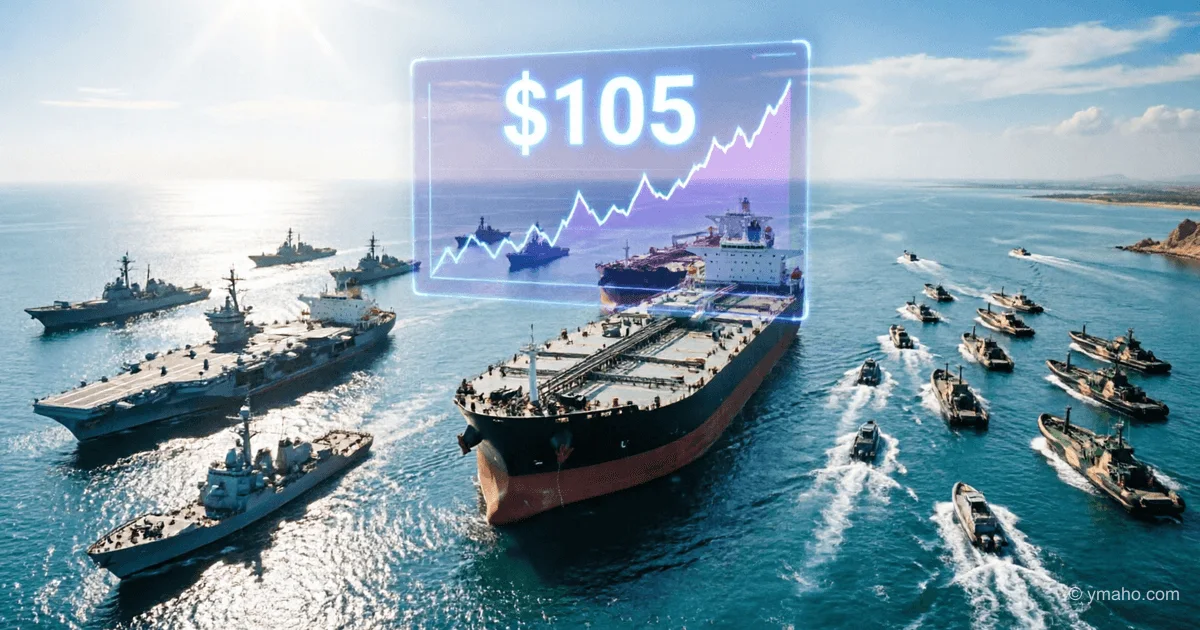
Oil Prices Stabilize Above $100 Amid Hormuz Strait Blockade
The US military blockade of Iranian ports and Tehran's unwillingness to make concessions keep oil prices from returning to pre-war levels. Brent crude is trading above $105, WTI around $100, and the World Bank expects energy prices to rise by 24% by the end of 2026.
Oil Frozen Above $100: How the Hormuz Strait Blockade Is Reshaping the Global Economy
Introduction
On April 29, 2026, the global oil market registered a new reality: Brent crude is steadily trading above $105, US WTI around $100, and the World Bank forecasts a 24% rise in energy prices for the year. The cause is a unique crisis with no historical precedent: the Strait of Hormuz, through which about 20% of global seaborne oil passes, is effectively paralyzed by a dual blockade.
"Two blockades are currently in effect: one imposed by Iran through threats against the Strait of Hormuz, and another enforced by US military power blockading Iranian ports," summarized military expert Sergey Migdal. Fatih Birol, head of the International Energy Agency, described the situation as "the greatest threat to global energy security in human history." This is no exaggeration: global oil supply has fallen by 10.1 million barrels per day to 97 million bpd, exceeding the shortfall of any previous crisis, including the 1973 oil embargo and the Iraqi invasion of Kuwait.
Event Details and Timeline
The crisis developed rapidly. In February 2026, the US launched Operation Epic Fury—a series of strikes on Iranian nuclear and military infrastructure. Iran responded by effectively closing the Strait of Hormuz: the Islamic Revolutionary Guard Corps began attacking tankers linked to the US and its allies. By March 6, about a thousand commercial vessels had accumulated at the entrance to the strait.
On April 8, the parties agreed to a two-week temporary truce that was supposed to resume shipping. However, the next day it became clear that Iran was not honoring the agreement. Instead of opening the strait, Tehran imposed a $2 million fee per vessel for passage.
On April 11-12, negotiations were held in Islamabad with Pakistan's mediation. The round ended without result. US Vice President JD Vance stated that "the ball is in Iran's court," and on April 13, President Trump announced a full naval blockade of Iranian ports by US Navy forces.
US command concentrated a group of at least 15 warships in the Gulf of Oman and the Arabian Sea, including the nuclear-powered aircraft carrier USS Abraham Lincoln and missile destroyers. The strategy is to intercept vessels exiting the strait. As CENTCOM reported on April 16, the US Navy has intercepted ten ships since the operation began.
Trump repeatedly threatened Iran with new bombings. In one social media post, he promised that Iranians would "live in hell" if the strait was not opened. Meanwhile, the previously agreed ceasefire deadline expired on April 21, and the parties considered extending it.
Impact and Significance (for the World / Industry / Society)
The scale of events extends far beyond the oil market. We are witnessing a synchronized shock across multiple commodity groups, where logistical stress is turning into a physical supply deficit.
Unprecedented Energy Shock. The March report from the International Energy Agency recorded a drop in global oil supply of 10.1 million barrels per day. For comparison, during the 1973 oil embargo, the deficit was 4-5 million bpd; during the Iraqi invasion of Kuwait, about 4 million bpd. Goldman Sachs analysts forecast a global oil deficit of 9.6 million bpd in Q2 2026, with global oil stocks shrinking at a record pace of 11-12 million barrels per day in April.
Food Crisis on the Horizon. The Strait of Hormuz is not just about oil. A third of global fertilizer trade also passes through this route. Qatar, which supplies a fifth of global liquefied natural gas, first halted exports, and missile strikes on the largest Ras Laffan plant collapsed gas markets in Asia and Europe. In West Africa, governments are entering the planting season with a critical fertilizer shortage, threatening cocoa and cotton harvests. In Europe, farmer protests are already underway—rising diesel prices make planting campaigns unprofitable.
Collapse of Global Logistics. With Iran closing the strait and the US imposing a blockade, Asian buyers rushed to purchase oil from the US. The Panama Canal is overwhelmed: oil tankers are buying up all slots, and vessels wait in long queues of up to 40 days. Grain delivery on some routes has become 50-60% more expensive.
Threat of Global Recession. As analysts at ALT3 Capital note, the current commodity shock is叠加 on unprecedented debt burdens of major economies. US public debt is stuck near 130% of GDP. Rising oil prices require importing countries to secure more dollar funding, which, combined with banks shifting to risk reduction, causes liquidity shortages. Foreign central banks have sold over $100 billion in US Treasury bonds since February 11.
Dollar Losing Ground. The crisis is accelerating de-dollarization. The dollar's share in global reserves has fallen from 55-56% two decades ago to about 40%, while gold's share has risen to nearly 30%, surpassing US Treasury securities. Ray Dalio at the Davos forum in January 2026 called the situation a "breakdown of the global monetary order."
Reactions of Key Players
Goldman Sachs and Investment Banks. Goldman analysts raised their Q4 2026 Brent price forecast to $90 from $80, and WTI to $83 from $75. The reason is the expectation of normalized exports from the Persian Gulf by the end of June (instead of mid-May) and slower production recovery. Goldman warns: "Economic risks are higher than our baseline scenario for the oil market suggests, given the potential for further oil price increases, extremely high refined product costs, and the unprecedented scale of the crisis itself."
OPEC+. Amid oil prices rising to $120 per barrel, OPEC+ approved a production quota increase for May of about 206,000 barrels per day—a step analysts called "symbolic." Given that oil exports from the Persian Gulf are reduced due to the war and leading producers are forced to cut supplies, this decision will have no real impact on the market. Saudi Arabia redirected some supplies to a terminal on the Red Sea coast, and the UAE increased exports from the port of Fujairah.
UAE Leaves OPEC. On April 29, it was announced that the United Arab Emirates decided to leave OPEC and OPEC+ effective May 1, 2026. As noted by Alexey Belogoryev, Research Director at the Institute of Energy and Finance, this decision could lead to additional oil production growth in the Persian Gulf starting in 2027. "The market will clearly perceive this as evidence of additional production growth and as a likely incentive to loosen quotas for the remaining OPEC+ countries," he said.
International Organizations. IEA head Fatih Birol called the crisis the greatest threat to energy security in history. Traders surveyed by the Financial Times warn that the worst is yet to come: "Markets still hope for a short conflict, but that's a mistake. Even six more months of such a blockade will ruin the 2027 harvest cycle."
Forecast and Conclusions
Analysts agree that a return to pre-war prices of $60-70 per barrel in the coming months is unlikely.
Goldman Sachs expects normalized exports from the Persian Gulf by the end of June—almost a month and a half later than initial forecasts. Analysts warn that even a partial resumption of supplies will take time: logistics chains are broken, tankers are in the wrong ports, insurance policies are canceled, and contracts are breached.
Forecasts for 2026 vary. Goldman raised its average Brent price forecast for the year to $90 from $83. The US Energy Information Administration expects average Brent prices above $90 per barrel with a second-quarter peak of $115. However, alternative scenarios exist. Analyst Kirill Rodionov believes the conflict could end the era of high prices: "If the crisis began with a sharp price increase, it is the Iranian conflict that could become a turning point, after which the market moves to a lower price regime"—according to his forecasts, a barrel could fall below $60 in the second half of 2026 or in 2027.
Key Takeaways:
- Unprecedented Scale. The loss of 10 million barrels per day is the largest supply disruption in history, surpassing the crises of 1973 and 1990.
- Domino Effect. The blockade has hit not only oil but also gas, fertilizers, logistics, and ultimately food security worldwide.
- Risk of Long-Term Crisis. Traders warn that markets underestimate the risk of a protracted conflict. "Even six months of blockade will ruin the 2027 harvest cycle."
- Dollar Under Threat. The commodity shock叠加 on the debt crisis and accelerates de-dollarization. The dollar's share in reserves has fallen to 40%.
- New Reality. The Strait of Hormuz, while formally partially open, has effectively become a zone impassable for commercial shipping without military escort. And even if the conflict ends tomorrow, it will take weeks or months to restore broken logistics chains.
One thing is certain: the world will never be the same. Energy security, which seemed self-evident in the era of globalization, has today become the main vulnerability of the global economy. And as missiles and ships block the narrow corridor in the Persian Gulf, the entire world economy is frozen in uncertainty.
— Editorial Team









