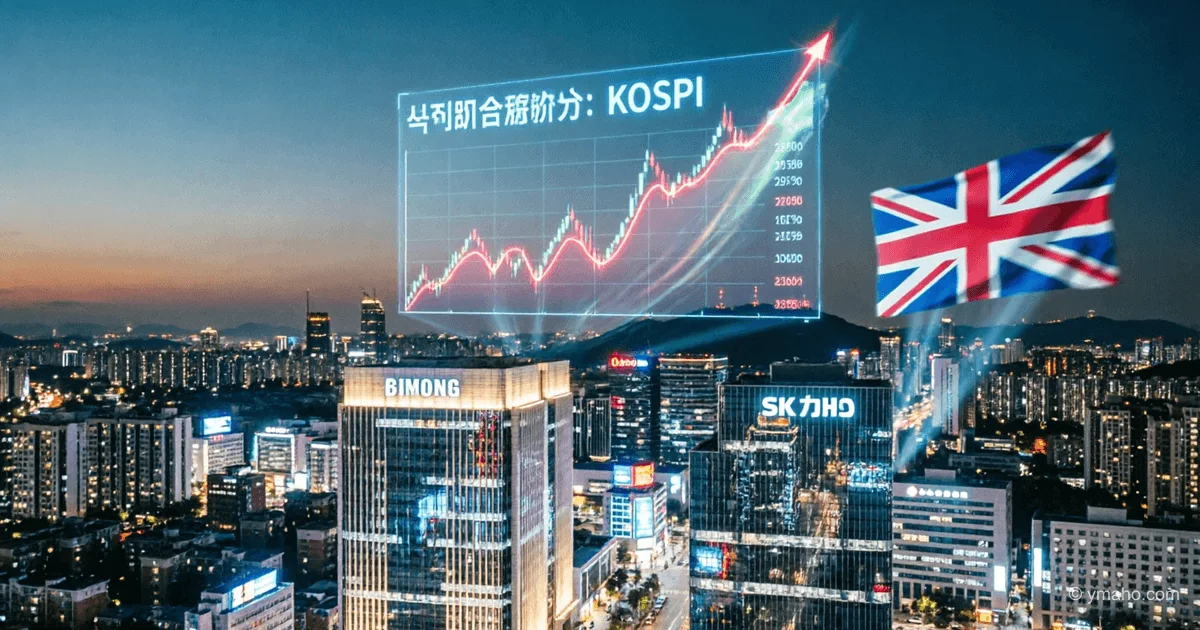
South Korea's Stock Market Surpasses UK in Market Capitalization
The Kospi index surged 31% in April, posting its second-best month on record and lifting South Korea's stock market capitalization above that of the UK, amid AI-driven successes.
South Korea overtakes the UK: Why KOSPI is becoming the new magnet for global capital
Introduction
Late April 2026 marked a historic redistribution of power on the global financial stage. South Korea, led by its tech giants, officially overtook the United Kingdom in total stock market capitalization, claiming the eighth spot worldwide. This leap, fueled by a nearly 31% surge in the KOSPI index in April, was not just a statistical curiosity but a vivid demonstration of how bets on artificial intelligence are redrawing the map of global investment.
Event Details and Timeline
As of April 28, 2026, the total capitalization of the Korean stock market (including KOSPI and KOSDAQ) reached $4.04 trillion, roughly $50 billion more than the UK market, which stood at $3.99 trillion. This figure is particularly impressive given that at the end of 2024, the UK market was twice the size of Korea's.
The rally was swift: in April alone, the KOSPI index gained 30.61%, its best monthly performance since January 1998. During trading on April 28, the index hit an all-time high, breaking through the 6,700-point mark for the first time (peak at 6,750.27). Year-to-date, the index has risen about 57%, making the Korean market the fastest-growing among the world's largest economies.
Impact and Significance
For the global financial architecture. Korea moved up to eighth place, trailing Taiwan ($4.48 trillion) and ahead of not only the UK but also France ($3.45 trillion). This shift reflects deep tectonic changes in the global economy: the center of gravity is definitively moving from traditional commodity and financial hubs toward high-tech manufacturing centers.
Experts note structural changes in capital flows. Francesco Chan of J.P. Morgan Asset Management described Korea's rise as "a structural reallocation in global equity markets driven by the country's dominance in AI hardware, not just short-term tactical asset movements."
For Korea itself: The 'Korean Discount' begins to fade. For a long time, Korean stocks traded at a discount to global peers due to opaque chaebol structures and low dividend yields. However, reforms under the Lee Jae-myung administration to improve corporate governance—including mandatory cancellation of treasury shares and easier access for foreign investors—are starting to pay off. The market is aggressively repricing fair value.
Key Players' Reactions
The rally triggered a wave of forecast upgrades from leading investment banks. Goldman Sachs raised its 12-month target for KOSPI from 7,000 to 8,000 points, citing sustained growth in the semiconductor sector and attractive valuations. JPMorgan went further, publishing a forecast that the index could reach 8,500 points by year-end.
Sector analysts urge caution when extrapolating past cycles to the current situation. "Given the uniqueness of this cycle, applying forward-looking empirical rules from previous periods should be done with great caution," JPMorgan's report states. "It is preferable to exit positions too late rather than too early."
Forecast and Conclusions
The key question remains the sustainability of these heights. Market concentration is extremely high: two companies, Samsung Electronics and SK hynix, account for about 40% of total KOSPI capitalization, which includes nearly 800 issuers. This turns the Korean market into a proxy for global demand for AI memory.
The baseline scenario assumes the bull trend continues, provided the HBM chip shortage persists and the geopolitical environment remains favorable. According to analysts, the memory supply deficit is expected to last at least until 2027. However, risks are also evident: any slowdown in global AI spending or deterioration in the Middle East could trigger a sharp correction from current overheated levels. Korea's rise to eighth place worldwide is a historic moment, but holding that position will require Seoul to continue structural reforms and diversify the economy beyond the semiconductor sector.
— Editorial Team









