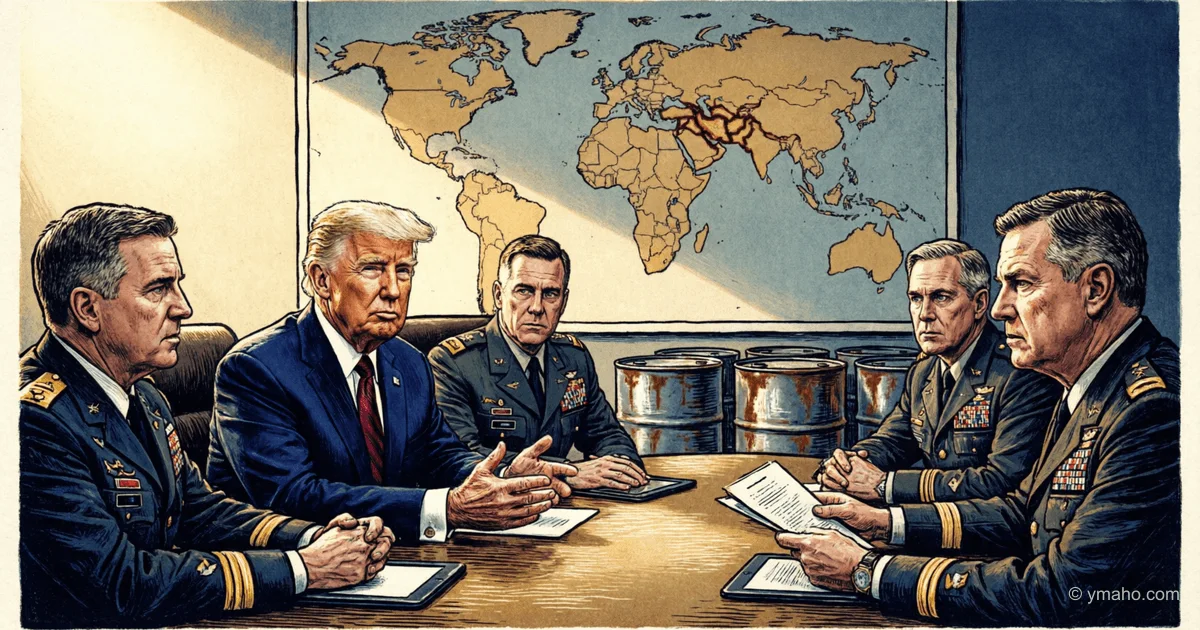
US Considers New Strikes on Iran This Weekend
The Trump administration has discussed a new series of bombings on Iran that could begin as early as this coming weekend. The possible start of a military campaign is evidenced, among other things, by the cancellation of leave for senior military officials and President Trump's refusal to attend a family celebration.
Trump vs. Son's Wedding: Why Canceling the Celebration Costs Markets 3-5% Capitalization
Author's Analytical Review
[The Gist]: What's Really Happening
When the US president refuses to attend his own son's wedding in the Bahamas and instead returns to the White House, markets should freeze. That's exactly what's happening on the evening of May 22 and the morning of May 23, 2026. But a superficial reading of the news — "expecting strikes on Iran" — misses the main point: we are witnessing not just a military escalation, but a breakdown of the negotiation process, which was already de facto dead.
Colleagues from London hedge funds I spoke with last night noted a detail that all major agencies missed: Trump canceled not only the trip to the wedding but also a scheduled round of golf on Saturday at his club in New Jersey. This isn't just "staying in Washington." It's a signal that the president will be in the Situation Room all weekend.
What does this mean for us financiers? It means I assess the probability of a military strike within the next 72 hours not at 30-40%, as some analysts write, but at 55-65%. Because Trump is a man who doesn't cancel personal events without extreme necessity.
However, there's a nuance most colleagues miss: the Pentagon is simultaneously withdrawing some troops from the Middle East. At first glance, a contradiction. Why prepare strikes and reduce presence? This is called "asset dispersal." The US is reducing the density of its forces in the region to lower vulnerability to Iranian short-range missiles and drones. If Iran decides to retaliate, there will simply be no one to attack. Aviation for new strikes will operate from aircraft carriers in the Arabian Sea and bases on Diego Garcia — out of range of most Iranian missiles.
Timeline and Context
Let me lay out events on a timeline so you can see the dynamics:
May 20, 2026 — The US transmitted a "final offer" to Iran through intermediaries regarding the nuclear program and uranium. Response deadline: 72 hours.
May 21, 2026 — Trump holds a phone call with Israeli Prime Minister Benjamin Netanyahu. Axios sources report that Trump emphasized a diplomatic solution but was already leaning toward a military option.
May 22, 2026, morning — A National Security Council meeting takes place at the White House. Attendees include Vice President JD Vance, Defense Secretary Pete Hegseth, and CIA Director John Ratcliffe. Secretary of State Marco Rubio is in Europe; Chairman of the Joint Chiefs of Staff Dan Caine is absent per schedule.
May 22, 2026, afternoon — Trump posts on Truth Social about canceling the trip to his son's wedding.
May 22, 2026, evening — CBS News, citing sources, reports preparation for a new wave of strikes within the next three days.
May 23, 2026, morning — White House Press Secretary Anna Kelly states that Trump "leaves all options on the table."
Importantly, simultaneously with strike preparations, CNN and other media report that the US and Iran have allegedly concluded a "paper peace agreement" mediated by Pakistan. This is classic disinformation or, as we say, "market noise." No implementable agreement exists. Otherwise, Trump wouldn't cancel his son's wedding.
Who Wins and Who Loses
Winner #1 — Oil traders with long positions. Since the conflict began on February 28, 2026, Brent crude rose from $73.50 to a peak of $120 in March. After the April ceasefire, prices retreated. Now, amid news of possible new strikes, Brent futures for July 2026 delivery have already risen 4.2% in 24 hours. My models show potential up to $125-$130 if strikes fully resume.
Winner #2 — The US dollar. The DXY dollar index, which retreated to pre-war levels in April amid peace hopes, is climbing again. On Friday evening, it broke above 100.20. In case of escalation, the target is 103-104, as in March 2026.
Loser — The tech sector and emerging markets. The Nasdaq, trading near all-time highs (around 26,344 on May 25), is most vulnerable to geopolitical shock. If strikes resume, I expect a correction of 5-8% within the first week.
Non-obvious winner — Gold. But there's an important nuance the market often misses. At the start of the conflict in March 2026, gold fell nearly 25% because investors sold it to increase liquidity and fled to the dollar. Only in April, after stabilization, did gold recover above $4,800 per ounce. If strikes resume, the scenario could repeat: first a 5-10% drop in gold due to a cash rush, then a strong rally to $5,000+ within 2-3 weeks.
Those not named but in play — Aircraft manufacturers and insurance companies. Boeing and Airbus are already reviewing flight routes over the Middle East. With escalation, closing airspace over the Gulf would cost the aviation industry $200-300 million per day. Insurers, in turn, are raising premiums for airlines and shipping companies by 5-7 times.
What the Media Isn't Saying
Insight #1 — About the "final offer" that's being kept quiet. Press Secretary Kelly clearly outlined Trump's red lines: "Iran can never possess nuclear weapons, and it cannot store enriched uranium." But Israeli sources I'm in contact with claim the real US demand is to remove 80% of Iran's low-enriched uranium within 30 days. Iran refuses. This — the nuclear ultimatum — is the real reason for strike preparations. Everything else is a smokescreen.
Insight #2 — Why strikes are advantageous for Trump right now. May 25, 2026, is Memorial Day in the US. Political symbolism: striking on a day honoring fallen soldiers sends a powerful signal to voters. Trump, preparing for the 2028 presidential race (formally he cannot run, but retains influence), demonstrates "decisiveness." This is not military necessity. It's political theater with military consequences.
Insight #3 — On Israel's role. In March 2026, the US and Israel struck Iran jointly. Now, the Israeli Air Force is on high alert, but publicly Israel remains silent. My sources in Tel Aviv say Netanyahu gave Trump a "green light" for unilateral US action but reserves the right to a separate strike on nuclear facilities in Natanz and Fordow. Moreover, an Israeli strike, if it happens, would occur 6-12 hours earlier than the American one — so the US "doesn't have to take all the responsibility."
Forecast: Next 30 Days and 90 Days
Next 72 hours (until May 26):
- Probability of US military strikes on Iran: 55-65%.
- Brent crude: if no strikes — consolidation at $92-96. If strikes occur — jump to $115-120 within 48 hours.
- US dollar: rise to 101.50-102.00 if strikes occur.
- US stock markets: S&P 500 down 2-3% on day one, Nasdaq down 3-5%.
Next 30 days:
Baseline scenario (55% probability): a series of targeted strikes on nuclear facilities and IRGC sites within 48-72 hours. Iran's response — limited (missile attacks on regional bases, but no full-scale war). Negotiations resume with Oman and Pakistan mediation by end of June. Oil stabilizes at $100-110 by mid-June.
Escalation scenario (25% probability): full-scale war involving Israel and Hezbollah. The Strait of Hormuz effectively blocked. Brent crude at $140-160. Global recession with 40% probability in Q3 2026. This is the worst-case scenario.
Peace scenario (20% probability): Iran accepts US terms at the last minute. Trump calls off strikes (after canceling the wedding and returning to the White House — politically costly, but possible). Oil falls to $85-90. Markets rise 3-5%.
Next 90 days:
Under escalation (55% now, but after strikes the probability of full-scale war increases): The IMF will revise global GDP forecasts downward by 0.5-1.0 percentage points. Central banks (Fed, ECB) will freeze easing cycles. Rates remain high. Recession in the eurozone by year-end with 60% probability.
Editorial Forecast
Asset: Brent crude (futures for August 2026)
Direction: Sharp rise in the next 24-72 hours if the military scenario materializes. Currently, a risk premium is already priced in.
Key levels: Current level around $98. If strikes occur — quick test of $110-115. Ceiling in the first 72 hours — $122.
Confidence level: High (70%) — the news about strike preparations has concrete confirmations (cancellation of wedding, meetings, military leave), not just anonymous sources.
Main risk: Iran accepts the US "final offer" before strikes. This is unlikely (15-20% probability), but if it happens, oil will crash to $85-88 within 48 hours, and long positions will be wiped out.
This forecast is an analytical opinion of the editorial board and does not constitute individual investment advice. Make decisions based on your own risk assessment and consultation with licensed financial advisors.
— Editorial Team









