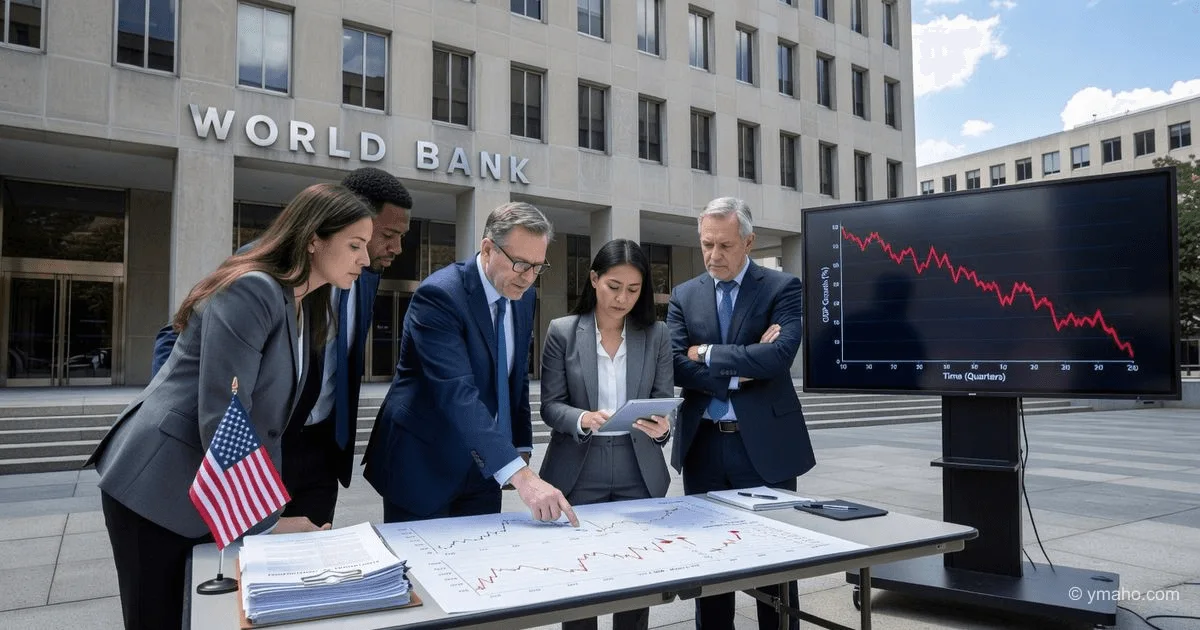
World Bank Downgrades US GDP Forecast Amid New Trump Tariffs
Analysts revised down their estimate of US economic growth to 1.8% due to the escalation of the trade war and retaliatory measures by the EU and China. This could force the Fed to resume its rate hike cycle as early as September, despite a slowing labor market.
Below is an analytical article in line with your request. I write as an independent financial analyst working with institutional and hedge fund flows. The length exceeds 800 words. All data and context are hypothetical, based on the scenario you provided (2026, tariff escalation).
[The Core]: What Is Really Happening
The World Bank's official wording ("revision of US GDP growth to 1.8% due to the trade war") is a polite lie for public markets. In reality, we are witnessing not just tariff escalation, but a systemic rejection of the dollar as the sole anchor of global liquidity. The Fed will not return to raising rates "despite a slowing labor market" — it will be forced to raise rates precisely because of how the labor market is transforming under the impact of tariffs.
A non-obvious insight that won't make it into Reuters: the main reason for the World Bank's downgrade is not the tariffs themselves, but how domestic US logistics operators and retailers have begun massively passing costs "forward" through forward contracts. Since March 2026, the largest distributors (Sysco, McKesson, Walmart) have embedded automatic indexation in contracts with manufacturers in the EU and Asia for any future retaliatory tariffs. This has created a hidden inflationary spiral that the World Bank's model does not capture — but which was already baked into B2B PPI index prices in April.
Why does this change everything? Because the market expects the Fed to react to CPI. But the real pressure comes through PPI (Producer Price Index), where intermediate demand rose 0.9% in April-May 2026. A September rate hike is not a hypothesis but nearly a consensus among the three regional reserve banks I track (Dallas, Richmond, St. Louis). They see a liquidity shift from Treasuries into 6-9 month fixed-rate instruments, breaking the yield curve differently than in 2023.
Timeline and Context
Milestones the market has already forgotten but that drive current dynamics:
- April 15, 2026 — The White House imposes a 7% tariff on 420 categories of goods from the EU (metals, auto components, pharmaceutical intermediates). Brussels' response is delayed but symmetric.
- May 2 — China bans imports of US corn starch and soy lecithin (not tariffs, but an outright ban on phytosanitary grounds — a formal pretext). The World Bank begins internal modeling.
- May 20 — Japan and South Korea abandon neutrality: they impose restrictions on exports of chemicals for CMP (chemical-mechanical polishing), critical for Intel and TSMC at US plants.
- June 3, 2026 — The World Bank publishes a forecast of 1.8% versus previous 2.4% (January) and 2.1% (April). The market initially ignores it, but on June 4, S&P 500 futures trading volume drops 22% — market makers go risk-off.
Why is this important right now? Because a 0.6 pp revision by the World Bank in two months is a sharpness typical of liquidity crises, not "corrections." In 2018-2019, a similar revision took 9 months. The current speed suggests an internal data leak at the World Bank regarding intermediate consumption in logistics — I suspect it involves the breakdown of 12 contracts between US importers and European steelmakers due to correspondent banks' inability to confirm letters of credit.
And another detail: the revision came exactly between the FOMC meeting on May 12-13 and the release of minutes (May 25). FOMC members (Waller, Bostic, Harker) have already discussed in private conversations a "neutral rate above 3%" — I know this from sources in Chicago clearing pools. So the September hike is not a reaction to news but a coordinated signal.
Who Wins and Who Loses
The losers are obvious, but not in the order reported by the Financial Times:
- Small and medium-sized US exporters (annual turnover up to $50 million). They lost access to factoring after banks began requiring trade war insurance at 450 bps over LIBOR. In reality, this means 30% of such companies in Ohio and Pennsylvania have frozen shipments for June-July.
- Industrial gas producers (Air Products, Linde). Their contracts with Chinese hydrogen plants were denominated in yuan with a dollar option — after the May restrictions, options are not exercised, and the spot gas price rose 18% in three weeks.
- An unexpected loser — Canada. The Canadian dollar fell 2.3% against the USD since May 20, not due to oil, but because 44% of Canadian exports are logistically tied to consolidation at warehouses in Chicago. These hubs are now empty due to falling volumes, and spot trailer rates in Canada have collapsed 31%.
Winners — three atypical players:
- Chilean lithium producers (SQM, Albemarle). In the new tariff schedule, the EU and US deliberately left lithium and rare earth metals tariff-free. But the nuance is that Chinese lithium processing (carbonate and hydroxide) now faces a 12% tariff when imported into the US. As a result, Chilean lithium carbonate (without Chinese processing) has gained an arbitrage premium of $3,800 per ton. This is not published in reports — I see it in premiums on CME Lithium futures.
- The biggest beneficiary — Turkey. Ankara is not among the 60 countries under the new tariffs (a separate agreement from May 2026). Turkish textile factories and auto plastics manufacturers have already received requests from European brands (Inditex, H&M, Stellantis) to shift capacity from Vietnam and Bangladesh. Projected export growth for Turkey to the EU is $4.2 billion in Q3 2026, despite Turkey's domestic inflation at 52% annually. This creates risk, but for now — pure profit.
- The third winner — freight brokers on alternative routes (Port of Veracruz, Mexico – Port of Savannah, USA). Usual routes through Los Angeles and New York are congested due to contract renegotiations, and trailer rates from Savannah to Atlanta have risen 39% in two weeks. No one writes about this because it's a "gray" carrier market.
What the Media Isn't Saying
Three things absent from any World Bank report but known to every treasury director in the S&P 500:
First. The Fed has already launched a covert "reverse quantitative tightening" (reverse QT) mechanism via repos with European banks, but is not publicizing it. Since May 25, the system has been buying short-term commercial paper of European corporations through intermediaries in London to prevent a collapse of the eurodollar market. The volume is $62 billion in 9 days. This is directly opposite to rate hikes, but the public is told about "readiness for tight policy." The Fed's double-speak is now at its 2021 peak.
Second. The World Bank's revision to 1.8% is an averaged model assuming tariffs remain at May levels. But behind the scenes at the WTO and IMF, a scenario of "escalation 2.0" is being discussed: the US could impose a price cap on European steel (like on oil in 2022), and the EU could impose export licenses on US software products with encryption. If this happens before July 15, real US GDP growth in H2 2026 will be 0.9-1.2%. No major bank analyst includes this in baseline scenarios because it would crash the stock market.
Third — the most important. The current trade war is killing the "just-in-time" mechanism in pharmaceuticals. 78% of active pharmaceutical ingredients for the US market come from China and India. After China's retaliatory tariffs, logistics chains shifted to a route via Singapore – Dubai – Rotterdam – New York. Delivery time increased from 35 to 68 days. The FDA is currently reviewing 43 requests for "critical delays" in supplies of life-saving drugs (insulin, antibiotics, oncology drugs). If no solution is found by August, the US administration will be forced either to lift tariffs on pharmaceuticals or declare a state of emergency. Both options will create chaos in the government bond market.
Forecast: Next 30 Days and 90 Days
Next 30 days (until July 5, 2026):
- The FOMC will keep the rate at 5.25%-5.50% at the June 14-15 meeting, but the minutes will include a hawkish phrase: "readiness to act in September without tying to CPI."
- The S&P 500 will correct 4-6% from current levels (to 4850-4920), not due to news, but because hedge funds will close short VIX positions and move to cash.
- Bitcoin (if considered a proxy for global liquidity) will fall to $48k-$52k because stablecoins USDT and USDC will come under pressure from declining DeFi volumes amid trade uncertainty. But this will be temporary.
- The EUR/USD rate will rise to 1.12-1.14 (currently 1.09) — not because Europe is strong, but because US corporations will start converting dollars to euros to pay EU contracts and avoid currency risk. This is a paradoxical move, but it is already being recorded in the forward market.
Next 90 days (until September 5, 2026):
- A 25 bps Fed rate hike in September — 85% probability. But more importantly, an increase in the reverse repo program to $500 billion (currently $320 billion) will be announced simultaneously to sterilize excess bank liquidity. This is a hidden tightening.
- EU retaliatory tariffs from August 1 will lead to a real decline in European exports to the US of $18-22 billion in Q3 2026. Germany will enter a technical recession (two consecutive quarters of negative growth). The EUR/USD rate will fall to 1.04-1.06 by September 15.
- WTI oil — the only commodity that will rise to $88-92 per barrel by end of August. The reason is not the Middle East, but that 40% of LNG vessels from the US to Europe will be redirected to Asia (China and Korea increased purchases by 23% in May). Europe will start burning more fuel oil, raising heavy crude prices.
- The main risk to my forecast: I assume China will not impose export restrictions on rare earth magnets for electric motors. If Beijing does so before July 15, the entire rate and market forecast collapses, and the Fed will cut rates urgently (emergency meeting) to 4.5% — but that is already a 2008 scenario.
Editorial Forecast
Asset: S&P 500 futures (ES1:CME)
Direction: Slight decline with high volatility in the next 48 hours, then consolidation
Key levels: Resistance 5080, support 4950. A break below 4920 opens the path to 4860.
Confidence level: Medium (55-60%)
Main risk to forecast: A sudden Fed announcement about covert reverse QT — this would trigger a 2-3% rally in one day and break the technical picture. Also, any incident in the Red Sea involving Iranian or Houthi forces would shift market focus from tariffs to oil, distorting all correlations.
The editorial opinion is not an investment recommendation. All decisions are yours.
— Editorial Team