International Relations Theories: Realism, Liberalism, Constructivism
International relations (IR) theories are the analytical lenses through which scholars, policymakers, and citizens understand the complex web of interactions between states, international organizations, non-state actors, and transnational forces. They provide the foundational frameworks for interpreting everything from diplomatic negotiations and trade wars to military conflicts and global governance, helping us move beyond surface-level news to grasp the underlying logic of world politics. In this comprehensive explainer, we will dissect the three dominant paradigms—Realism, Liberalism, and Constructivism—to answer the fundamental question: what are the main theories of international relations, and how do they shape our understanding of global affairs today?
What You'll Learn
The three main IR theories offer distinct explanations for state behavior. Realism emphasizes power, security, and the anarchic structure of the international system; Liberalism focuses on cooperation, international institutions, and economic interdependence; and Constructivism argues that ideas, identities, and norms shape state interests and actions. These frameworks are not mutually exclusive but serve as essential tools for analyzing contemporary events like the war in Ukraine, great power competition, and global climate governance.
How It Works: Mechanistic Explanations and Real-World Analogies
To truly grasp these theories, it is helpful to understand them as mental models—like different apps on a smartphone, each designed to perform a specific analytical function.
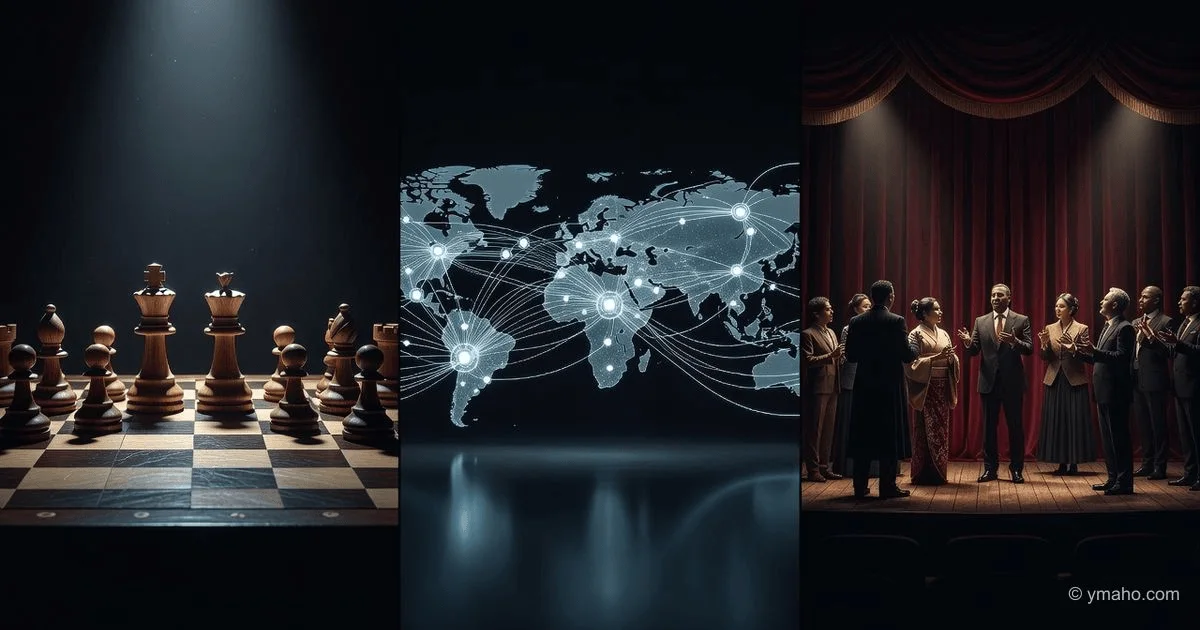
Realism: The World as a Billiard Table
Realism operates on a mechanistic analogy of a billiard table. States are the hard, solid balls, each acting as a unified, rational actor. The table itself is the international system, which is anarchic—there is no global "referee" to enforce rules. The cue ball, representing the most powerful state, dictates the game's flow. The core mechanism of Realism is the relentless pursuit of power. According to Hans Morgenthau's classic formulation, politics is governed by objective laws rooted in human nature, and states define their interests in terms of power (Morgenthau, Politics Among Nations, 1948). The security dilemma is a key operational principle: actions taken by a state to increase its own security (e.g., building up its military) are often perceived as threatening by others, leading to an arms race and decreased security for all. In this world, cooperation is difficult because states are constantly worried about relative gains—who benefits more from an agreement—since today's ally could be tomorrow's adversary.
Liberalism: The World as a Network of Connections
In stark contrast, Liberalism envisions international relations as a dynamic network, akin to the internet. States are not isolated billiard balls but are deeply embedded in a web of economic, social, and institutional ties. The mechanism here is cooperation through institutions and interdependence. The core insight, powerfully articulated by Robert Keohane and Joseph Nye, is that complex interdependence creates multiple channels of contact between societies, diminishing the utility of military force (Keohane & Nye, Power and Interdependence, 1977). International organizations like the UN, WTO, and EU act as mechanisms for information sharing, rule-making, and dispute resolution, which reduces transaction costs and facilitates cooperation. Economic interdependence—where states are tied together through trade and finance—raises the costs of conflict, as war would disrupt mutually beneficial exchanges. The democratic peace theory, an empirical and logical pillar of Liberalism, posits that liberal democracies almost never go to war with one another because they share norms of peaceful conflict resolution (Doyle, Michael W., "Kant, Liberal Legacies, and Foreign Affairs," Philosophy & Public Affairs, 1983).
Constructivism: The World as a Stage
Constructivism offers the most distinct mechanistic explanation: it posits that the world is socially constructed, much like a theatrical stage where the script and roles are defined by shared ideas. The central mechanism is the creation and evolution of norms and identities. Alexander Wendt's famous assertion that "anarchy is what states make of it" (Wendt, "Anarchy is what States Make of it: The Social Construction of Power Politics," International Organization, 1992) captures the crux of this theory. Unlike Realism and Liberalism, which take state interests as given, Constructivism argues that state interests are shaped by their identities, which, in turn, are formed through interaction with other actors. For example, the United States does not view the UK as a threat because of a shared identity and history, whereas it views North Korea differently based on a constructed threat perception. The spread of international norms—like the prohibition of landmines or the principle of "Responsibility to Protect" (R2P)—demonstrates how changing ideas can lead to changes in state behavior (Finnemore, Martha, and Kathryn Sikkink, "International Norm Dynamics and Political Change," International Organization, 1998). These shared ideas and identities, not just material power, determine what states consider legitimate and appropriate.
Why It Matters: Concrete Impact on People's Lives
These theories are not just academic abstractions; they have a direct and tangible impact on policy decisions that affect billions of people.
- National Security and Defense Spending: A Realist worldview led the U.S. and NATO to shift focus from counterterrorism to "great power competition" with China and Russia, as articulated in the 2018 U.S. National Defense Strategy. This shift directly influences defense budgets, the stationing of troops, and the development of new weapons systems. For a European citizen, it means increased security from NATO deterrence; for a taxpayer, it means higher military spending. Conversely, a Liberal perspective drives the U.S. to maintain alliances through institutions like NATO, leveraging collective security and burden-sharing. This institutional approach was central to the transatlantic response to Russia's invasion of Ukraine in 2022.
- International Trade and Economic Prosperity: The Liberal emphasis on free trade and open markets shapes the global economy. The rules of the World Trade Organization (WTO), which were designed to lower tariffs and resolve disputes, are a direct product of liberal thinking (World Bank, "World Development Report 2020: Trading for Development in the Age of Global Value Chains"). When a factory worker loses their job to a foreign competitor or when a consumer buys a cheap imported smartphone, the daily reality reflects the mechanics of economic interdependence. The recent trend towards "de-risking" or decoupling from China represents a significant shift in this logic, demonstrating how a more Realist perspective on security is starting to override pure liberal economic efficiency.
- Global Cooperation on Shared Threats: Constructivism matters profoundly when we consider global crises like climate change or pandemics. The Paris Agreement on climate change is, in large part, a constructivist success story—a product of evolving global norms around climate responsibility and the identity of nations as "climate leaders." As the World Health Organization (WHO) states, cooperation requires a shared identity and a normative framework of mutual responsibility (WHO, "Global Health and International Cooperation"). The treaty's success depends not just on material incentives but on the norm that states should publicly commit to emissions reductions, even without a global enforcement mechanism. When norms shift, so do the policies that determine our planet's future.
By the Numbers: Key Stats, Dates, and Milestones
The evolution of IR theories and their impact can be charted through historical milestones and data points.
| Date | Event / Milestone | Theory in Focus | Quantitative Impact / Data |
|---|---|---|---|
| 1648 | Peace of Westphalia | Realism | Ends the Thirty Years' War; establishes the modern state system based on sovereignty. |
| 1945 | Founding of the UN | Liberalism | Birth of the primary liberal institution for international cooperation, now with 193 member states. |
| 1949 | Formation of NATO | Realism | A collective defense alliance created to counter Soviet power; 31 member states as of 2024. |
| 1990s | "End of History" (Fukuyama) | Liberalism | The 1990s saw a peak in global cooperation with 1.2 billion people living in extreme poverty in 1990, which dropped to 648 million by 2019, driven by liberalized trade (World Bank). |
| 2003 | U.S. Invasion of Iraq | Constructivism | Highlighted how identity and norms (the "War on Terror") were used to justify military action; a key moment for poststructuralist IR. |
| 2015 | Paris Agreement | Constructivism | 196 parties adopted a global climate deal; a testament to the power of international norms and non-state actor influence. |
| 2022 | Russia Invades Ukraine | Realism | Demonstrates the primacy of power politics and the security dilemma; led to an 11% increase in global defense spending from 2021 to 2023 (IISS, Military Balance 2024). |
Common Myths vs. Facts
| Myth | Fact |
|---|---|
| Myth 1: Realism means that states only care about military power. | Fact: While Realism emphasizes military and economic power, classical realists like Morgenthau also recognize the importance of diplomacy, reputation, and moral restraint. As articulated by the Council on Foreign Relations, "power" encompasses a range of capabilities. |
| Myth 2: Liberalism is idealistic and ignores power. | Fact: Liberalism doesn't ignore power; it argues that power can be structured and tamed through institutions. The success of the EU in preventing war between its members is a liberal argument that demonstrates how institutionalized cooperation changes power dynamics (European Commission historical reports). |
| Myth 3: Constructivism says that material things don't matter. | Fact: Constructivism does not deny that material things (like nuclear weapons) matter. It argues, rather, that their meaning and effect are mediated by ideas. For instance, the same number of nuclear weapons in the hands of the UK vs. North Korea has vastly different political implications (Wendt, 1992). |
| Myth 4: IR theories are just academic exercises and can't be applied to real-world policy. | Fact: Policymakers frequently use these frameworks. The shift in U.S. foreign policy from "engagement" to "strategic competition" with China is a conscious move from a Liberal to a Realist paradigm (U.S. Department of State, 2022 National Security Strategy). |
| Myth 5: Economic interdependence makes war impossible. | Fact: The Liberal idea that interdependence prevents war has been challenged, notably by the Russia-Ukraine war, where deep economic ties existed before the invasion. The conflict underscores that while interdependence is a powerful force, it does not override core security concerns (Baldwin, David A., "Economic Statecraft," 1985). |
What You Should Do With This Knowledge
Understanding these theories equips you with a powerful analytical toolkit to cut through the noise of daily news and form more sophisticated opinions on global events.
- Become a More Critical News Consumer: When you read a headline, ask yourself which theoretical perspective is being used to frame the story. Is the journalist, politician, or analyst emphasizing power struggles (Realist), economic cooperation and institutions (Liberal), or identity and cultural factors (Constructivist)? By recognizing these biases, you can evaluate arguments more effectively.
- Enhance Your Professional Outlook: For those in business, finance, or technology, understanding IR theories is not optional—it’s essential. A Realist lens can help you anticipate geopolitical risks like supply chain disruptions, sanctions, and resource nationalism. A Liberal lens helps you understand the benefits of regulatory standards and international treaties that create a stable operating environment. A Constructivist lens helps you grasp the importance of cultural and social norms in building trust and brand reputation in new markets.
- Develop a Pragmatic Worldview: Few real-world events can be explained by a single theory. The most insightful analysts use an eclectic approach, drawing on Realism to understand the power dynamics of the war in Ukraine, Liberalism to analyze the economic sanctions imposed on Russia, and Constructivism to examine the evolving global norm against territorial aggression. This synthesis allows for a more comprehensive understanding and, consequently, more effective decision-making.
Frequently Asked Questions
What are the main theories of international relations? The three main theories are Realism, Liberalism, and Constructivism. Realism focuses on state power and security in an anarchic system; Liberalism emphasizes cooperation, interdependence, and international institutions; and Constructivism highlights the role of ideas, norms, and identities in shaping state interests and behavior.
Which theory of international relations is most accurate? There is no single "most accurate" theory, as each offers a unique perspective suited to different types of questions. Realism often provides better explanations for war and conflict, Liberalism is stronger on cooperation and economic relations, and Constructivism is excellent for understanding changes in global norms and long-term shifts in state behavior, such as the evolution of human rights or environmental policy.
Is realism or liberalism better for understanding the US-China relationship? Both are essential. A Realist framework explains the U.S.-China relationship through the lens of power competition, the security dilemma, and military build-up in the Asia-Pacific. A Liberal perspective is crucial for understanding the deep economic interdependence, the role of trade disputes, and the efforts to maintain international financial rules. An effective analysis must integrate both.
What is an example of constructivism in international relations? A prime example is the emergence of the Responsibility to Protect (R2P) norm. It is not based on material power but on the evolving idea that sovereignty entails a responsibility to protect populations from genocide and crimes against humanity. This norm has shifted state behavior, leading to interventions in Libya and the U.S. decision to label the Armenian genocide as such, showing how ideas change policy.
How does international relations theory affect everyday life? Theories influence decisions on defense spending, which affects your tax dollars; on trade policy, which impacts the cost and availability of goods; and on global agreements on climate change and public health, which directly affect your environment, your health, and your safety. For instance, WHO policies on pandemic response are deeply influenced by cooperative, liberal-institutionalist frameworks.
— Editorial Team