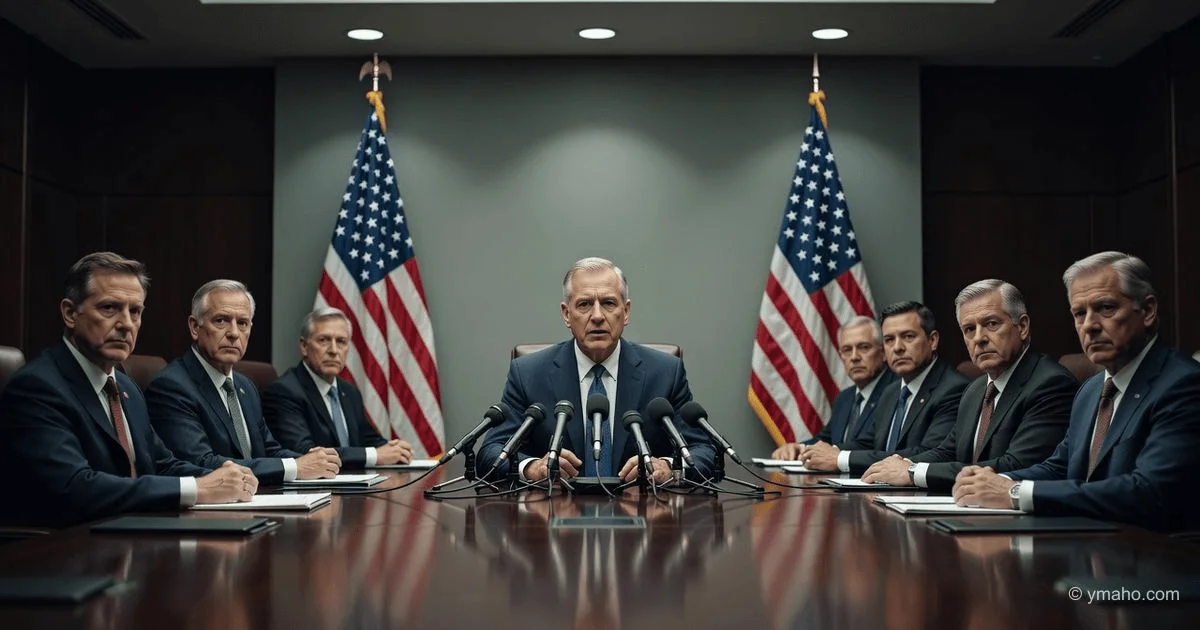
Fed Decision and Kevin Warsh Press Conference to Be the Week's Main Events
The Federal Reserve is expected to keep rates at 3.50%-3.75% at its June 16-17 meeting. The main focus will be on the first speech by new Chair Kevin Warsh, who may signal a departure from the previous leadership's dovish approach.
Analytical article: Kevin Warsh's Debut — The Quiet Revolution No One Is Talking About
[The Gist]: What's Really Happening
The market is fixated on the question, "Will Warsh raise rates or not?" That's a focus error. The reality is far more interesting and dangerous for long-term investors. At the FOMC meeting on June 16-17, 2026, the rate will almost certainly remain at 3.50%-3.75%. But that doesn't matter. Because Warsh intends to change the very operating system of the Federal Reserve — how inflation is measured, how policy is communicated, and how markets should interpret the regulator's signals.
The key non-obvious insight missing from public discourse: Warsh will not fight current inflation by raising rates. Instead, he will change the definition of inflation itself. In his April 2026 Senate testimony, he proposed an "old-fashioned" definition: "Price stability is when no one talks about price changes." This is not a rhetorical figure. It is a fundamental shift from a quantitative 2% target to a qualitative, subjective criterion.
For markets, this means a massive increase in uncertainty. Previously, investors knew: inflation above 2% — the Fed tightens policy. Now the criterion is "people talk or don't talk." And who determines whether "people are talking"? Warsh and his team. This gives him carte blanche for any interpretation of the data.
The second hidden factor: Warsh wants to unwind the Fed's balance sheet, which currently stands at just over $6.7 trillion. He believes the central bank should not be an "active market participant." Selling trillions of dollars in government bonds and mortgage-backed securities means one thing: Treasury yields will rise, regardless of what happens with the key rate. This is a de facto tightening of monetary conditions, but without a formal rate hike. The media is silent about this because it's hard to package into a headline.
Timeline and Context
The power transition at the Fed occurred on May 22, 2026, when Kevin Warsh was sworn in at the White House. This was the first time since 1987 that the ceremony took place not at the Fed's headquarters on Constitution Avenue, but at the president's residence. A symbolic gesture that Wall Street did not appreciate: a signal of possible political dependence of the new chair.
Jeffrey Lacker, former president of the Richmond Fed, noted in a private conversation that such a public "start" creates a false impression in the market that Warsh is an extension of the Trump administration. Although the president himself publicly urged him to be "fully independent" and "do his job," context matters. Trump would not gain political dividends from immediately pressuring Warsh amid rising inflation and a geopolitical crisis. But the "indulgence" will eventually expire.
Below is the key timeline of events leading to the current moment:
| Date | Event | Market Significance |
|---|---|---|
| May 22, 2026 | Kevin Warsh sworn in at the White House | First signal of possible rapprochement between the Fed and the administration |
| June 4-9, 2026 | Reuters poll of 102 economists | 70% rule out a rate cut in 2026 |
| June 12, 2026 | May PPI release (+6.5% YoY) | Highest level since November 2022 |
| June 16-17, 2026 | First FOMC meeting under Warsh | Rate expected to be held, but tone to change |
| June 17, 2026 | Warsh's first press conference | Key moment for understanding his communication strategy |
The inflation data Warsh inherited is alarming. The PPI surged 6.5% year-over-year in May, exceeding forecasts of 6.4%. The CPI, according to the Cleveland Fed, reached 4.2% in May. That is more than double the 2% target, but Warsh himself believes that "once you let inflation become entrenched in the economy, it becomes more expensive and harder to bring down." Yet he also wants to abandon the rigid target. A contradiction? No. It's strategic flexibility.
Who Wins and Who Loses
Losers: holders of long-term Treasuries. If Warsh begins selling off the balance sheet, the yield on 10-year government bonds could jump from the current 4.15% to 4.75-5.00% within 6-9 months. This is a direct blow to funds holding "risk-free" assets. Buy-and-hold strategies in bonds no longer work.
Second loser: growth stocks with high multiples. Rising bond yields increase the discount rate for future cash flows. Particularly vulnerable are technology companies, whose value is 60-70% based on forecasts 5-10 years out. Tesla (TSLA) with a P/E of 68x and Amazon (AMZN) with a P/E of 42x are in the crosshairs. The AI stock market, which already began correcting last week (NVDA -4.6% for the week), will face additional pressure.
Who wins? Short positions in the dollar. Yes, you heard that right. The paradox is that aggressive balance sheet selling and Warsh's hawkish tone could paradoxically weaken the dollar in the medium term. Why? Because the market has already priced in "higher for longer." The DXY rose to 106.4 over the past two weeks. If Warsh, in his June 17 press conference, signals that he will not raise rates but will focus on the balance sheet, it will be perceived as a "dovish shift" for the currency market. The dollar could correct to 104-105.
Winner: gold. With the Fed maintaining a hawkish rhetoric, gold traditionally suffers, but now there is a unique situation: a weakening dollar plus geopolitical risks (Iran, Strait of Hormuz) could push XAU/USD above $2,450 by the end of June. Hedge funds have been increasing long gold positions since the beginning of June, according to CFTC Commitment of Traders data from June 9.
What the Media Isn't Saying
The most important untold story is the "dot plot." Warsh has publicly stated that it is "useless" and "ties the Fed's hands." His idea: to stop publishing individual rate forecasts by FOMC members. Why is this revolutionary? Because for the last 15 years, markets have traded NOT current policy, but forecasts. Without the dot plot, traders will have no "anchor" for forward curves. Volatility in interest rate swaps and fed funds futures will skyrocket.
But Warsh does not have autocratic power. Formally abolishing the SEP (Summary of Economic Projections) and the dot plot requires a vote of the 12 FOMC members. And here he faces a surprise. Jerome Powell remained on the Board of Governors — for the first time in 80 years, a former chair stays on as a regular Fed member. Powell is a proponent of transparency and predictability. He will vote AGAINST abolishing the dot plot. So will Michelle Bowman and Christopher Waller, who publicly support maintaining the "forecast anchor."
Thus, Warsh's first meeting may be marked not by unity, but by division. If Warsh pushes through changes, it will be a victory of the "political" chair over institutional consensus. If not, his reputation will take a hit from the start. Insider sources in Washington say the White House is already developing a "Plan B": if reforms are blocked in the FOMC, the administration may try to change the Fed's mandate through legislative initiatives in Congress. This is what Bloomberg and the WSJ are not writing about.
The second untold factor: the role of Paul Krugman and other "academic hawks." Warsh consults with a group of economists who promote the "trimmed mean" PCE as an alternative to the standard index. This measure excludes extreme price swings (e.g., the oil spike due to the Iran conflict). According to the trimmed mean PCE, US inflation is only 2.9%, not 3.8% as per the standard PCE. If the Fed switches to this measure, it would provide a formal basis NOT to raise rates despite the external shock. A brilliant move that the market is completely ignoring.
Forecast: Next 30 Days and 90 Days
Next 30 days (until mid-July 2026). Key date: June 17, 2:30 PM Eastern, Warsh's press conference. Base case (65% probability): Warsh will be as neutral as possible. Rate held. Dot plot removed from public release "for technical review." The phrase "easing bias" will no longer appear in the statement. The market will react with increased volatility: indices will drop 1.5-2.5% within 48 hours due to uncertainty. The healthcare sector (JNJ, UNH, PFE), which is less rate-sensitive, will hold up best.
Alternative scenario (25%): Warsh unexpectedly takes a hard line, stating the need for "balance sheet normalization." This will trigger panic in the bond market, with 10-year yields jumping to 4.50%, and the S&P 500 falling 3-4% in a week. The technology sector (XLK ETF) will be the worst performer.
Next 90 days (until mid-September 2026). I expect Warsh to gradually implement three changes: (1) a shift to trimmed mean PCE as a "supplementary indicator," (2) reducing press conferences from 8 to 4 per year, (3) beginning quantitative tightening (QT) with $50 billion in government bond sales per month. This will be perceived by markets as a "quiet revolution." By September, 10-year yields will stabilize at 4.60-4.75%, the S&P 500 will correct 5-7% from current highs, but then a recovery will begin driven by value sectors (energy, financials).
Bottom line: the next 90 days will be a period of maximum uncertainty for markets since the 2020 pandemic. Diversification and defensive assets (gold, cash, short-term bonds) will be king.
Editorial Forecast
Asset: US Dollar Index (DXY). Direction: decline in the 24-72 hours following Warsh's press conference. We expect a pullback from the current 106.4 to the 105.2 level. Key levels: resistance — 106.8, support — 105.0 (50-day moving average). Confidence level: moderate (60%). Main risk: if Warsh unexpectedly supports a rate hike in 2026, the DXY will break above 107.0, and the dollar will strengthen, sending gold and commodity currencies (AUD, CAD) into a tailspin. Watch for Warsh's first word on the "balance of risks." That will be the trigger.
— Editorial Team