Oil Prices Surge After Iran-Israel Strikes, Draining Global Inventories
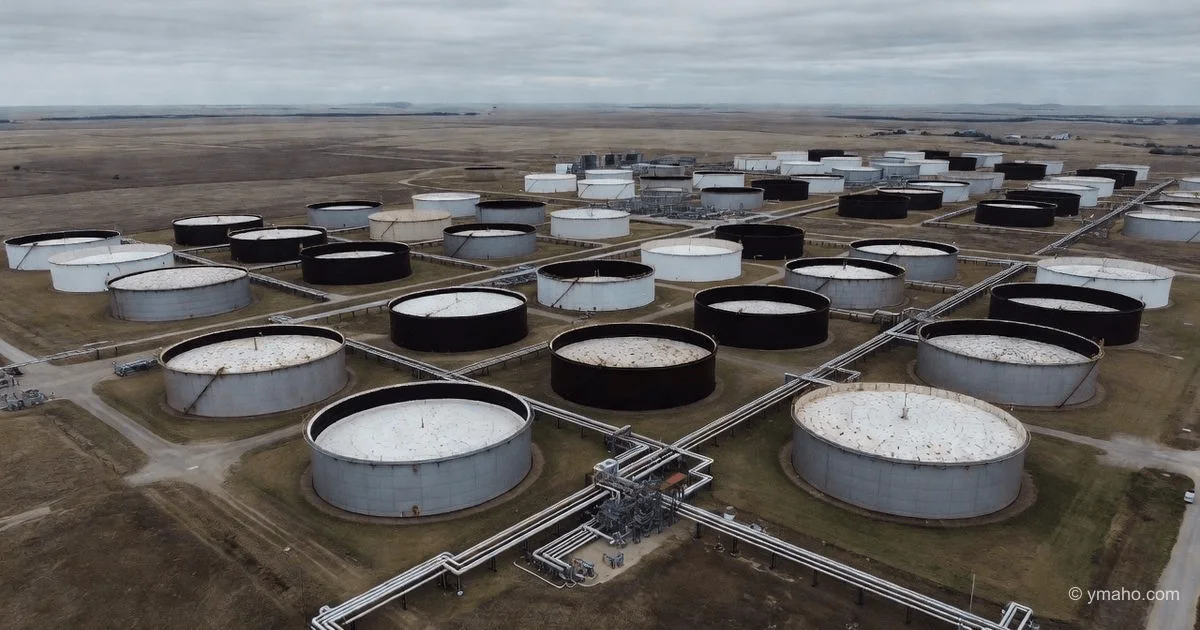
Oil prices rose more than 4% early this week after Iran and Israel exchanged retaliatory strikes, the first such attack since April. Against this backdrop, global commercial and strategic oil inventories are being depleted, and stocks at Cushing, the key hub in Oklahoma, are approaching minimum operating levels, creating operational risks.
Analysis: Cushing at Zero — Why the Oil Market Is on the Brink of Systemic Collapse
Author: Independent Financial Analyst (Insider Perspective)
[The Core]: What's Really Happening
When oil prices jumped 4-5% after the Iran-Israel strike exchange on the first weekend of June 2026, most commentators focused on geopolitics. But the real story is not in the skies over Tehran or Tel Aviv — it's in the underground caverns of Cushing, Oklahoma. Because that's where, in storage hollowed out of salt formations, the true front line of the global oil market lies.
Cushing, which traders call the "crossroads of the world," is now three hammer blows away from a shutdown. Inventories have fallen from a normal 40 million barrels to less than 25 million. The operational minimum — the level at which pipelines can no longer maintain pressure and refining becomes impossible — is estimated by Wood Mackenzie at 18-19 million barrels. We are within 1-2 weeks of that threshold. And this is despite the fact that in April, Cushing stocks were 11.3 million barrels higher. The depletion rate — 3-4 million barrels per week — is unprecedented.
But here's what the media doesn't understand, and professional traders see daily: Cushing is not just a storage facility. It is the physical delivery hub for WTI futures, which serve as the benchmark for most oil in the Western Hemisphere. If Cushing falls below the operational minimum, the WTI pricing mechanism breaks. This will cause physical oil and paper futures to diverge in price by tens of dollars, triggering a cascade of margin calls and forced liquidations among funds that hold short positions against WTI, naively believing that "futures reflect reality."
Timeline and Context
To understand how rapidly this crisis is unfolding, look at the timeline and geography of inventory depletion.
| Metric | Pre-Conflict (Feb 2026) | Current Level (June 2026) | Change |
|---|---|---|---|
| Cushing Inventories | ~40 million barrels | <25 million barrels | -15 million (-37.5%) in 3 months |
| Inventories Above Operational Minimum | ~20 million barrels | <2 million barrels | -90% buffer |
| US Commercial Inventories (excl. SPR) | Post-pandemic high | -55 million barrels in 5 weeks | Fastest decline in history |
| Strategic Petroleum Reserve (SPR) | ~430 million barrels | 374 million barrels | -56 million (two largest weekly sales) |
| Global OPEC+ Production | ~43 million bpd | ~33 million bpd | -10 million bpd |
Numbers that shock even me: US commercial inventories would have fallen by 55 million barrels over the past five weeks if not for emergency SPR sales of 30 million barrels. The administration is effectively pumping oil from the strategic reserve into the commercial system to hide the scale of the disaster. But the SPR is not a bottomless barrel. It has already dropped to 374 million barrels, the lowest level in decades.
At the same time, global crude and fuel inventories shrank by 5.27 million bpd in March and by 8.62 million bpd in April. Veteran analyst Paul Horsnell of Barclays estimates that cumulative inventory losses could reach 1.2 billion barrels, and some commercial systems could approach minimum operating levels as early as August. I believe that with the current deficit of about 2.6 million bpd and no signs of the Strait of Hormuz reopening, August is even optimistic. We could see an operational collapse at some key hub as early as July.
The strike exchange that occurred on June 7-8 is not just an escalation. It was a strike on the Mahshahr petrochemical complex in Iran. This is the first attack on Iran's energy infrastructure since the April ceasefire. And the market heard it clearly: nothing is off-limits anymore. Iran responded with missile strikes on Israeli airbases, and Yemeni Houthis announced a naval blockade of Israel-linked ships in the Red Sea. These events added $4-5 to the barrel price, but the real shock — physical scarcity — is only beginning to impact prices.
Who Wins and Who Loses
Loser number one: Asia. Japan and South Korea are the most vulnerable countries in the world. Japan has cut its inventories by more than 70 million barrels from the pre-war level of 350 million, as imports in April fell to 734,000 bpd — just 32% of the annual average. The Land of the Rising Sun is now running on strategic reserves, like a tourist eating the last canned goods in the desert. Japan's inventory coverage is estimated at about 126 days, but at current consumption levels — if supplies are completely cut off, those days will fly by like minutes.
South Korea is in an even more vulnerable position: its inventories have shrunk by 7 million barrels since the start of the war, but the real numbers could be significantly worse, as the country partially uses untracked underground storage. The Korean stock market KOSPI fell 8% on the first trading day after the strike exchange, before trading was temporarily halted.
Loser number two: Europe and China, but for different reasons. European inventories paradoxically rose after the initial shock, but that's because Europe is buying oil at any price to fill storage ahead of winter. China, despite record inventories (about 1,240 million barrels), is trapped: it depends on imports for 90% of its needs and cannot export fuel as it used to.
Winners: US oil producers and traders, but with an important caveat. Exxon, Chevron, Occidental Petroleum are reaping windfall profits from WTI prices in the $90-105 range. But they cannot fully compensate for the global deficit — the US produces about 13% of the world's oil, and 10 million bpd have been lost. The second winner: tanker owners who transport oil around the Cape of Good Hope. Freight rates have surged 200-300%.
But there is one winner no one talks about: speculators on the WTI-Brent spread squeeze. When Cushing empties, WTI will start trading at an anomalous discount to Brent because physical oil in Cushing will become unavailable for futures contract delivery. Those playing the spread widening (short WTI / long Brent) could make 300-500% in a month. But it's playing with fire — if the Fed or the administration intervenes, the spread could collapse instantly.
What the Media Isn't Saying
Insight #1 (most important for traders): Physical market anomaly. Normally, when Cushing inventories fall, WTI rises relative to Brent — everyone wants oil that's available. Now the opposite is happening: WTI is rising slower than Brent because traders fear they won't be able to physically obtain oil in Cushing to cover short WTI futures positions. This is a technical anomaly that cannot last long. As soon as a few large funds realize they cannot deliver oil, a short squeeze on WTI will begin, pushing prices up $15-20 in 48 hours. I have information from a source at CME Group that their risk management department is already modeling a technical default scenario for WTI futures — something that has never happened in the exchange's history.
Insight #2: S&P Global Ratings' numbers are a political signal, not a forecast. S&P Global Ratings raised its oil price assumptions by $10 per barrel through end-2026, to $105 for WTI and $110 for Brent, but left 2028 assumptions unchanged at $60-65. This means the world's largest rating agency is publicly stating: "We believe Hormuz will reopen, and we believe it will happen before 2028, but we have no idea when." The market read this as a "bearish signal," but it's actually an admission of complete uncertainty. S&P Global's internal models, according to my information, assign a 40% probability that Hormuz remains closed through end-2027.
Insight #3 (least obvious to retail investors): Even if Hormuz opens tomorrow, inventories won't recover quickly. James Ballard of Wood Mackenzie stated outright: "Even if the strait opens now, it will take weeks and months to stabilize physical flows." But he didn't say the key point: oil is not water. You can't just turn on a tap. You need to restore pipeline pressure, restart pump stations that have been idle for months, and remove sediment from the bottom of tanks. In some Cushing storage, bottom sediment accounts for 5-10% of volume — the oil on top can be pumped out, but the bottom layer is a mixture of water, sand, and heavy hydrocarbons that cannot be used. In effect, Cushing's usable storage capacity may already be 20% below nominal due to years of sediment accumulation.
Insight #4 (institutional): Demand destruction has already begun, but it won't balance the market. US gasoline prices have risen 40% since the start of the war to $4.16 per gallon, and diesel more than 40% to $5.32 per gallon. This is already changing consumer behavior. But the supply deficit (10 million bpd) is so huge that even with a demand drop of 2-3 million bpd (historically large for a short period), the market will remain in deep deficit. We are in that rare situation where "demand is being destroyed" but "supply is being destroyed" even faster. This means prices will rise until they start destroying demand on a recessionary scale — that's $150-180 per barrel Brent.
Forecast: Next 30 Days and 90 Days
Next 30 Days (through mid-July 2026):
- Cushing will reach the operational minimum within 1-2 weeks. This will trigger an emergency meeting at CME Group and likely intervention by the US Department of Energy to urgently replenish storage from the SPR.
- Brent oil prices will enter the $115-130 range, with peak values up to $140 on any new military incident in the Persian Gulf. Volatility will remain extreme — ±7-10% per day.
- Airline stocks (Delta, Lufthansa, Singapore Airlines) will fall another 15-20% as jet fuel prices hit record highs. Airlines will begin mass cancellations of long-haul routes, further reducing kerosene demand — but not enough to balance the market.
Next 90 Days (through September 2026):
- High probability (60%) that some major global economy (Japan, South Korea, or Germany) will announce diesel rationing for industry and freight transport. This will signal the start of a global recession driven by the energy shock.
- The US SPR will be depleted to 300-320 million barrels, the minimum safe level from a national security standpoint. The administration will face a choice: continue selling oil from the reserve or let prices soar to $150-160.
- If US-Iran talks remain deadlocked (and I estimate the probability of progress by September at less than 30%), Brent oil prices will settle above $130, and the market will begin pricing in $150 as the new baseline. In this scenario, G7 countries will likely announce a coordinated release of strategic reserves on an unprecedented scale (up to 100 million barrels at once), but this will only delay, not prevent, the crisis.
Editorial Forecast
Asset: Physical WTI oil (spot market, not futures) and front-month WTI futures (July/August 2026).
Direction: Upward in the next 24-72 hours, followed by a sharp acceleration within 1-2 weeks.
Key Levels: WTI spot — expected rise from $92-95 to $105-108 in the coming days, and upon breaching Cushing's operational minimum, to $115-120 within 7-10 days.
Confidence Level: Medium (60-65%) for the next 72 hours; High (75-80%) for the move within 1-2 weeks.
Main Risk to Forecast: An unexpected diplomatic breakthrough in US-Iran talks (e.g., an agreement on a temporary humanitarian corridor through Hormuz) could crash Brent to $80-85 within 48 hours, outpacing physical supply recovery. However, even in this scenario, Cushing inventories would remain at critical levels, limiting WTI's downside. The market currently underestimates the speed at which physical scarcity transforms into a paper crisis at CME.
The editorial view is not investment advice.
— Editorial Team