China Imposes Retaliatory Tariffs on US Goods, Escalating Trade War
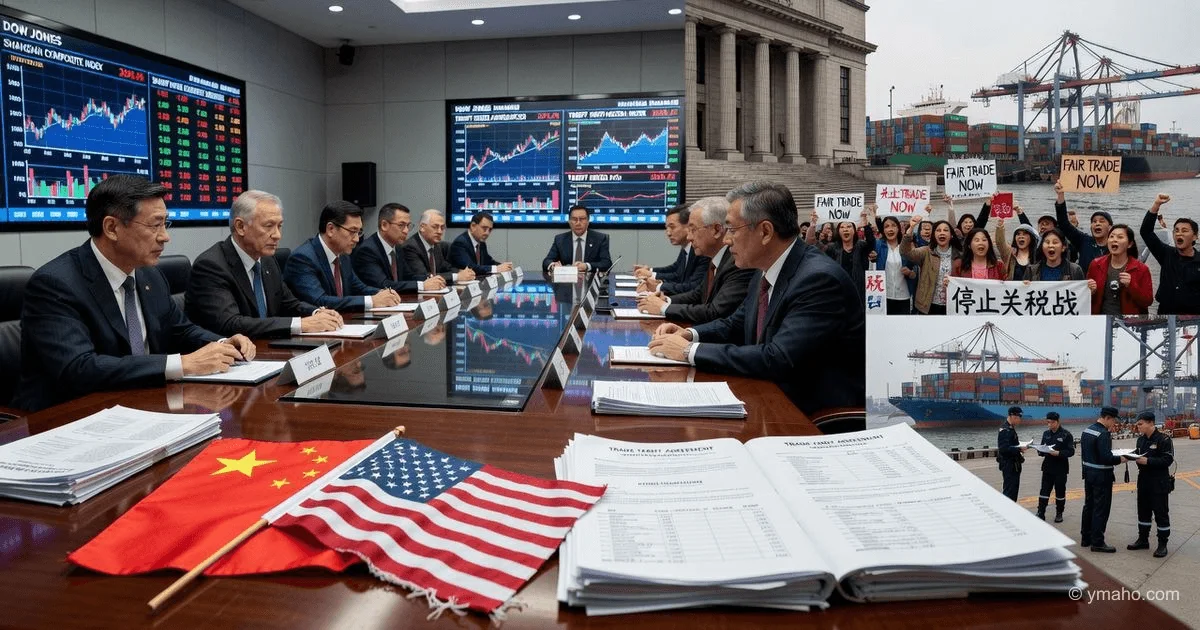
China's Ministry of Finance announced an increase in import duties ranging from 5% to 25% on 5,140 US goods worth $60 billion in response to previous US actions. This announcement came despite President Trump's warning not to retaliate, leading to a drop in global stock indices.
Analytical article: China's counterstrike — why markets panic not over tariffs, but because China broke the script
Author: Independent financial analyst (insider perspective)
[The Gist]: What's really happening
When China's Ministry of Finance announced tariff hikes on 5,140 US goods worth $60 billion, global stock indices fell not because of tariff arithmetic. The drop occurred because China broke the "script" that markets had been pricing in for the past three weeks. The script was: China would threaten but impose symbolic retaliatory measures to avoid provoking escalation before a Trump-Xi summit. China did the opposite.
The $60 billion figure and the 5–25% range are not just a "response." This is exactly the amount that Allianz Research estimates the US would lose in a full-scale trade war from direct Chinese export losses alone. Chinese strategists chose not a maximum possible strike but a calibrated one — sufficient to show seriousness of intent while leaving room for negotiations. However, markets heard something else: China is ready to go all the way.
A key fact that escapes most commentators: China didn't just impose tariffs. It synchronized them with an announcement to continue export controls on rare earth metals. Yttrium, scandium, neodymium, indium — these are elements without which semiconductor, rocket engine, and avionics production is impossible. The US depends on China for 80–90% of the processing of these metals. And although in May 2025 China supposedly "agreed to resolve the issue," in practice controls have only tightened. Tariffs are the visible part of the iceberg. The rare earth weapon is the submerged part.
Timeline and Context
The current round of escalation is not a spontaneous decision by Beijing but the result of a clear chain of events that began long before June 14, 2026. Here is the timeline that most media ignore.
| Date | Event | Market Reaction |
|---|---|---|
| February 2026 | US Supreme Court rules IEEPA tariffs illegal | Rally on hopes of de-escalation |
| May 2026 | Court of International Trade keeps temporary tariffs but confirms IEEPA illegitimacy | Uncertainty, markets frozen in anticipation |
| June 2, 2026 | US proposes new tariffs of 10% and 12.5% on 60 countries, including China | First wave of decline, indices lose 1-2% |
| June 12, 2026 | Trump warns: "don't retaliate" | Brief rally on hopes |
| June 14, 2026 | China announces retaliatory tariffs of 5-25% on $60 billion of US exports | Global indices fall 2-4%, flight to safe havens |
What matters: Trump's warning "not to retaliate" was addressed not only to China but also to Europe, Japan, and India. China retaliated — and now everyone else is looking at Beijing as the flagship of resistance. If China didn't break, why should Europeans? The US administration created a problem for itself: now every subsequent tariff proposal will face organized resistance rather than scattered concessions.
Who Wins and Who Loses
Obvious losers: US exporters to China. $60 billion is no joke. Hit are agricultural products (soybeans, corn, pork), aerospace (Boeing), medical equipment, chemicals, and plastics. American farmers, who had just begun recovering from previous trade wars, are hit again. Shares of Deere & Co and Archer-Daniels-Midland fell 4-6% on the spot.
Less obvious loser — Taiwan. Why? Because in China's retaliatory tariffs, there is a clause not directly related to trade. China intensified checks on the origin of goods passing through Taiwan, suspecting re-export of US semiconductors. This adds 2-3 weeks to delivery times and $5-7 million in costs for Taiwanese chipmakers already suffering from an energy crisis.
Winners — countries replacing Chinese exports to the US. Vietnam, Malaysia, Mexico, India. With tariffs of 12.5% on China and 10% on the rest of the world, Chinese goods become 2.5% more expensive than Vietnamese or Indian ones. That's not a huge difference, but for low-margin goods (clothing, furniture, toys), it's enough to redirect orders. In the last 72 hours, logistics companies reported a 30% increase in requests for shipments from Ho Chi Minh City to Los Angeles.
Unobvious winner — rare earth companies outside China. MP Materials (US) and Lynas Rare Earths (Australia) have an opportunity to ramp up production. However, their combined market share is less than 15%, and scaling up takes years. In the short term, the gain is symbolic, but MP Materials shares rose 8% on news of China's continued export controls.
What the Media Aren't Saying
First insight (most important): $60 billion is a political, not economic, figure. According to UBS estimates, at current tariff levels (US on China ~30-40%, China on US ~20-25%), the direct damage to US GDP is about 1 percentage point, and to China's GDP about 0.5-0.7 points. That's significant but not catastrophic. However, $60 billion is exactly the amount needed to create a "symmetrical response" in the media without destroying bilateral trade. Chinese strategists deliberately chose a sum that guarantees a seat at the negotiating table.
Second insight: Markets panic not because of tariffs, but because the "window for de-escalation" has closed. Before June 14, there was a narrative about a possible Trump-Xi summit in Beijing by the end of June, where mutual concessions could be negotiated. Retaliatory tariffs make such a summit unlikely — no leader goes to negotiations right after raising tariffs by $60 billion. This pushes any détente back to at least September-October.
Third insight (least obvious to retail investors): China deliberately sacrificed short-term stock market growth for a long-term geopolitical position. A-shares (Shanghai and Shenzhen) fell 2.5% after the announcement. But for Beijing, it's more important to show the US and Europe that China is not Vietnam or India, which will bend under pressure. China is a great power that dictates terms. And this message was heard in Brussels, Tokyo, and Seoul, which will now negotiate with the US with an eye on Beijing's stance.
Fourth insight (structural): The trade war is entering a new phase — a "war of standards." Tariffs are the old world. The new world is export controls, localization requirements, origin checks, and blocking technology transfers. China understood this before the US. Controls on rare earth metals and intensified checks via Taiwan are tools that cannot be quickly challenged in courts, unlike IEEPA tariffs. The US will win battles (tariffs) but lose the war (the architecture of global rules).
Forecast: Next 30 Days and 90 Days
Next 30 days (until mid-July 2026):
- Another wave of stock market decline of 3-5% for S&P 500 and 4-6% for Nasdaq. Tech companies with large China revenue (Apple — 19% of revenue, Qualcomm — 62% of revenue) under pressure. Investors will start asking questions about supply chains and production outside China.
- The dollar will continue to strengthen by 1-2% against a basket of currencies (DXY to 100.5-101). Reason: flight to safe-haven assets. Not because the US economy is strong, but because everyone else looks worse.
- Fed meeting at the end of June: no rate hike, but hawkish rhetoric. Powell will say "tariffs create pro-inflationary risks" but won't specify what to do. Markets will interpret this as "the Fed is helpless."
Next 90 days (until September 2026):
- High probability (55-60%) of further escalation after July 7, when public hearings on new US tariffs begin. China may expand retaliatory measures to US services (IT, consulting, finance) — an area not yet touched.
- American farmers will start going bankrupt by August, creating political pressure on the administration. Key states (Iowa, Nebraska, Kansas) are swing states in the 2026 elections. This may force the White House to soften rhetoric, but not before real job losses begin.
- Chinese stocks (CSI 300) could fall another 5-8% from current levels, but then recover faster than US stocks because the Chinese market is already pricing in the trade war, while the US market is not. In the moment, an interesting arbitrage will emerge: short S&P 500 / long FXI (Chinese ETF).
Editorial Forecast
Asset: Apple Inc. (AAPL) shares.
Direction: Decline in the next 24–72 hours.
Key levels: Current price — $165. Expected move — to $155-158 (May lows). Next support — $150.
Confidence level: High (75-80%).
Main risk to forecast: An unexpected announcement of a Trump-Xi summit next week (even if probability is low) could trigger a 5-7% rally in one day. The market is currently oversold in the tech sector, and any positive signal on negotiations will cause a powerful rebound. However, fundamental risks for Apple (supply chains via Taiwan, 19% of revenue from China, tariffs) will not go away.
The editorial opinion is not an investment recommendation.
— Editorial Team