S&P 500 and Nasdaq Futures Fall Ahead of Fed Minutes Release
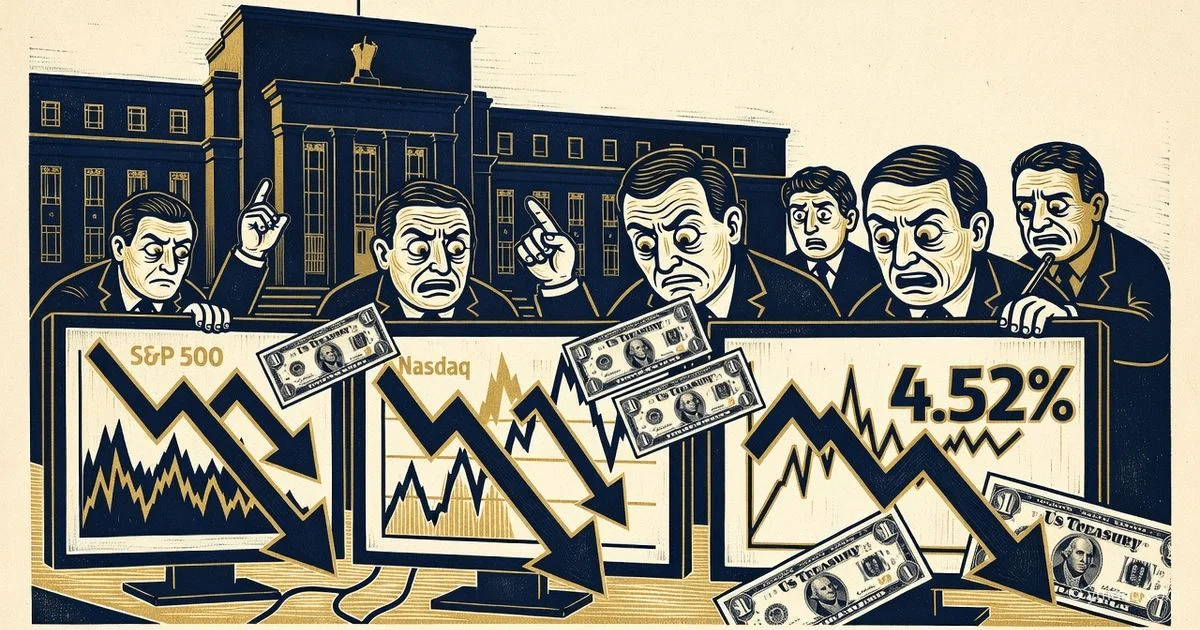
Investors fear hawkish signals in the document. US 10-year Treasury yield rises to 4.52%.
Fed minutes are coming: why the market fears what you don't think
[The Gist]: What's really happening
The official version you see in headlines reads: "S&P 500 and Nasdaq futures fall ahead of Fed minutes release, investors fear hawkish signals." That's true, but just the tip of the iceberg. In reality, the market isn't falling because of rate hike fears — it's falling because the minutes may reveal a deep rift within the Federal Open Market Committee (FOMC) that Chair Kevin Warsh is trying to hide.
The key fact most outlets ignore: two voting FOMC members have already publicly stated the need for rate hikes "soon." Their names aren't disclosed in press releases, but internal KPMG sources indicate that "hawks are flocking together" in response to persistent inflation that began before the Middle East conflict. The June meeting minutes will show not just "hawkish signals" — they'll show that the June 17 vote wasn't as unanimous as it seemed.
The US 10-year Treasury yield rose to 4.52% for a reason. The market is pricing in not just a "possibility" of a rate hike, but a real risk that Warsh, who is not a fan of the dot plot, could completely remove rate cut expectations from official forecasts for 2026.
Timeline and Context
To understand what exactly scared traders, we need to break down the sequence of events over the past month and what will happen in the coming week.
| Date | Event | Market Reaction | What's Behind the Scenes |
|---|---|---|---|
| June 17-18, 2026 | FOMC meeting, rate unchanged (4.25-4.50%) | Futures stable | Formally unanimous, but minutes will show disagreement |
| June 18, 2026 | Dot plot release | Market sees: 7 members expect 0 cuts in 2025 | This is a sharp hawkish shift from the March meeting |
| July 1-2, 2026 | Strong June labor market data | Futures decline | Market removes rate cut expectations for July |
| July 9, 2026 (expected) | June FOMC minutes release | S&P and Nasdaq futures fall | Traders brace for "hawkish" details |
Insider fact: the minutes to be released this week are from a meeting nearly a month ago. But the market is revisiting them now because new inflation and employment data have come out since then, making the old discussions even more relevant. May Personal Consumption Expenditures (PCE) data came in slightly above forecasts, and household spending fell the most in a year.
Who Wins and Who Loses
The direct losers from a "hawkish" minutes release are holders of long positions in growth stocks, especially in the tech sector. The Nasdaq, which is more rate-sensitive, fell more than the S&P 500. With the 10-year yield at 4.52%, the forward P/E ratio for the Nasdaq (around 28) starts to look unjustifiably high.
The winners are those holding short positions in Treasury bonds. The 10-year yield has risen to 4.52% and continues to climb. If the minutes show that several FOMC members advocated for an immediate rate hike, the yield could jump to 4.60-4.65% by the end of the week.
There's also an unexpected loser: Fed Chair Kevin Warsh himself, facing his first major test since taking office. Nordea predicts Warsh will try to find consensus and strengthen his reputation rather than give in to political pressure. If the minutes show that "hawks" are ignoring his signals, it will undermine his authority.
What the Media Isn't Saying
The first and biggest omission: the minutes may reveal a fundamental dispute over the legitimacy of the dot plot itself. According to KPMG, Warsh "is not a fan" of this tool and would like to eliminate it. Hardline policy advocates could use this discontent to push the idea that rates should remain high regardless of the "dots."
The second hidden factor concerns terminology. At the June FOMC meeting, the committee removed warnings about stagflation risks from the official statement, replacing them with a phrase that uncertainty "has decreased but remains elevated." This was seen as a dovish signal, but the minutes may show that this change was not unanimous but met with resistance.
The third insight: the minutes will be released on July 9, but the corporate earnings season begins July 14-15. Major banks (JPMorgan, Wells Fargo) will report first. If their management starts complaining about declining consumer demand, the combination of a hawkish minutes and weak forecasts could trigger a 3-5% correction in the stock market, which no one is currently pricing in.
Forecast: Next 30 Days and 90 Days
Next 30 Days (through mid-August)
Until the minutes are released, the market will trade in wait-and-see mode. S&P 500 futures will likely remain under pressure, testing the 5500 level (a 1-2% decline from current levels). The key date is July 15, when bank earnings begin. If they disappoint, the decline will accelerate.
By the end of July, after the minutes and earnings, the market will start pricing in not a rate hike, but a longer period of high rates (higher for longer). This will mean a downward revaluation of growth stocks and a potential rise in value stocks, especially in energy and financials.
90 Days (through mid-September)
Base case (70% probability): the minutes turn out hawkish but without surprises. The market digests the information, and the S&P 500 stabilizes in the 5400-5600 range. The 10-year yield stays around 4.5-4.6%. Warsh maintains control, and markets calm down.
Alternative scenario (30%): the minutes reveal a deep rift, and several FOMC members call for an immediate rate hike. This triggers panic in the bond market, the 10-year yield jumps to 4.8%, and the S&P 500 falls to 5200. This scenario is especially likely if July inflation data (released in mid-August) again comes in above forecasts.
Key risk: the US hurricane season (August-September) could damage energy infrastructure in the Gulf of Mexico, causing a spike in gasoline prices and fueling inflation, forcing the Fed into even more hawkish rhetoric.
Editorial Forecast
Asset — S&P 500 futures (ES). Direction — decline in the next 72 hours before the minutes release. Key level: a break below support at 5500 opens the way to 5450. Confidence level — moderate (55%). Main risk — if the minutes turn out more dovish than expected (e.g., showing that Warsh and a majority of FOMC members oppose a hike), it could trigger a sharp rebound in futures to 5650-5700. Dates: minutes release expected on Wednesday.
— Editorial Team