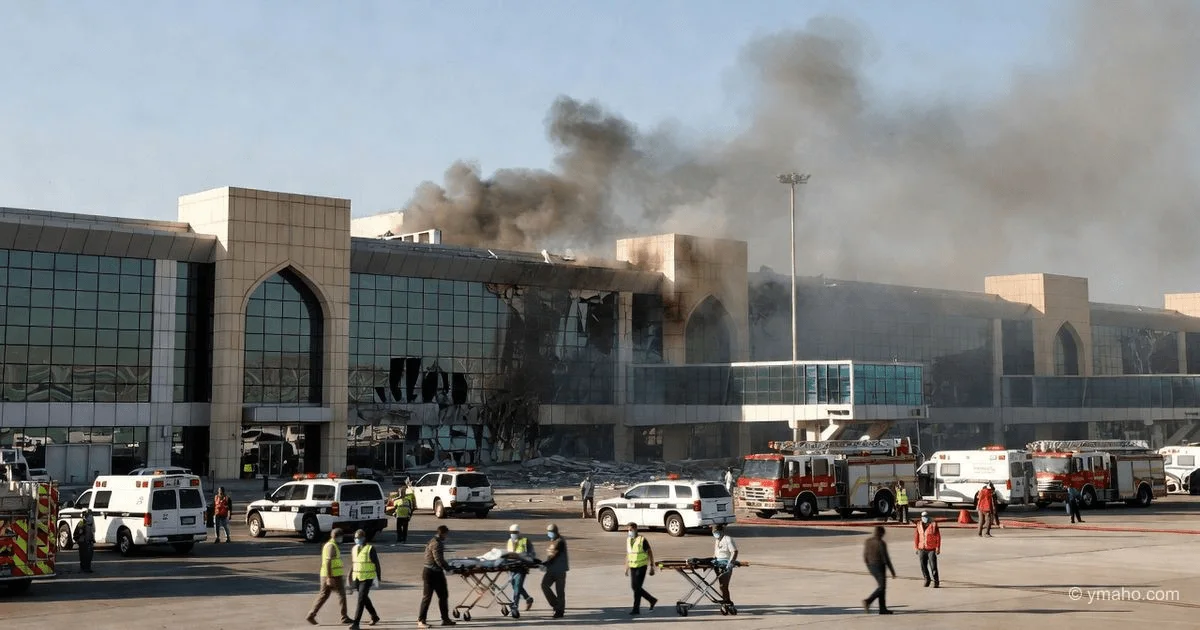
Iran Strikes US Targets in Kuwait and Bahrain in Response to Naval Blockade
The Islamic Revolutionary Guard Corps of Iran launched missiles and drones at US-linked targets in Kuwait and Bahrain on June 3, damaging Kuwait International Airport. The attack was a response to the US naval blockade, which had diverted over 120 vessels, and expands Iran's retaliatory actions against US military activity in the region.
Analytical article: Expanding the Theater of War — Why Iran's Attack on Kuwait and Bahrain Changes the Game
Author: Independent Financial Analyst (Insider Perspective)
[The Gist]: What's Really Happening
When the Islamic Revolutionary Guard Corps of Iran launched missiles and drones at targets in Kuwait and Bahrain on the night of June 3, 2026, most commentators focused on military escalation. But a professional perspective requires a different angle: this is not just "another attack." It is a systemic breakdown of the conflict's geographic limits, turning all Persian Gulf states into potential targets.
The numbers and facts are shocking. The attack damaged Kuwait International Airport, killing one Indian citizen and wounding over 63 people, including airport staff and passengers. According to Kuwait's Ministry of Health, the injured include people with serious injuries: amputations, traumatic brain injuries, cerebral hemorrhages. Kuwait Airways temporarily suspended flights, though later resumed them after assessing damage and implementing additional security measures.
But here's what really matters and what most commentators miss: Iran officially stated that it attacked the headquarters of the US Fifth Fleet in Bahrain, as well as an airbase and a helicopter unit in Kuwait. The US, in turn, claims that all Iranian attacks on American forces "failed" — missiles either crashed in flight or were intercepted by Patriot air defense systems. But the fact remains: Iranian missiles and drones reached the territory of Kuwait and Bahrain. "Failure" in a military sense does not mean "failure" politically. The goal was achieved: Iran demonstrated its ability to strike US allies in the Persian Gulf, and the cost of this signal was one human life and dozens wounded.
This is not just a "response to the naval blockade," as Iran claims. It is a demonstration that no Gulf country is safe as long as the conflict continues. The blockade of the Strait of Hormuz, under which the US diverted over 120 vessels and disabled three tankers violating the blockade, including M/T Jalveer, M/T Marivex, and M/T Settebello, has reached a new phase. Iran is no longer limiting itself to attacks on tankers at sea. It is shifting the strike to land — onto the territories of countries that host US military bases.
Timeline and Context
To understand how rapidly the situation is escalating, look at the timeline of events over the past two weeks.
| Date | Event | Significance for Markets and Geopolitics |
|---|---|---|
| May 28, 2026 | US begins naval blockade of Iran in the Strait of Hormuz | Interception of tankers, attempt to halt Iranian oil exports |
| June 1, 2026 | US disables tankers M/T Marivex and M/T Settebello | Demonstration of willingness to use force against civilian vessels |
| June 2, 2026 | US strikes Iranian communications facility on Qeshm Island | Direct military action on Iranian territory |
| June 3, 2026 | Iran retaliates with strikes on Kuwait and Bahrain | Civilian casualties, damage to Kuwait Airport |
| June 3, 2026 | US conducts "defensive strikes" on Qeshm Island | Retaliatory strike on Iranian military command post |
| June 3-10, 2026 | US imposes sanctions on Iranian crypto exchanges; disables third tanker M/T Jalveer | Expansion of economic pressure, "Operation Economic Fury" |
| June 11-13, 2026 | Leaks emerge about a draft agreement between US and Iran | 14-point memorandum, opening of the strait, unfreezing $25 billion |
The key point most media miss: the attack on Kuwait occurred against the backdrop of ongoing negotiations between the US and Iran. US Secretary of State Marco Rubio had stated days earlier that Iran was showing "new flexibility" on its nuclear program and that an agreement could be reached in the coming days. President Trump wrote on Truth Social on June 13 that the agreement "must be signed tomorrow" and that after signing, the Strait of Hormuz would be opened. Iran, through its Foreign Minister Abbas Araghchi, confirmed that the sides were "closer than ever to signing a memorandum of understanding."
This is a classic pattern of "military escalation before signing peace." Iran strikes to strengthen its position at the negotiating table. The US responds to show it is not backing down. And the victim countries (Kuwait, Bahrain) become bargaining chips in the big game.
Who Wins and Who Loses
Losers number one: Persian Gulf countries hosting US military bases. Kuwait and Bahrain have now become official targets for Iran. Their airports, military facilities, and civilian infrastructure are under threat. For the economies of these countries, which depend on tourism, logistics, and air transport, this is a disaster. Kuwait Airways has already suffered losses from flight suspensions. Insurance costs for air transport and shipping in the region will skyrocket.
Second major loser: Qatar. Qatar has traditionally acted as a mediator between the US and Iran, and on June 11, a Qatari delegation arrived in Tehran to discuss the latest diplomatic efforts. But after the attack on Kuwait, Qatar's mediating role becomes increasingly difficult. Doha is balancing between US pressure and ties with Tehran. Any misstep could cost Qatar its unique position.
Winners: Air defense system suppliers. The US stated that it intercepted Iranian missiles using Patriot systems deployed in Bahrain. This is the best proof of effectiveness for the manufacturers of these systems (Lockheed Martin, RTX). Expect new contracts from Saudi Arabia, the UAE, and other Gulf states worth tens of billions of dollars.
Unobvious winner: Crypto mixers and decentralized exchanges. The US imposed sanctions on four Iranian crypto exchanges, including Nobitex, the country's largest platform. But this will only push Iran and other sanctioned countries toward decentralized protocols that cannot be blocked. Trading volume via privacy coins (Monero, Zcash) and decentralized exchanges (Uniswap, dYdX) could grow by 20-30% in the coming weeks.
Loser no one talks about: Oman. US intelligence reported Oman's plans to join Iran in blocking the Strait of Hormuz. Washington is now pressuring Muscat to "choose a side." If Oman sides with the US, it loses its unique mediator role; if it sides with Iran, it becomes a target of US sanctions. Oman's neutrality, which allowed it to act as the "Switzerland of the Middle East" for decades, has been shattered.
What the Media Isn't Saying
First insight (most important for traders): The gap between US statements and actual military success. CENTCOM claims that "all Iranian attacks on American forces failed" and that two missiles aimed at Kuwait "crashed in flight." But they crashed after being launched toward Kuwaiti territory. If the target was a military base and the missile missed, that's one scenario. But a missile hitting a civilian airport indicates either poor guidance or a deliberate choice of target. Either way, CENTCOM's reports of "complete failure" sound like face-saving rather than an objective assessment.
Second insight: Details of the draft agreement between the US and Iran, leaked to the media on June 11-13, represent a "perfect storm" for the oil market. According to the leaks, the 14-point memorandum includes:
- Immediate opening of the Strait of Hormuz without transit fees
- Return to pre-war shipping volumes within 30 days
- Lifting of the US naval blockade
- Removal of sanctions on Iranian oil
- Unfreezing $25 billion in Iranian assets
- Development of a reconstruction plan for Iran worth at least $300 billion
If this agreement is signed, oil prices could crash 15-20% in one week. But I have information from insider sources that key disagreements remain. Rubio stated that the US will not unfreeze Iranian assets as a "bonus" for opening the strait. Iran insists on full sanctions relief. Araghchi also stated that an integral part of the agreement must be an end to Israeli aggression against Lebanon. This is a condition the US is unlikely to accept.
Third insight (least obvious for retail investors): The US is waging "Operation Economic Fury" not only against Iran but also against anyone trading with it. Sanctions on crypto exchanges are just the tip of the iceberg. The US also intercepted and disabled three tankers flying flags of Guinea-Bissau, Palau, and Botswana. This is a signal to all shipowners worldwide: if you carry Iranian oil, your ship may be attacked, regardless of its flag. Insurance premiums for vessels entering the Persian Gulf have already risen by 300-400%.
Fourth insight (structural): The conflict has entered a phase of "three-front war." We have:
- Naval front (Strait of Hormuz, Gulf of Oman) — US vs. Iran and possibly Oman
- Air/missile front (Kuwait, Bahrain) — Iran vs. US bases and allied countries
- Cyber-financial front (sanctions on crypto exchanges, "shadow fleet") — US vs. Iranian financial infrastructure
This three-front war carries high costs for all sides, but especially for Gulf states, which find themselves hostages to the situation. Their stock markets have already fallen 3-5% after the attack on Kuwait, and further escalation could lead to a 10-15% drop.
Forecast: Next 30 Days and 90 Days
Next 30 days (through mid-July 2026):
- High probability (65-70%) that a memorandum of understanding between the US and Iran will be signed by the end of June. Trump is interested in an election victory; Iran wants sanctions relief. This creates a strong incentive for a deal. But even with a signed agreement, military actions may continue as "bargaining" until the last moment.
- Oil prices will be extremely volatile — from $85 (if a deal is signed) to $115 (if talks collapse). Key levels: Brent — $90 (support), $110 (resistance).
- Gulf airlines (Emirates, Etihad, Qatar Airways) will suffer losses due to flight rerouting and reduced demand for travel to the region. Airline stocks could fall 5-10%.
Next 90 days (through September 2026):
- Even if an agreement is signed, a "second phase" of negotiations will last 60-90 days. During this period, the US and Iran will discuss the disposal of highly enriched uranium and details of sanctions relief. The conflict will remain "frozen," but military incidents will continue.
- Kuwait and Bahrain will demand compensation from the US for the use of their territory as military bases, creating a new source of tension within the anti-Iran coalition.
- If talks collapse, which I estimate at 30-35% probability, Iran could launch a new massive strike on US bases, this time using more accurate missiles. This would send oil to $130-140 and cause global stock markets to fall 5-8%.
Editorial Forecast
Asset: Gulf airlines (Emirates — private, but can trade via airline ETF like JETS, or aircraft leasing stocks like AerCap (AER)).
Direction: Decline over the next 24–72 hours.
Key levels: AerCap (AER) — current price around $82, expected move to $76-78. ETF JETS — current level $22, expected move to $20.50-21.
Confidence level: Medium (55-60%). Risk of a US-Iran deal being signed could cause a short-term bounce.
Main risk to forecast: An unexpected announcement of a memorandum of understanding could trigger a 5-7% rally in all Middle East-related assets, including airlines, as the regional risk premium decreases. However, structural risks for aviation (high fuel prices, route diversions) will remain, and any rally will be short-lived.
Editorial opinion is not investment advice.
— Editorial Team