Israel Expands Control in Gaza to 60% and Intensifies Pressure on Hamas Despite Ceasefire
Since the ceasefire was established in October 2025, Israel has expanded its control in the Gaza Strip to approximately 60% of the territory and carried out over 40 attacks on Hamas in May, the highest monthly figure. Israeli strikes target field commanders and aim to weaken the group's civil authority, while hundreds of thousands of Palestinians continue to live in tent camps under harsh conditions.
Analytical Article: The "Yellow Line" Creeps — Why Israel's Expanding Control in Gaza Changes the War Economy
Author: Independent Financial Analyst (Insider Perspective)
[The Gist]: What's Really Happening
When Israeli Prime Minister Benjamin Netanyahu publicly stated on May 28, 2026, that he had ordered the IDF to expand its control in the Gaza Strip to 70% of the territory, most global media outlets saw it as another round of military escalation. But a professional view of the situation requires a different angle: this is not just "another attack." It is a systemic breakdown of the ceasefire regime established in October 2025 and a transition to a new phase of the conflict, where humanitarian catastrophe becomes a tool of military strategy.
The figures cited by Israeli military and independent sources create a false impression of gradualness. At the time of the ceasefire agreement on October 9, 2025, initiated by U.S. President Donald Trump, the "yellow line" of Israeli-controlled territory stood at approximately 52-53% of the Gaza Strip. By May 2026, according to various estimates, this share had grown to 59-64%. And now Netanyahu announces 70%.
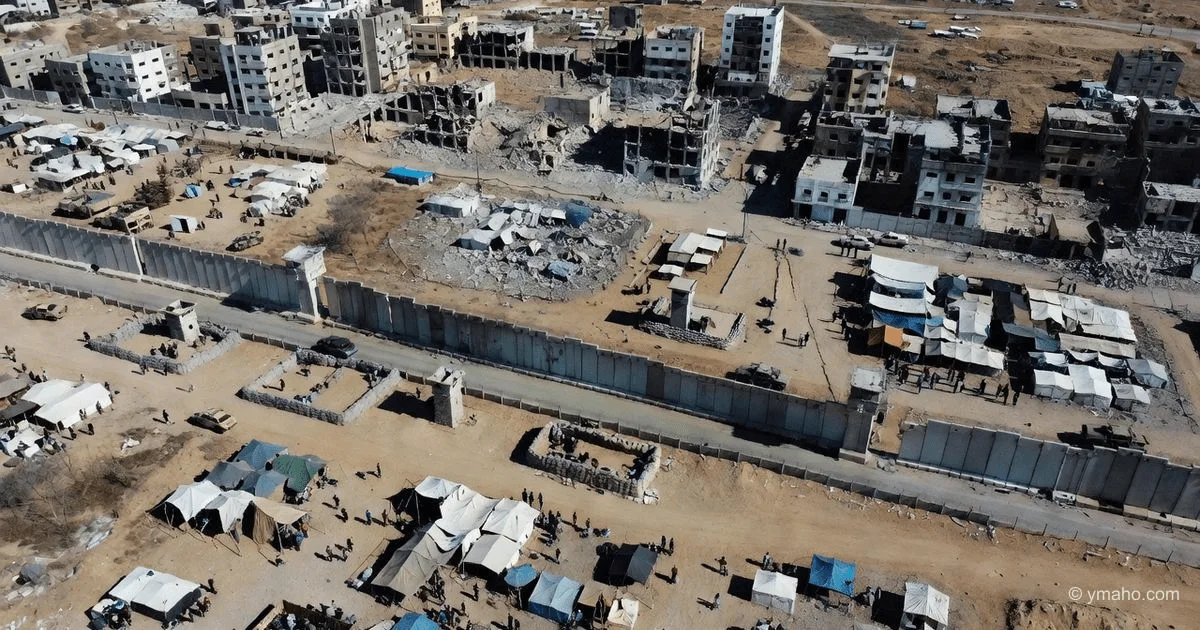
But here's what really matters and what most commentators miss: this is not just about "control" in the sense of military patrol presence. Israel is building new outposts, reinforcing the demarcation line with concrete blocks, and, as reported by The Wall Street Journal citing satellite imagery, has shifted the "yellow line" in the central part of the sector so that it now crosses Salah al-Din Road—the main transport artery connecting north and south Gaza. This means the enclave is physically cut into two isolated parts. For 2 million Palestinians, 1.9 million of whom are internally displaced, this is not an "expansion of the buffer zone"—it is turning Gaza into an even more compressed open-air prison.
Media often talk about "ceasefire violations" as a political fact. But from a financial analyst's perspective, something else matters: the "ceasefire regime" has been de facto dead for months. In early May 2026, the U.S. closed the coordination center for monitoring the ceasefire, acknowledging that the plan had reached a dead end. Since October 2025, according to Palestinian authorities, Israeli strikes have killed over 900 people. In May 2026, more than 40 attacks were carried out—the highest monthly figure since the agreement. This is not a ceasefire. It is a frozen war, where one side slowly but steadily expands territory, using the pause in hostilities to strengthen its positions.
Timeline and Context
To understand how systemic this process is, look at the dynamics of controlled territory and accompanying military actions.
| Period | Israeli Control (% of Gaza territory) | Key Event | Number of Israeli Attacks on Hamas (month) |
|---|---|---|---|
| October 2025 | ~53% | Ceasefire agreement signed ("yellow line") | — |
| March 2026 | ~64% (per IDF military maps) | Expansion of "yellow line"; construction of outposts | ~30 (estimate) |
| May 2026 | 59-64% (various sources) | Line shift in central Gaza; blockade of Salah al-Din Road | Over 40 (highest since October) |
| End of May 2026 | 70% announced | Netanyahu publicly orders further expansion | — |
What lies behind these numbers: The increase from 53% to 64% over 7 months is not a military necessity. It is a systematic annexation of territory under the guise of "anti-terror operations." Each time Israeli forces move concrete blocks a few hundred meters, hundreds of thousands of Palestinians are forced to pack up their tents again and move into even more compressed zones.
Meanwhile, the targets of strikes have changed. If in the first months after the ceasefire the IDF focused on preventing rocket attacks, in May 2026 strikes are aimed at targeted killings of Hamas field commanders. On May 28, Israel killed the head of Hamas's military wing, and 10 days earlier, his predecessor. This is a "decapitation" strategy: Israel is trying to destroy Hamas's command structure to create conditions for the collapse of civil governance in Gaza.
The UN, in turn, warns that delays in implementing UN Security Council Resolution 2803, which provides for the disarmament of Hamas, the withdrawal of Israeli troops, and the deployment of International Stabilization Forces, have led to "daily violence replacing the early post-ceasefire momentum." But no one in the Security Council can stop the process because the U.S.—the key mediator—has already acknowledged the failure of its efforts.
Who Wins and Who Loses
Losers: Gaza's civilians. This is obvious, but the scale of the catastrophe is underestimated. 1.9 million displaced people live in tents amid the ruins. In the winter of 2026, 127,000 out of 135,000 tents became unusable due to storms. Israel blocks the import of prefabricated mobile homes and construction materials, making reconstruction impossible. The humanitarian catastrophe in Gaza is not collateral damage. Under Israel's current strategy (expanding control + blockade + targeted killings), it becomes self-perpetuating: destroyed infrastructure and lack of shelter make the population dependent on humanitarian aid, and dependence weakens resistance and gives Israel leverage.
Second loser: The Biden administration (or any other U.S. administration in power by the elections). The U.S. acted as a guarantor of the ceasefire in October 2025. But its coordination center closed in May 2026, acknowledging failure. This is a serious reputational blow for Washington in the Middle East. Saudi Arabia and the UAE, which were close to normalizing relations with Israel in 2025, are now watching and pausing. No one wants to sign peace agreements with a partner that ignores its own guarantees.
Winners: Arms manufacturers. The conflict in Gaza continues; expanding control requires new munitions, fortifications, and equipment. Companies like Lockheed Martin and RTX (Raytheon) have already received additional contracts to supply precision-guided munitions to the IDF, estimated at hundreds of millions of dollars. A second winner: border fortification contractors. Companies building walls, outposts, and observation towers (both Israeli and international) enjoy a steady stream of orders.
Less obvious winner: Energy corporations operating in the Eastern Mediterranean. Israeli gas from the Leviathan and Tamar fields, supplied to Egypt and Europe, becomes even more strategically important as the conflict continues. And the expansion of Israeli military presence creates a "security umbrella" for these platforms. Europe, seeking alternatives to Russian gas, looks increasingly favorably on Israeli LNG despite the humanitarian cost.
What the Media Isn't Saying
First insight (most important): Netanyahu's "buffer zones" are a euphemism for annexation. Netanyahu publicly calls the controlled territories "buffer zones" that will prevent future attacks on Israel. But look at the numbers: 60-70% of the territory with a population of 2 million is not a buffer. It is occupation. The true goal, whispered in the corridors of the Israeli government, is to create conditions where Hamas's return to civil governance becomes impossible, and the Palestinian population is either concentrated in a few "densely populated zones" or forced into "voluntary migration" (a term already used by Israeli Defense Minister Israel Katz). This is not conspiracy theory—it is direct speech from Israeli officials that Western media delicately avoid.
Second insight: The U.S. abandonment of ceasefire monitoring is a signal to regional players. The closure of the coordination center on May 1, 2026, was publicly presented as a "technical decision," but insiders know: American mediators concluded that Israel does not intend to comply with the agreement, and Hamas does not intend to disarm. The U.S. simply washed its hands of responsibility. This means any future negotiations will be even more difficult, as neither side will trust American guarantees. For markets, this raises the "regional risk premium"—not only because of the war itself but also due to weakened de-escalation mechanisms.
Third insight (least obvious for financial analysts): The gap between Western estimates of "control" and the real situation. WSJ and Reuters report 59-64%. Netanyahu says 60% and sets a target of 70%. But the numbers diverge because "control" can mean different things: from full military presence to zones where Israeli forces can conduct operations but are not permanently stationed. This discrepancy creates potential for sudden "reassessments" of the situation, which markets typically dislike. If tomorrow some source publishes satellite imagery proving that Israel de facto controls 75%, it will trigger a new wave of questions about when and how this conflict might end.
Fourth insight (structural): The Gaza conflict is no longer "local" in terms of regional stability. Expanding Israeli control to 70% means further compression of the Palestinian population. This is a direct factor in radicalization in the West Bank and neighboring countries (Jordan, Egypt). Instability on Egypt's and Jordan's borders poses risks for the tourism industry (hotel chain stocks in Sharm el-Sheikh and Petra) and for logistics routes through the Suez Canal (about 12% of global trade). Markets have not yet fully priced in this risk, assuming "Gaza is far away." But when protests start in Cairo or Amman, the cost of being wrong will be high.
Forecast: Next 30 Days and 90 Days
Next 30 days (to mid-July 2026):
- Israel will achieve the declared 70% control of Gaza territory. This will be accompanied by a new wave of strikes on Hamas commanders, causing further civilian casualties. The number of airstrikes in June may exceed May's figures (over 40).
- The U.S. will continue to distance itself from the process, perceived by regional players as a sign of weakness. This may push Iran or Hezbollah to more aggressive actions on other fronts (Lebanon, Syria), increasing overall tension.
- European leaders (Germany, France, UK) will issue new statements condemning the expansion of control but without concrete sanctions or actions. This will be the fifth or sixth such statement since October 2025—markets will stop reacting.
Next 90 days (to September 2026):
- High probability (60-70%) that the "ceasefire regime" will be officially declared dead by one side—most likely Hamas, which will announce a resumption of rocket attacks, seeing that it is losing territory and getting nothing in return. This will return the conflict to a "hot" phase and trigger a new spike in energy prices.
- Germany and France may begin to exert economic pressure on Israel through EU mechanisms (e.g., suspending scientific cooperation or reviewing trade agreements), but it is unlikely to go beyond statements. Political support for Israel in Berlin and Paris remains strong.
- If by September Israeli control reaches 75-80%, the UN may convene an emergency session of the General Assembly demanding sanctions. But the Security Council will be blocked by a U.S. veto.
Editorial Forecast
Asset: Shares of European and U.S. defense contractors (Lockheed Martin, RTX, BAE Systems, Rheinmetall).
Direction: Upward in the next 24–72 hours and continuing the trend.
Key Levels: Lockheed Martin (LMT) — current range $520-530, expected move to $545-550 in the coming days, then to $560-570 within a month if escalation persists.
Confidence Level: Medium (60-65%). The defense sector traditionally rises on news of prolonged conflicts.
Main Risk to Forecast: Unexpected diplomatic intervention (e.g., a joint initiative by Egypt and Saudi Arabia) could temporarily cool rhetoric and trigger a 3-5% correction in defense stocks. However, fundamental drivers (real contracts for replenishing munitions and fortifying borders) will remain in place, as physical infrastructure is already under construction and stopping it will be difficult.
The editorial opinion is not an investment recommendation.
— Editorial Team