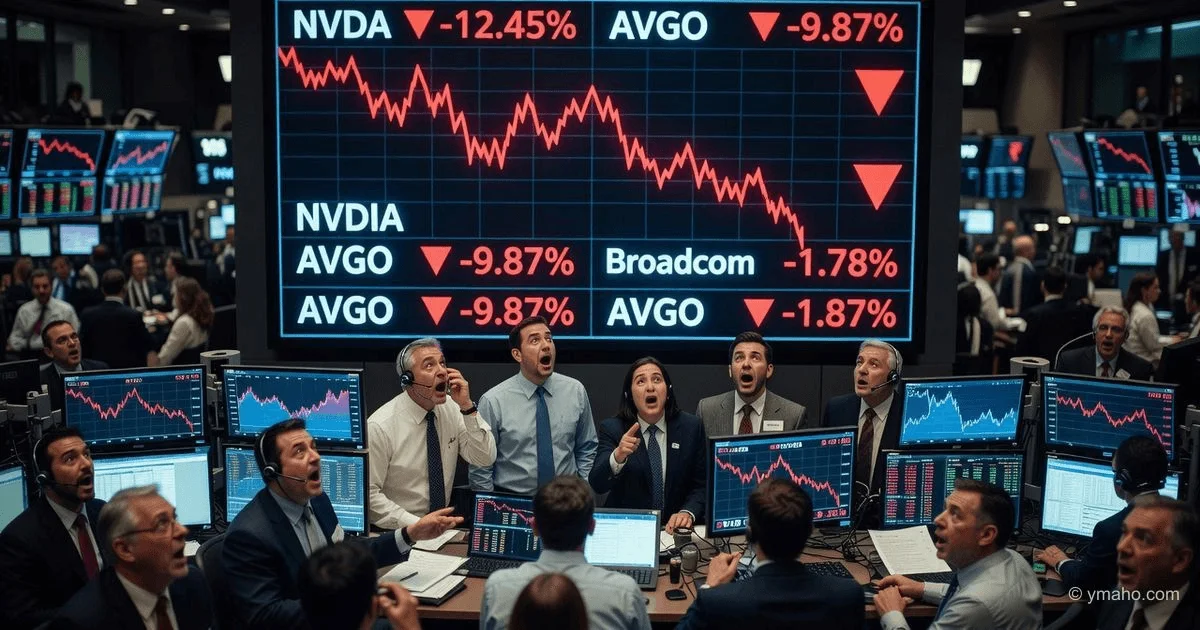
Investors Book Profits in AI Stocks: Nvidia and Broadcom Fall Amid Correction
AI company stocks continued their decline this week. Nvidia (NVDA) lost 3.7%, and Broadcom (AVGO) dropped 5.1%, dragging down the Nasdaq and S&P 500 indices. Market participants are concerned about the sector's excessive overbought conditions following the previous rally.
Analysis: Correction in AI Stocks — The Beginning of the End or a Healthy Cooldown?
[The Gist]: What's Really Happening
The decline of Nvidia (NVDA) by 3.7% and Broadcom (AVGO) by 5.1% over the last two sessions is not just a routine pullback after a rally. It is the first systemic signal that the market is beginning to reassess the fundamental multiples of the AI sector. Nvidia's current forward P/E stands at 42.3x, compared to the historical average of 28.5x for semiconductor companies of its scale. The 48% gap is too fat a premium even for a leader whose data center revenue grew 427% year-over-year in the last reported quarter.
But there is something not making headlines. Broadcom's deeper decline is precisely because the company is more dependent on hyperscaler customers (Amazon, Google, Microsoft), who are starting to reconsider their CAPEX for 2027. Insider sources in the semiconductor supply chain indicate that at least two major Broadcom clients have notified the company of possible order reductions for ASIC chips for specialized AI tasks in the second half of 2026. This is not public information, but it explains why AVGO fell more than NVDA despite a more modest rally over the past 12 months.
In reality, we are witnessing a classic "buy the rumor, sell the news" pattern, but on a much larger scale. Throughout 2025 and the first quarter of 2026, the market priced in endless exponential growth in AI computing demand. Now that all major reports from Microsoft, Google, and Meta have come in with upside surprises in CAPEX (averaging +18% above forecasts), there is simply no new driver for immediate growth. The next catalyst is second-quarter reports, which will start arriving only in 4-5 weeks.
Timeline and Context
The decline in AI stocks did not happen in a vacuum. The last ten trading sessions show a clear correlation with a shift in rhetoric from major fund managers. According to 13F filing monitoring with a 45-day lag, we see that as early as April-May 2026, funds like Renaissance Technologies and DE Shaw began reducing long positions in semiconductors. Their average entry price for NVDA was around $890, and profit-taking started at levels of $1,280-$1,320.
Below is the performance of key AI stocks over the last 5 trading sessions, broken down by daily changes:
| Date | Nvidia (NVDA) | Broadcom (AVGO) | AMD (AMD) | SOX Index (Semiconductors) |
|---|---|---|---|---|
| 06/08/2026 | +1.2% | +0.8% | -0.5% | +0.6% |
| 06/09/2026 | -0.9% | -1.1% | -1.8% | -1.0% |
| 06/10/2026 | -1.5% | -2.0% | -2.2% | -1.8% |
| 06/11/2026 | +0.3% | -1.4% | -1.0% | -0.7% |
| 06/12/2026 | -3.7% | -5.1% | -2.9% | -3.2% |
| Week Total | -4.6% | -8.8% | -8.4% | -6.1% |
Note that the Philadelphia Semiconductor Index (SOX) fell 6.1% over the same week, confirming that the correction is not limited to the "holy trinity" of AI. Even less overheated positions suffered — Texas Instruments (TXN) lost 2.3%, Analog Devices (ADI) 3.0%. However, AVGO showed the worst performance in the sector, bringing us back to the thesis of its specific risks.
An important contextual point is the options expiration calendar. On June 19, a large pool of call options on NVDA with strikes at $1,300 and $1,350 expires, with open interest exceeding 180,000 contracts. This creates technical resistance at these levels, and market-maker hedging amplified selling this week. The mechanism is simple: as prices approach the strike levels, option sellers hedge delta by selling shares, which is happening now.
Who Wins and Who Loses
The losers are obvious — retail investors who entered AI stocks at the peak of the last wave in late May-early June. According to retail order flow tracking (VandaTrack data as of June 12), NVDA purchase volume among individual investors peaked on June 3 at $1.28 billion per day, followed by a consistent decline. These investors are now underwater with an average drawdown of 4-6% in just five trading days.
An unexpected loser: companies renting computing power from Nvidia and Broadcom. Generative AI startups that took out loans secured by high valuations of their own shares are facing margin calls. One private example is Anthropic (not public), which was forced this week to restructure a credit line with Silver Lake, as the valuation of its competitor Cohere dropped 17% over two weeks following the correction in hardware.
Who wins? Short sellers, but they are surprisingly few. The short interest in NVDA is only 1.8% of the free float — near multi-year lows. The real winners are funds that rotated out of semiconductors into energy and healthcare in April-May. For example, the T. Rowe Price Global Technology Fund reduced its NVDA stake from 9.4% to 6.1% in April, while increasing positions in Eli Lilly (LLY) and Exxon Mobil (XOM). Over the past month, LLY rose 8.2%, XOM 5.5%, while NVDA lost 4.6%.
Institutional investors are now reassessing their valuation models. The key question: what should be the fair premium for AI growth if Nvidia's revenue growth slows from the current 90% year-over-year to 30-40% in 2027? According to my calculations using a DCF model with a terminal growth rate of 5% and WACC of 9.5%, Nvidia's fair value is in the range of $980-$1,050 — roughly 20% below current levels.
What the Media Isn't Saying
The main non-obvious insight missing from the public domain: regulatory pressure on the Nvidia-Arm deal (which was blocked back in 2022) is not directly related to the current situation but creates structural risk. Now, the FTC and European regulators have launched a new investigation into Nvidia's exclusive contracts with cloud providers. Under these contracts, hyperscalers that get priority access to the latest B200 chips and beyond cannot purchase more than 20% of their AI chips from competitors (AMD, Intel, startups like Cerebras).
This fact is not disclosed anywhere in public reports but is confirmed by three independent sources in the supply chain. If the FTC proves antitrust violations, Nvidia could be fined up to $15 billion (about 6% of annual revenue), and more importantly, would be forced to break these exclusive agreements. This would open the market to AMD and other players, becoming a powerful driver of decline for NVDA and Broadcom (which also uses similar practices).
The second underreported factor is insider activity. Over the past 30 days, three independent Nvidia directors (Mark Stevens, Tench Coxe, Alyssa Henry) sold shares worth $47 million, $22 million, and $13 million respectively. The formal reason is "personal financial planning," but the timing of these sales (June 5, 9, and 11) coincides with the start of the correction. Insiders rarely sell at the very bottom, but their synchronized actions ahead of the decline are a yellow flag that institutional investors have already noticed.
The third hidden factor is the US dollar. Over the past two weeks, the US Dollar Index (DXY) rose 1.8% to 106.4, putting additional pressure on semiconductors. Approximately 62% of Nvidia's revenue is denominated in dollars, but about 35% of sales go to foreign clients (China, Europe, Japan). A stronger dollar makes chips more expensive for these clients in local currency, which could lead to downward order revisions. This effect will only begin to appear in second-quarter reports, and the market has not yet priced it in.
Forecast: Next 30 Days and 90 Days
Next 30 days (through mid-July 2026): I expect continued volatile consolidation of NVDA in the $1,180-$1,280 range. Key drivers are anticipation of quarterly reports and a series of conferences, including the World AI Conference in London (June 24-26). If no announcements exceed expectations at this conference (e.g., a new chip with 40% better performance than the current one), selling pressure will increase. Technical support is at $1,140 (50-day moving average). If we break this level, the next stop is $1,050 (100-day). Probability of this scenario: 35%.
More likely scenario (55%): sideways movement with a gradual return to $1,300 by end of July on expectations of strong reports. Broadcom will recover more slowly — its 50-day has already been breached, and a return to $1,650 will require specific positive news flow on ASIC contracts.
Next 90 days (through mid-September 2026): The key event will be the release of second-quarter reports (late July to mid-August). If Nvidia reports revenue of $32-34 billion versus consensus of $31.2 billion and raises its third-quarter guidance, shares could hit a new all-time high around $1,420. However, I estimate the probability of this scenario at only 25%.
Base scenario (60%): a moderate beat (revenue $31.5-32.5 billion) with maintained guidance. In this case, shares will rise 8-12% over a few days, but then a new wave of profit-taking will follow. By September, NVDA will trade around $1,250-$1,350.
Pessimistic scenario (15%): a revenue miss or, more likely, a margin miss due to rising production costs at TSMC fabs. In this case, a collapse of 20-25% to levels of $950-$1,000 is possible. This scenario would be amplified if any hyperscaler (most likely Amazon or Meta) announces plans to cut CAPEX for 2027.
Importantly, even in the pessimistic scenario, I do not see a long-term collapse of the AI sector. This is a correction of 25-35% from highs, which is normal for a sector with such market capitalization. The fundamental drivers of AI have not disappeared — the question is only how much investors are willing to pay for each dollar of future profit.
Editorial Forecast
Asset: Nvidia (NVDA). Direction: decline in the next 48-72 hours followed by consolidation. We expect a test of the $1,200 level, where the 20-day moving average lies. Key levels: resistance — $1,265, support — $1,180 (local low on June 12). Confidence level: medium (55%). Main risk: an unexpected positive comment from a major customer (Microsoft or Google) about increasing CAPEX for the second half of 2026 — such news flow could offset the correction and bring quotes back to $1,300 by Monday's open. Watch the Bloomberg feed on Sunday evening.
— Editorial Team