Japan's Nikkei 225 Hits Record High on Tech Giant Buying Spree
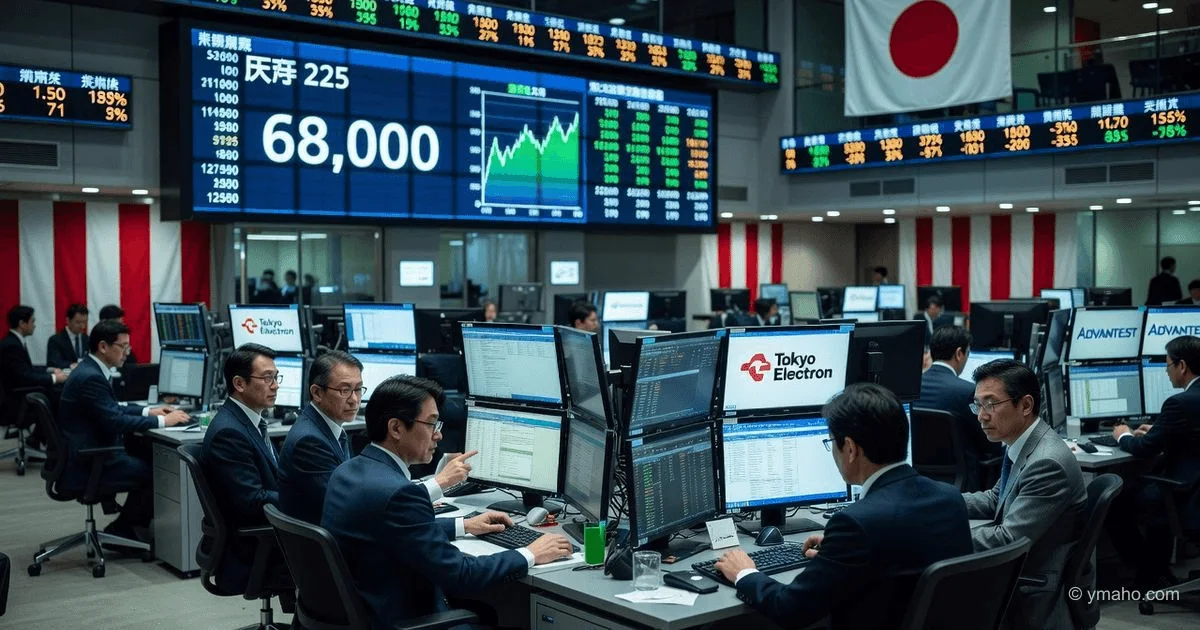
Japan's Nikkei 225 surged 2.5% to breach the 68,000-point mark for the first time in history. The rally was led by chipmaker stocks such as Tokyo Electron (+13.4%) and Advantest (+5.1%), following the global AI boom.
Analytical article: Nikkei 68,000 Record — Triumph of 'Picks and Shovels' or Last Dance Before the Storm?
[The Gist]: What's Really Happening
When the Nikkei 225 closed above 68,000 points for the first time on June 3, 2026, most headlines screamed about a 'Japanese miracle' and an 'unstoppable bull market.' But the truth, as usual, lies in the details of distribution. The index jumped 2.5% to 68,402 points, but just two companies did the heavy lifting: Tokyo Electron (+13.4%) and Advantest (+5.1%), which together added nearly 840 points to the index.
This is the key insight the media misses. The Nikkei is a price-weighted index, not market-cap-weighted. This means stocks with a high per-share price have a disproportionately large impact on the index's movement. Tokyo Electron, trading around ¥60,700, has dozens of times the weight of a company with a ¥1,000 stock price, even if their market caps are comparable.
The real story of this rally isn't 'Japan' but a narrow cohort of chip equipment suppliers known as 'picks and shovels sellers' during the AI gold rush. While global investors are fixated on Nvidia, smart money in Tokyo went one level up — to companies that make chip production and testing equipment. Moreover, on the record day, SoftBank Group, recently Japan's most valuable company, fell 3.5%. This isn't a broad market rally; it's a rotation within the AI trade.
Timeline and Context
The path to 68,000 was swift but full of hidden reversals. Just days before the record, the market experienced a brutal sell-off that erased nearly 4% of the index in a single session. On June 8, investors exited overheated AI and semiconductor positions, following a correction on Wall Street.
Below is a key timeline showing why 'steady growth' is an illusion:
| Date | Event | Nikkei Change | Key Driver |
|---|---|---|---|
| June 2, 2026 | Index breaks 67,000 for first time | +1.8% | Continuation of chip rally |
| June 3, 2026 | ALL-TIME HIGH: closes above 68,000 | +2.5% | Tokyo Electron (+13.4%) and Advantest (+5.1%) |
| June 4-6, 2026 | Profit-taking before weekend | -0.5% | Anticipation of US jobs data |
| June 8, 2026 | PLUNGE: Worst day in 3 months | -3.85% | SOX down 6% and BOJ rate hike fears |
| June 9, 2026 | Technical bounce | +0.95% | Buying beaten-down chips, Tokyo Electron +7.3% |
By June 12, the Nikkei was trading back below 66,600. This means the entire record rally turned out to be a 'spike' that didn't hold. For institutional investors, this is a classic 'failed breakout' pattern, where the price breaks out of a range but fails to sustain.
Kioxia deserves special attention — the company held its IPO just 18 months ago at ¥1,455 per share. By the time of the Nikkei record, its shares traded above ¥78,000, a gain of over 3,500%. It briefly overtook Toyota in market cap to become Japan's second-largest company. This isn't fundamental growth; it's pure speculation on AI HBM memory shortages.
Who Wins and Who Loses
The obvious winners are shareholders of Tokyo Electron and Advantest. Tokyo Electron, the world's third-largest semiconductor equipment maker, controls nearly 90% of the photoresist coating market. Without it, TSMC, Samsung, and Intel can't build modern fabs. The company's margin is 29%, and revenue hit a record ¥2.44 trillion. Advantest, with 50% of the global SoC tester market, boasts an operating margin of 44% — numbers most chipmakers can only dream of.
Unexpected winners: Japanese banks. MUFG rose 0.5%, Mizuho gained 1.4% on days when the index fell. Why? Because the market is actively pricing in a Bank of Japan rate hike at the June 15-16 meeting. Banks are direct beneficiaries of rising rates as their net interest margins expand.
Losers: investors who bought the 'broad Japanese market' via ETFs like EWJ or DXJ. The broader Topix index rose only 1.5% on the Nikkei record day, versus 2.5% for blue chips. Moreover, on the day the Nikkei crashed 882 points on Friday, the number of advancing stocks on the Prime Market actually exceeded decliners. This means the drop was entirely concentrated in heavyweight AI stocks, while second-tier stocks held steady or rose. The 'beta' of this market is now extremely fractured.
A separate category of losers: retail investors who bought SoftBank Group at highs. SoftBank shares fell 3.5% on the very day of the Nikkei record. This is classic rotation: investors exit 'AI proxies' (SoftBank holds stakes in Arm and many startups) and buy 'hardware' (equipment) that has already secured contracts.
What the Media Isn't Saying
The first and most important non-obvious insight is the structural vulnerability of a price-weighted index. The Nikkei 225 suffers from a 'single-stock effect' long dead in the S&P 500 (market-cap weighted) and the Dow Jones (also price-weighted, but stocks split more often). In Japan, corporate culture dislikes stock splits. Tokyo Electron costs ¥60,000 per share. Advantest is around ¥28,000. Contrast with companies like Lasertec (around ¥40,000), creating a situation where 10% of the index's movement depends on 3-4 issuers.
This creates a false sense of a 'broad rally.' When Bloomberg writes 'Nikkei hits record high,' it sounds like Japan's entire economy is booming. In reality, Japan's manufacturing sector (automotive, robotics, machine tools) is still stagnating. Toyota rose only 2% on the same day after a decline, while industrial conglomerate IHI fell 5.5%. The rally is purely tech-driven, tied to the US AI investment cycle.
The second hidden factor is Japan's tax system. Until 2026, Japan had tax breaks for long-term investors (NISA), which fueled retail inflows. However, the key driver of the last two weeks' rally is corporate restructuring. Kioxia announced dividends starting in 2027. This signals that Japanese companies are finally listening to shareholders, not just hoarding cash. But this trend is already priced in. The market awaits the next step: share buybacks.
The third omission: SpaceX. Market rumors (confirmed by Japanese press) suggest that SpaceX's massive IPO next week, with a valuation of around $283 billion (nearly ¥40 trillion), could trigger a 'liquidity suction' effect. Funds need to sell existing positions to participate. Given that Japanese AI stocks have risen tens of percent this quarter, they will be the main source of cash for this IPO. In other words, the higher the Nikkei record now, the stronger the sell-off in 5 days.
Forecast: Next 30 Days and 90 Days
Next 30 days (to mid-July 2026). Key event: Bank of Japan meeting on June 15-16. Base case (70% probability): BOJ raises rates by 0.25% to 0.75% or 1.0%. This is the first step toward policy normalization in 20 years. Ironically, a rate hike benefits banks (MUFG, Mizuho) but is deadly for exporters (Tokyo Electron, Sony, Toyota) due to potential yen strengthening. If the dollar falls below ¥150, current forward earnings of Japanese exporters will come under pressure.
Technical picture, according to PrimeXBT analysts, is critical: the index must hold above support at 64,000 (50-day moving average and Fibonacci retracement level). If 64,000 falls, the next stop is 62,000. To recover to 68,000, bulls need to first close above 65,600.
Next 90 days (to mid-September 2026). Long-term outlook depends on two factors: (1) BOJ rate decision and (2) oil price trajectory. If rates rise and the Middle East conflict ends, the yen could strengthen to ¥140-145 per dollar, cutting 10-15% of exporters' yen-denominated profits. Tokyo Electron and Advantest shares could correct 20-30% from highs.
However, the pessimistic view has a flip side. Global demand for 2-nanometer chip equipment, which Tokyo Electron produces, will only grow in 2027. If you can stomach 30-40% volatility, current levels could be a 'entry point' for 3-5 years. But for traders, the next 90 days will be a time for capital preservation, not aggressive position-building in Japanese AI stocks.
By September, I expect the Nikkei to trade in a range of 62,000-65,000 if the BOJ raises rates. If rates stay unchanged due to economic weakness, the index could retest 68,000. But I rate the probability of a 'hold' at the June meeting as low (30%).
Editorial Forecast
Asset: USD/JPY pair. Direction: sharp yen strengthening (pair decline) within 24-48 hours after the BOJ decision on June 16. Expect a move from current ~156 yen per dollar to 152-153. Key levels: resistance — 158.5 (local high), support — 151.8 (50-day moving average). Confidence level: high (75%). Main risk: if the BOJ unexpectedly holds rates due to economic concerns, USD/JPY could surge to 160 and above, triggering emergency intervention by Japan's Ministry of Finance. The BOJ decision is the main trigger for the coming days.
— Editorial Team