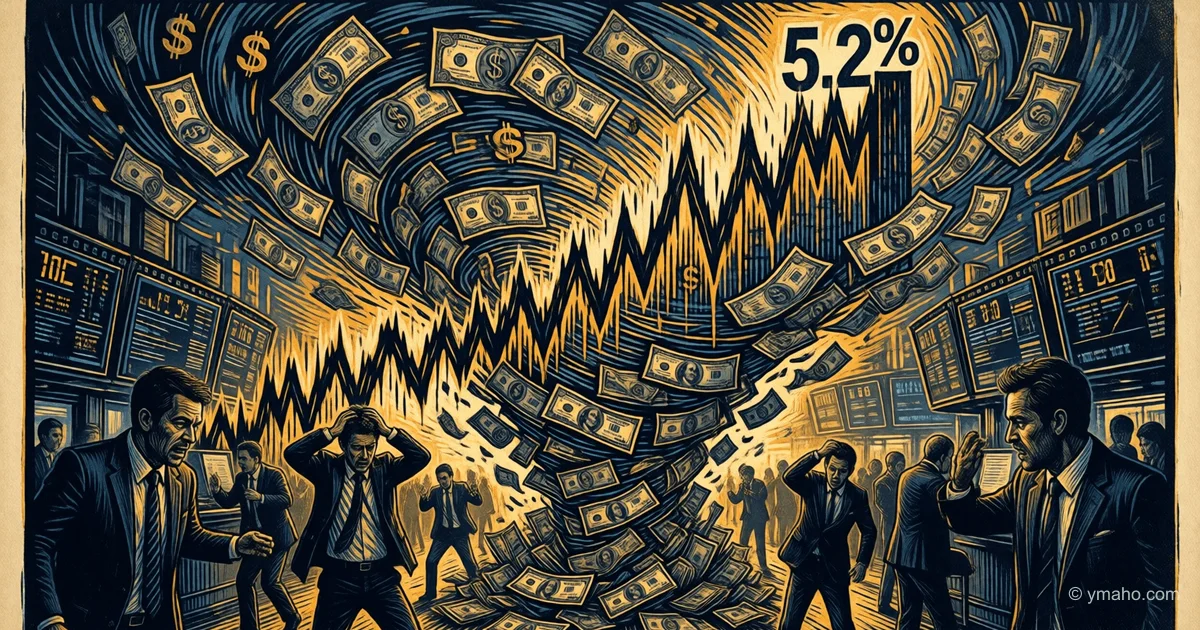
Yield on 30-Year US Treasury Bonds Approaches 5.2%, Sparking Market Fears
Yields on US government bonds have reached multi-year highs. Investors fear that a prolonged period of high interest rates and significant budget spending could pressure economic growth and high-risk assets.
Sell-off in the long end: why 5.2% on 30-year Treasuries is not the limit, but an entry point for the most dangerous trade of the decade
The Gist: What's Really Happening
The breakout above 5.2% on 30-year Treasuries is not an isolated reaction to a war premium in the Persian Gulf. It is a public execution of the concept of a "risk-free asset" as we have known it for the last forty years. The market no longer believes that the Federal Reserve or the Treasury can control the debt spiral. The real problem is not geopolitics but arithmetic: when Fed Chair Kevin Warsh tries to shrink the balance sheet (QT) while the Treasury continues to flood the market with new issuance to cover the deficit, these two forces collide, creating a classic "buyers' strike."
What we witnessed on May 13 at the auction for $25 billion in 30-year bonds was a moment of truth. The yield came in at 5.046%, with a tail of 0.5 basis points to the market—meaning dealers had to offer a premium to place the issue. The key alarm signal is not even the rise in yield itself, but who is buying. The share of primary dealers rose to 11.7%—the third consecutive monthly increase. This is symptomatic of a sick market: when the "lender of last resort" in the form of the largest banks is forced to take an ever-larger volume of unsold debt onto its balance sheet, liquidity evaporates.
Timeline and Context
Let's break down the chain of events: On May 13, the auction of 30-year Treasuries closed above 5% for the first time since August 2007. By May 19, the yield on secondary trading reached 5.2%—a 19-year high. Three days later, at the moment of Warsh's inauguration, the S&P 500 index plunged to an all-time low of around 740 points, while the 10-year yield soared to 4.60%. The correlation is obvious: as soon as the market realized that the new chair had no intention of abandoning balance sheet reduction, a mass exodus from long-duration assets began.
The reason is simple: according to the Congressional Budget Office (CBO), the budget deficit for fiscal year 2026 is $1.9 trillion, and the debt-to-GDP ratio has already reached 101% and will exceed 120% by 2027. This is a structural overhang of paper supply that cannot be eliminated by rhetoric.
Who Wins and Who Loses
Beneficiaries:
Banks with large deposit bases. JPMorgan, Wells Fargo, and Goldman Sachs are becoming the main favorites of the new regime. According to Wedbush, a steep yield curve allows them to borrow at low short-term rates and immediately lend or buy assets at high long-term rates, sharply expanding net interest margins. In addition, Warsh has announced deregulation of "Basel III," freeing banks' hands.
Hedge funds betting on swap spreads. This is a complex but incredibly profitable trade. When dealers are stuffed with bonds, swap spreads collapse or go negative. Those who understand the mechanics of primary dealer balance sheets are now making a fortune by selling Treasuries against IRS.
Losers:
The US housing market and borrowers. This is the most painful spot. Investors do not fully realize that Warsh's policy is specifically aimed at the Fed's mortgage portfolio. He intends to aggressively sell MBS (mortgage-backed securities). As a result, the rate on a 30-year fixed mortgage in the US has jumped from less than 6% in February to 6.51% this week. We see a direct transmission: the rise in 30-year Treasury yields to 5.2% is killing housing affordability. Existing home sales in April rose only 0.2%, while a jump of 3% was forecast. This is not a soft landing—it is a paralysis of the market that will last through 2026.
"Zombie companies." Tech startups and corporations accustomed to living in a zero-rate environment will face the impossibility of refinancing. Warsh's era of "Productive Dovishness" means that rates may stay low, but inefficient companies will have no access to liquidity.
What the Media Isn't Saying
The most important hidden story is that the 5.2% yield is an artificial construct that Warsh will not rescue. Warsh is the author of the concept of "Productive Dovishness." He believes that AI will stop inflation, so short-term rates can be kept low or even cut. But at the same time, as a long-time critic of Bernanke, he considers the Fed's huge balance sheet to be the main evil. Financial media write about rising yields as a fear of inflation. That's not true. It is a fear of the absence of the "largest buyer." By exiting the MBS market, the Fed leaves a multi-trillion dollar hole in demand. This is not a classic "bond vigilante"—it is a structural shift in liquidity.
The second point is the false dilemma of "rate or balance sheet." Warsh believes that by shrinking the balance sheet, we remove the "subsidy" to the Treasury and force Congress to live within its means. But in reality, what is happening now is this: the yield on 30-year bonds is rising so fast that the cost of servicing US debt becomes the largest item of budget spending, closing the loop and increasing the deficit, which again pushes yields higher. This is a feedback loop that the FOMC does not yet control.
Forecast: Next 30 Days and 90 Days
30 days. The next FOMC meeting chaired by Warsh will take place on June 16-17. I expect he will not raise rates but will announce balance sheet reduction parameters much more aggressive than the market currently expects, possibly stopping reinvestment of mortgage securities in full. This will immediately push 10-year Treasuries to 4.80-4.90% and 30-year Treasuries above 5.3%. The S&P 500 will momentarily fall below 700 points as liquidity continues to drain.
90 days. By the end of August, the US housing market will enter a technical recession. Rates on 30-year mortgages will exceed 7% annually, shocking the entire consumer economy. At that point, facing political pressure ahead of the elections, Warsh will be forced to use emergency tools—likely a QT reversal through Operation Twist 2.0 to flatten the long end of the curve without touching rates. This will trigger a wild rally in gold, which by then will have corrected on expectations of a strong dollar.
Editorial Forecast
Asset: ETF on long-term US Treasury bonds (TLT). Direction: decline in the next 24–72 hours. Key levels: if the 30-year yield holds above 5.2%, the TLT index will break the $78 level, followed by a move to the October 2023 all-time low around $77. Confidence level: high. The rhetoric of new Fed Chair Warsh will focus on aggressive balance sheet reduction and refusal to act as a buyer of long-term debt, directly pressuring ETF prices. The main risk to the forecast is an escalation of military action in the Persian Gulf to a level that triggers a massive flight to quality, temporarily boosting demand for Treasuries as a safe haven despite fiscal problems. This is an editorial opinion, not investment advice.
— Editorial Team









