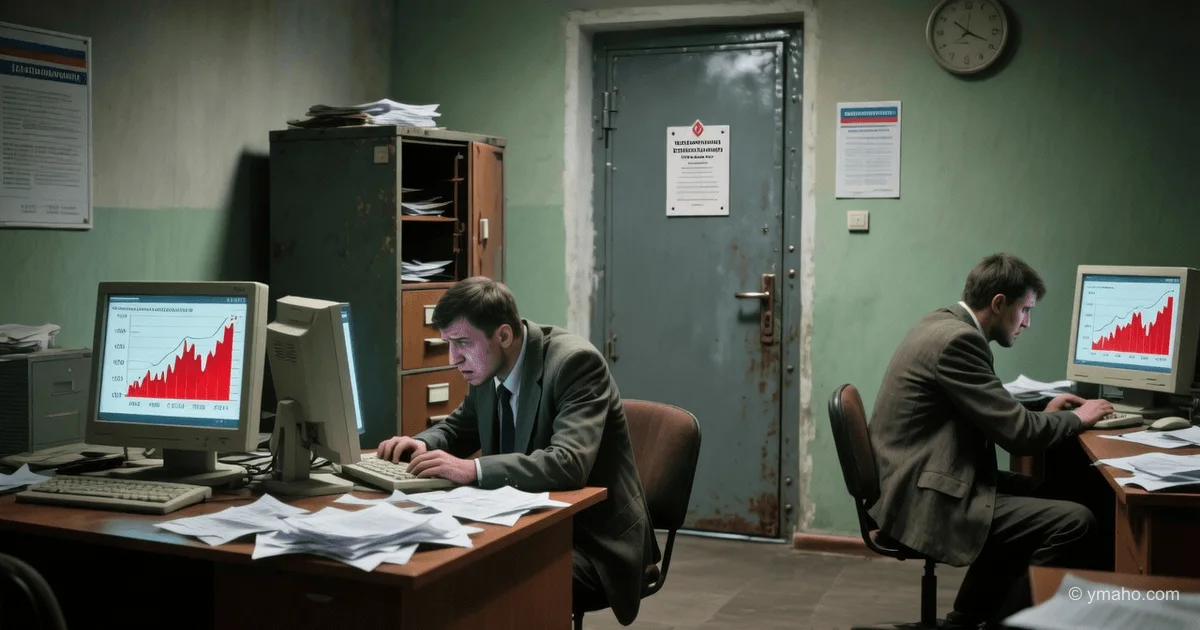
Almost 20% of Russian Banks Have Become Unprofitable Since Early 2026
According to the Central Bank, the number of unprofitable banks in the Russian Federation has increased 1.8 times to 60 institutions (19.7% of the market) amid prolonged tight monetary policy and shrinking margins.
[Essence]: What is really happening
The Russian banking sector is entering a phase of hidden but rapid stratification. The figure of 19.7% unprofitable banks is just the tip of the iceberg. What remains behind the scenes of official statistics: of these 60 institutions, at least 15–17 are in a state close to losing Tier 1 capital. This means they are formally still operating, but any sharp market move—a default of a major borrower, a currency spike, or a large deposit withdrawal—will push them over the edge.
I talk to risk managers from top-50 banks, and the picture is alarming. The key rate of 21% per annum has been in place for almost six months, and the compression of net interest margin has reached a critical level. In a healthy economy, the spread between funding costs and asset yields is 3–5 percentage points. Currently, for regional banks, it has narrowed to 1.2–1.8 points. This is not enough even to cover operating expenses, let alone provisioning.
The real problem is deeper than "tight monetary policy." Since March 2026, new Central Bank regulations on macroprudential limits for unsecured consumer loans have come into effect. This has hit small banks that historically earned from high-margin retail lending. Large players have absorbed these restrictions through technological advantages in scoring and cross-selling. Small ones have not.
Notably, exactly half of the unprofitable banks are institutions with capital equivalent to less than USD 1 billion. They are squeezed between rising liability costs (retail deposits at 18–20% per annum) and the inability to place these funds at adequate yields. Corporate borrowers are not willing to take loans at 24–27%, and those who are willing already have maximum debt loads.
Timeline and Context
If we rewind the tape, this crisis did not start forming today. In September 2025, the Central Bank raised the rate from 19% to 21%—and that was the turning point. Until then, banks held on thanks to capital buffers accumulated in 2023–2024 and revaluation of foreign currency assets.
The second blow came in February 2026. The regulator required banks to set aside additional reserves for loans to companies with high debt burdens (interest coverage ratio below 2.5). This instantly increased reserve contributions by 15–20% for SME lending portfolios. This segment is the mainstay for small banks.
The third factor is the compression of fee income. Since January 1, 2026, amendments to the law on the National Payment System have come into force, limiting acquiring fees for socially significant goods and services. For banks with a high share of transaction business, this means a loss of 0.3–0.5 percentage points of net fee income. It seems minor, but with a margin of 1.5–2%, it is critical.
Who Wins and Who Loses
Winners—and this is crucial to understand—are not just "large banks," but specifically Sberbank and 3–4 other state-owned banks. They have three advantages. First: access to funding through government programs and budget deposits at rates 1.5–2 points below market. Second: risk-based pricing technology—they segment borrowers more accurately and lend to those who can actually service debt at 24% per annum. Third: economies of scale in operating expenses. Sberbank's cost of servicing one retail client has already fallen below USD 12 per year, while for a regional bank it is around USD 35–40.
Losing are banks from the third and fourth hundred by assets. But there is a non-obvious group of victims—captive banks of industrial groups. I know of at least three cases where corporate banks within industrial holdings secretly funded unprofitable projects of the parent company through schemes involving promissory notes and non-standard credit notes. Amid rising reserves and tighter supervision, these schemes are being uncovered—and capital is melting before our eyes. One such bank, according to my information, has already received a Central Bank order to accrue additional reserves equivalent to 45% of its Tier 1 capital.
What the Media Are Not Saying
The first unspoken fact: the Central Bank is deliberately allowing sector cleanup through bankruptcies. This is not a "rehabilitation" policy; it is a policy of squeezing out weak players. Over the past 60 days, three closed meetings have been held in the Banking Supervision Department, discussing a scenario of reducing the number of banks to 200–220 by the end of 2027 (currently 304). Officially, they will not say this, but insiders confirm: the regulator will not save banks with negative operating margins.
The second fact that the media miss: the unprofitability of the banking sector is directly linked to the state of the commercial real estate market. About 12–15% of medium-sized banks' loan portfolios are secured by retail and office centers in million-plus cities. Since the beginning of the year, occupancy rates for these properties have fallen by an average of 7–9 percentage points, and rental rates in USD equivalent have dropped by 20–25%. Collateral is depreciating, LTV (loan-to-value) ratios are rising, and banks are forced to set aside additional reserves. This is a vicious circle.
Forecast: Next 30 Days and 90 Days
30 days (by June 8, 2026):
I expect the first high-profile license revocation of a bank in the top 150 by assets. This will not be a technical revocation but a rehabilitation case—a bank with a capital hole where the Deposit Insurance Agency will announce payouts to depositors. The amount of insurance payments could be around USD 450–500 million equivalent. The market will react with a short-term outflow of deposits from private banks to state banks—in my estimation, about USD 2.5–3 billion will shift over two weeks.
Additionally, the Bank of Russia at its meeting on June 13 will keep the rate at 21%. This is already priced in, but I assume the regulator's rhetoric will be tougher than expected—possibly Chair Elvira Nabiullina will mention a scenario of raising to 22–23% if inflationary pressure does not ease. This will further hit bank bond prices: yields on subordinated issues could jump by 50–70 basis points.
90 days (by August 7, 2026):
By the end of summer, the number of unprofitable banks will reach 75–80 institutions, i.e., about 25% of the sector. A cascade effect will kick in: small and medium-sized banks will start losing corporate clients who move to state banks in search of stability. This will further compress their revenue base.
The main non-obvious scenario I see: the Central Bank may apply an accelerated procedure for merging troubled banks with large players without formal rehabilitation. Essentially, these are forced mergers with zero premium for shareholders of the acquired bank. The first such deals could take place in July-August, and they will involve not Sberbank (it is not interested) but second-tier state-owned banks—for example, PSB or Rosselkhozbank. They will gain the client base and part of the working assets, while shareholders of the acquired banks will get virtually nothing.
For investors, the signal is clear: volatility in the Russian banking sector will increase over the next 90 days. Holders of subordinated bonds of private banks from the third hundred should seriously assess the risk of coupon write-offs or conversion into capital if the Common Equity Tier 1 ratio falls below 5.125%. This is not panic, it is calculation—and I prefer to voice it now rather than when it is too late.
— Editorial Team









