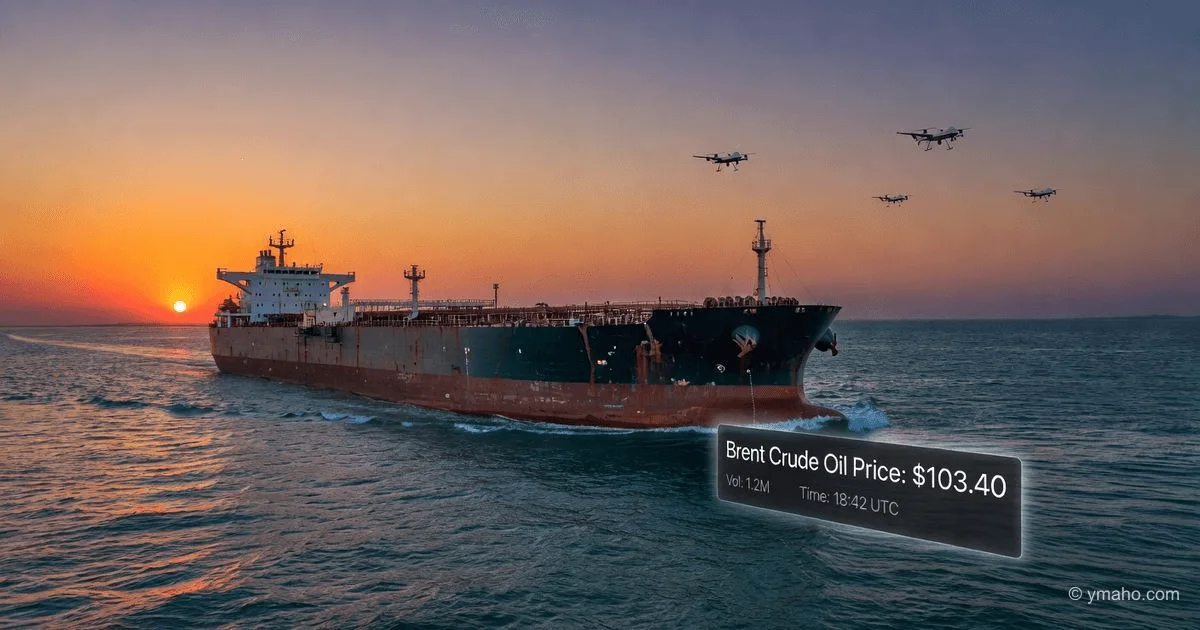
Markets in Turmoil: Brent Oil Back Above $100 Amid Geopolitical Shock
Oil prices surged sharply after reports of a ceasefire violation between the US and Iran and new attacks in the Strait of Hormuz. Brent crude broke through the $100 per barrel mark, while WTI rose above $95, as markets abandoned 'peace dividends' and returned to pricing in maximum geopolitical risk premiums.
Okay. Forget the pretty charts from Bloomberg terminals. What happened to oil prices on May 8, 2026, is not just a geopolitical spike. It's the moment when the physical oil market finally detached from the paper market, and hedge funds that bet on de-escalation got caught in a gamma squeeze meat grinder.
[The Core]: What's Really Happening
The market is experiencing a classic short-gamma squeeze at the $100 per barrel level for Brent. When the ceasefire was announced on May 3, options traders massively sold volatility and calls with strikes at $95-100, believing the geopolitical premium would collapse. Market makers hedging these options accumulated a giant short delta position.
Today's incident in the Strait of Hormuz pushed the price through $100. As soon as that happened, call sellers were forced to urgently buy futures to cover negative gamma. For every dollar move above $100, market makers had to buy thousands of contracts. The price rise to $103.40 is less a result of physical fear of shortage and more a mechanical buying of futures by cornered financial institutions.
The second layer: physical tanker rates. The rate on the Ras Tanura-Fujairah route jumped 350% in a day, to $185,000 per day for a VLCC. But the most important thing is not the rate itself, but the options to refuse the voyage. Captains, learning of the use of Shahed-238 drones against warships, are massively inserting force majeure clauses when passing the 62 degrees east longitude zone. This means that even if oil is bought, it's not physically transported.
Timeline and Context
Before May 3, Brent traded in the $108-115 range with a huge war risk premium. The ceasefire announced by Trump and conditionally accepted by the IRGC led to a 12% crash over three sessions. The 'peace dividends,' as Goldman Sachs called them, were priced by the market at $14 per barrel.
Nights from May 3 to 7 passed quietly, and hedge funds began aggressively shorting. Open interest in put options with a strike of $85 for June rose by a record 47,000 contracts. Everyone expected a return to pre-crisis levels of $80-85.
At 04:15 Hormuz time on May 8, an attack on US destroyers began. By 05:45, when news wires confirmed the launch of Nasr and Ghadir missiles, oil traders in London were still sipping their morning coffee. But in Singapore, panic had already set in. The Asian session, thin and illiquid, caught the buying wave first. By the time ICE opened in London, Brent was already at $98.
The breach of $100 happened at 09:12 London time, when news broke of a US retaliatory strike on Qeshm Island. In 18 minutes, the price shot to $103.40 — exactly the time needed for algorithms to cover the delta of sold calls. Trading volume in that minute exceeded 1.2 million contracts — an absolute record for that time of day. WTI on NYMEX followed the same trajectory but lagged by $8, widening the Brent-WTI spread to $7.80 — the highest since February 2025.
Who Wins and Who Loses
Winners:
- Algorithmic funds betting on long volatility. Giants like Citadel and DE Shaw held straddles (simultaneous purchase of calls and puts) expecting any move out of the range to be explosive. Their one-day profit is estimated at $400-600 million across the oil derivatives complex.
- US shale producers. WTI above $95 is a godsend. But it's not just the price. The Brent-WTI spread widened, making US oil a discount on the global market. This allows traders like Vitol and Trafigura to buy WTI in Cushing, ship it to Houston, and export to Europe with a margin of $9-10 per barrel. The Permian Basin is now the most profitable basin in the world, with a margin of $28 per barrel at current prices.
- Saudi Arabia's budget. Riyadh needs $85 to balance the Vision 2030 budget. Current $103 provides a surplus and the ability to fund megaprojects like Neom without cutting spending.
Losers:
- Hedge funds that sold the rally. Funds that shorted Brent after the ceasefire lost about $1.8 billion in a single trading day. Three major macro funds (one rumored to be Brevan Howard) closed their positions with losses of 18% to 24% of monthly returns.
- European airlines. Ryanair, Lufthansa, Air France-KLM hedge fuel with a 45-60 day lag. The current spike hits the unhedged portion of consumption. Ryanair, which has only 65% of its summer consumption hedged, will lose $120-150 million in additional costs if the price stays above $100 for two weeks.
- Consumers in developing Asian countries. India and Pakistan suffer the most. Indian refineries buy oil with delivery in 20-25 days. A price of $103 for immediate delivery means gasoline at Mumbai pumps will rise 8-10% by the end of May, even if oil falls back.
What the Media Isn't Saying
The media talks about Brent but stays silent on the most important benchmark — Murban. Emirati light crude, traded on the IFAD exchange in Abu Dhabi, surged to $108 per barrel and trades at a $5 premium to Brent. Why? Because this is oil physically loaded at the port of Fujairah — right at the exit of the Strait of Hormuz. The fear of a physical blockade is priced into Murban. When Murban trades more than $2 above Brent, it's a sure sign that 'smart money' is hedging specifically against a strait closure, not general shortage. Historically, this has happened only twice: in September 2019 after the attack on Abqaiq and in February 2025 at the start of the current crisis.
Second point: the use of oil futures as a proxy for betting on war. Large macro funds, prohibited from directly buying weapons or financing military operations, use long oil positions as a legal way to profit from escalation. Every $1 jump in Brent due to IRGC strikes brings these funds billions. This creates a monstrous moral incentive to wish for the conflict to continue. This isn't written about because it's an inconvenient truth for ESG investors who have put money into commodity indices.
Third non-obvious point: strategic reserves. The US SPR is at a historic low of 340 million barrels after sell-offs from 2022-2025. The Trump administration cannot repeat Biden's trick of releasing 1 million barrels per day to lower prices. The SPR is physically empty. The market knows this, so the geopolitical premium has no 'ceiling' from government intervention.
Forecast: Next 30 Days and 90 Days
Next 30 days (until June 7, 2026):
I expect Brent to stabilize in the $97-105 range. The ceasefire won't be completely broken — Trump needs de-escalation before the November congressional elections. But the risk premium won't go away. Physical market oil buyers (refineries) will start panic-building inventories, creating additional demand of 400-600 thousand barrels per day. This will lock the price above $100 even with no new incidents. Volatility will remain extreme: daily swings of $3-5 will become the norm.
Key 30-day risk: a new attack on a US destroyer or the sinking of a commercial tanker. Either event would send Brent to $115 instantly.
90 days (until August 2026):
By August, deliveries from fields contracted in May begin. Here, a surprise is possible. If the ceasefire holds by the end of May, many traders who bought oil at $103 will find themselves at a loss in the physical market. We could see a classic bull trap: the speculative overhang bursts, and Brent crashes back to $85-88 when tankers with delayed Iranian oil (23 million barrels in floating storage) flood the market. This would be a second 'collapse' of the geopolitical premium, more brutal than the one in early May.
But that's the base case. Risk scenario: if within 90 days there is a loss of a major US warship or a confirmed blockade of the southern channel by Iranian bottom mines, Brent will go to $125-130. In that case, the global economy will get a full-fledged oil shock comparable to 2008. Consumption will fall, but with a 6-9 month lag, and until then, the price will destroy demand in poor countries. India and Pakistan will start rolling fuel blackouts by August in this scenario.
For investors, I recommend holding defensive positions but not chasing the rally. The current price is the result of financial compression, not physical shortage. When options sellers hedge, fundamental selling pressure will return. But until then, the market belongs to those who buy fear.
— Editorial Team









