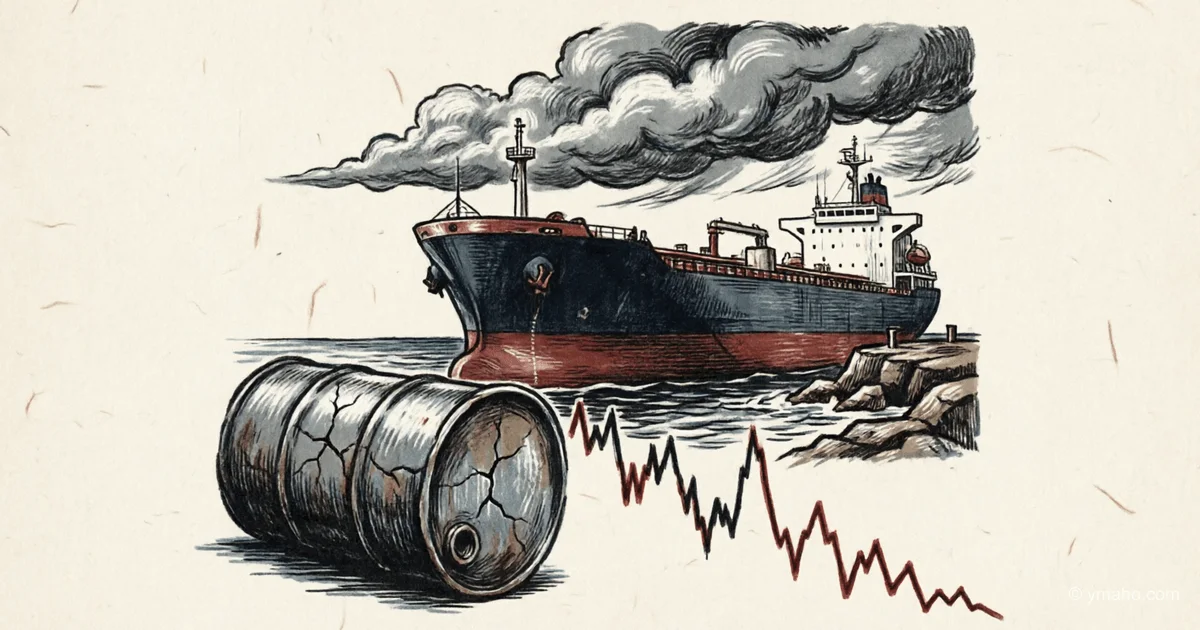
Brent Oil Prices Fall on Hopes of US-Iran Deal
Brent crude futures fell below $105 a barrel after Trump's statements about progress in negotiations and a possible early end to the conflict.
There is nothing surprising about oil prices falling below $105 a barrel, but only armchair analysts who have never sat at a real trading desk can see this as the start of a sustained trend. The market is currently playing not geopolitics, but a classic behavioral trap: buying up rumors of peace while ignoring the facts of war on the ground.
The Gist: What's Really Happening
The 2.2% drop in Brent after Trump's comments about canceling strikes on Iran and starting "serious negotiations" is a textbook reaction to verbal intervention, not a fundamental change in the balance. The US president said that "all their ships are broken and lying on the bottom," and that the Iranian air force has been "destroyed." This is classic Trump bluff, aimed at pressuring Tehran through the markets. However, a careful reading of intelligence data shows that Iran has retained 70% of its pre-war arsenal of ballistic missiles, repaired some damaged weapons, and continues to assemble new ones.
The market is buying the narrative of an imminent deal, but the facts suggest otherwise. The 14-point memorandum handed to Tehran calls for a 20-year renunciation of uranium enrichment and the dismantling of nuclear facilities—conditions that the Iranian Foreign Ministry is "still studying," without giving an answer. The negotiating impasse has not gone away. Just days ago, Washington rejected Tehran's latest proposals as "insufficient," while Iran itself called US demands "unacceptable." When two principled adversaries cannot agree on a negotiation format for a month, a 2% drop in oil prices is not a trend—it's noise.
Timeline and Context
The key to understanding what's happening is the time lag between statements and reality. On Saturday, May 17, Trump called Iran's proposals "unacceptable." On Sunday, May 18, a drone struck a nuclear power plant in the UAE, and Brent soared to $119.99 a barrel—the highest since May 5. On Monday, May 19, Trump announced the cancellation of strikes and the start of negotiations—and oil went down. Three sharp moves in three days. This is not a market; it's a slot machine.
Meanwhile, the fundamental picture remains extremely tense. Global oil inventories will decline by 1 million barrels in 2026, with the bulk of the decline occurring outside China, where reserves are moving toward 2011–2014 lows. The US Strategic Petroleum Reserve (SPR) has fallen to 384.1 million barrels from 415 million at the start of the year, and could drop to 347 million by the end of June—levels close to the 2023 historical low. Every week, 8–10 million barrels are drawn from the SPR. This is not a safety buffer—it's a countdown to the moment when the White House runs out of tools to pressure prices.
Who Wins and Who Loses
The paradox is that those who expect a reversal are making money on this decline. Every dollar drop in Brent is an opportunity for hedge funds to build long positions at a better price. Citigroup analysts expect a rise to $120 in the near term, and if the reopening of the Strait of Hormuz is delayed until the third quarter, up to $150. These figures are not pulled out of thin air: with the current supply deficit, any negative headline will send prices back up.
The losers are Asian importing countries, especially India. Its foreign exchange reserves have shrunk from $728 billion to $690 billion over four weeks, the rupee has broken through the 96-per-dollar mark, and the trade deficit hit a record $28.4 billion in April. For Delhi, every $10 increase in Brent adds an extra budget burden equivalent to $20–25 billion on an annualized basis.
For Russia, the situation is twofold. On the one hand, export revenues rose to $19.18 billion in April—up $6.28 billion from last year. On the other hand, as Anton Siluanov warns, the blockade of the strait hurts everyone: supply chains are disrupted, logistics become more expensive, fertilizers have risen by 30%, and food is becoming less affordable.
What the Media Isn't Saying
The main non-obvious insight is the "Iranian oil trap." Tehran is not just waiting for a change in fortune. Bloomberg reports that Iran has begun to cut oil production because its storage tanks are filling up. The country has built a decades-long system to bypass sanctions: a tanker "shadow fleet," cryptocurrency payments, and barter schemes. Now Tehran is proactively reducing output to prevent storage overflow while simultaneously dragging out negotiations. Why? Each month of delay in a deal while the Strait of Hormuz is blocked brings Russia an additional $6–7 billion in export revenue, strengthening Moscow's military potential. Iran is creating costs for the West on all fronts: driving up gasoline prices in the US (April inflation at 3.8% annualized), provoking recession risks in Europe, and indirectly financing the Russian budget. That's why there is no deal and none is expected—too many parties have an interest in maintaining the status quo.
Forecast: Next 30 Days and 90 Days
30 days (by June 21, 2026). A US-Iran deal will not be reached. The market will go through two or three rounds of "progress" and "deadlock," but no legally binding document will emerge. Brent will test the $100 level on another wave of "peace optimism," but will quickly bounce back to $110–115. By the end of June, I expect the trading range to narrow to $108–112—the market will get used to the geopolitical backdrop, as it does with any prolonged uncertainty.
90 days (by the end of August 2026). Here there is a fork. If a deal miraculously happens in June, as Mirae Asset forecasts, shipping will begin to normalize by September, and Brent will move into the $80–90 range. But that's the baseline scenario of analysts who overlook the main point: Tehran benefits from dragging its feet, and Trump cannot afford to look weak before the elections. The realistic scenario is a prolonged confrontation, Brent in the $105–120 range, with periodic spikes above $130 during escalations. The market will remain hostage to headlines.
Editorial Forecast
Asset: Brent futures. Direction: short-term decline of $2–3 in the next 48 hours, followed by a rebound.
Key levels: lower bound—$102–103 (closing level on May 20), resistance—$112 (high on May 18). Confidence level: high regarding volatility, low regarding direction. The market will continue to react sharply to headlines about negotiations, and any statement from Tehran or Washington can move the price by 3–5% in a session. The main risk to the forecast is a sudden attack by Iranian proxies on tankers in the Strait of Hormuz or UAE infrastructure, which would instantly push Brent above $115 and break the current downward momentum. This is the editorial opinion, not an investment recommendation.
— Editorial Team









