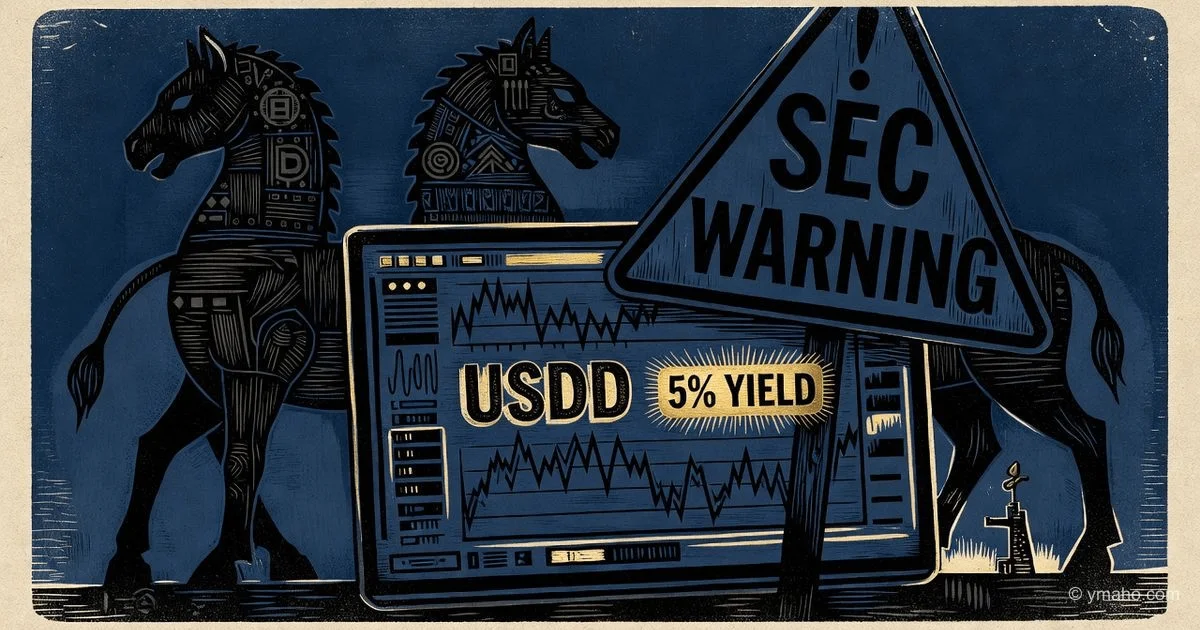
Coinbase Lists New Tron Stablecoin USDD with 5% Yield
The largest US crypto exchange added the USDD/USD pair, backed by algorithmic reserves, prompting SEC warnings about the asset's uncertain status.
USDD Listing on Coinbase: Return of the Algorithmic Dinosaur or Trojan Horse for the SEC?
I've been following the stablecoin market since 2020 — back when the Curve yield curve showed 30% APY on the UST/3Crv pair, and everyone pretended not to notice the elephant in the room. Now history is repeating itself, just with different scenery. News: Coinbase is listing USDD — an algorithmic stablecoin from Tron with a 5% annual yield. The SEC has already issued a warning about the "uncertain status of the asset."
But the official version hides the main point. There's one insight I'll reveal here that most analysts aren't even considering.
[The Core]: What's Really Happening
In reality, Coinbase isn't just "adding the USDD/USD pair." It's making a risky geopolitical maneuver 48 hours before Congressional hearings on the GENIUS Act, which is set to determine which stablecoins will be allowed in the US. USDD 2.0 is not TerraUSD, but it's also not USDC. It's a hybrid that experts call "the most controversial stablecoin of the year."
The architecture of USDD 2.0, launched in January 2025, completely changed the mechanism. Instead of a purely algorithmic model, it now uses an overcollateralization system at 120-300%, managed by the TRON DAO Reserve. The Smart Allocator automatically deploys reserves into DeFi strategies, generating yield for sUSDD holders. Sounds convincing. But the key word here is "managed."
Why? Because real control over USDD remains in the hands of a narrow group — a "whitelist" of about 10 organizations, including Tron DAO itself. This is not a decentralized MakerDAO with a DAO of thousands of participants. It's a centralized multi-sig pool. And this is exactly what the SEC will target: listing a stablecoin with a 5% yield that is effectively a security because its value depends on the management decisions of a small group.
The second non-obvious point: the 5% yield on sUSDD is not a "market rate" but a subsidized product. Messari's report notes that yields on major stable pools typically range from 3-5%. Yet sUSDD offers 6-8% on different networks. The 3-percentage-point difference amounts to roughly $42 million per year on the current TVL of $1.4 billion. Who pays this subsidy? The TRON DAO Reserve from its own reserves. This means that end-user yield depends not on market mechanisms but on the goodwill of Justin Sun and his team.
Timeline and Context
The history of USDD began in May 2022 — three weeks after the collapse of TerraUSD. The timing was either genius or insane. The early years were turbulent: in June 2022, USDD fell to $0.97, and in early 2023 it traded in the $0.96-0.99 range for several weeks. The market didn't trust the algorithmic model, and rightly so.
In January 2025, a key event occurred: the launch of USDD 2.0. The protocol fully transitioned to an overcollateralized model with publicly verifiable vaults on the blockchain. The Peg Stability Module (PSM) was introduced — a mechanism to swap USDD for USDT or USDC at a 1:1 rate without slippage. This was a signal to the market: "We're no longer Terra; we're now closer to DAI."
The result was immediate. Over the year, USDD's TVL grew to $1.4 billion, with $650 million on TRON, $340 million on Ethereum, and $7 million on BNB Chain. Circulating supply reached 1.4 billion tokens. As of May 2026, USDD's market cap was about $83 billion in Dominican pesos, roughly equivalent to $1.4 billion. In January 2026, Messari released a positive report, noting that reserves grew faster than issuance.
And now the climax: June 2026. Coinbase announces the listing of USDD. The SEC immediately issues a warning. The timing is no coincidence — two days later, Congressional hearings on the GENIUS Act begin, which will determine stablecoin regulation in the US. Coinbase is betting that USDD 2.0 will be deemed a "permissible" stablecoin. If they lose, they'll have to delist the asset within 60 days.
Who Wins and Who Loses
TRON and Justin Sun win — obviously. Listing on Coinbase is legitimization for the crypto community. After Binance and HTX (formerly Huobi) already added USDD, Coinbase was the last major holdout. Now USDD is available on the three largest exchanges in the US and globally. For the TRON ecosystem, this is a powerful signal: "We've been accepted into the mainstream."
Circle (USDC) and Tether (USDT) win — but only if USDD runs into regulatory trouble. They have billions in fiat reserves and US Treasury bonds. USDD operates on crypto collateral. Any crisis of confidence in USDD will send users back into the arms of Circle and Tether. Essentially, USDD is a proxy war between two stablecoin models, and a USDD victory would mean capital flowing away from fiat-backed models.
DeFi users win. More stablecoins with different architectures is always good for the market. USDD offers 5-8% APY on sUSDD, significantly higher than the 2-3% on USDC in Aave or Compound. For DeFi farmers, this is a new income source. But high yield comes with high risk.
The SEC loses — from the perspective of their authority. Listing USDD on Coinbase before the regulator has determined its status is a challenge. Coinbase is effectively saying, "We believe USDD is not a security, and we're ready for court." If the SEC loses this dispute, their ability to regulate other stablecoins will be seriously undermined.
Users who don't understand the risks lose. USDD is not USDC. It has a history of de-pegs. In 2022-2023, it deviated from its peg for weeks. If something similar happens again, users holding USDD as "cash" will lose purchasing power. The SEC warns directly: "uncertain status of the asset" is a euphemism for "we don't guarantee it will be worth a dollar tomorrow."
What the Media Isn't Saying
First, what all the news is silent about: USDD on Coinbase is not "native" USDD but a bridged version. USDD is a TRC-20 token on the TRON blockchain. To work on Ethereum or BNB Chain, it needs to be bridged. And bridges are one of the most vulnerable points in crypto infrastructure. Between 2021 and 2024, over $2.5 billion was lost through bridge exploits. If the USDD bridge is hacked, your USDD on Coinbase could become worthless.
Second. The 5% yield on USDD and 6-8% on sUSDD is a marketing gimmick, not an economic reality. Yes, you get 5% APY. But these returns come from the Smart Allocator, which invests reserves in "market-neutral DeFi strategies." In human terms: they lend your money as collateral, earn interest, and share it with you. But if the market crashes and borrowers default, the Smart Allocator will take losses. And so will your USDD yield. No one guarantees that 5%. It's expected, not fixed.
Third, and most importantly. The SEC is not silent by accident. They currently have three fronts: the case against Binance, the case against Coinbase, and the GENIUS Act, which could strip them of some authority. They don't want to start a new war against USDD right now. Their warning is a warning shot to show they see everything but aren't ready to shoot to kill. They simply don't have the resources for a fourth front.
But there's one detail. In November 2025, the SEC already challenged the BUSD stablecoin from Paxos and Binance, calling it an "unregistered security." The reasoning was simple: BUSD generated yield, so under the Howey test, it's an investment contract. By the same logic, sUSDD with its 6-8% yield is also a security. If the SEC decides to apply the same precedent to USDD, Coinbase will have to delist the asset within 30-60 days. And all 1.4 billion USDD tokens will start looking for new liquidity.
Forecast: Next 30 Days and 90 Days
30 days:
- Coinbase stock (COIN) — I expect increased volatility in the +/- 10% range. The USDD listing is a positive signal for the crypto community, but the SEC warning weighs on institutional investors. If the GENIUS Act hearings go favorably, COIN could rise 5-8%. If the law is strict, a 10-15% drop.
- TRX token — bullish trend. The USDD listing on Coinbase is directly tied to the Tron ecosystem. I expect TRX to rise 5-10% within two weeks, provided no new regulatory sanctions. Current level around $0.105 (hypothetical). Target: $0.115-0.12.
- USDD token — stability near $1. The PSM (1:1 swap with USDT/USDC) should keep the price in the $0.998-1.002 range. If it deviates 0.5% from the peg, that signals PSM liquidity issues.
90 days:
- I expect the SEC to make a final decision on USDD's status within 90 days. Two scenarios: either they deem it a "permissible" stablecoin under the GENIUS Act (40% probability) or they demand delisting (60% probability). The key factor is political pressure from Tron lobbyists. Justin Sun has been investing millions in Washington connections for years. It might work.
- In a negative scenario (USDD delisting on Coinbase), I expect USDD's TVL to drop 30-40% within a month. Users will migrate to USDC and DAI. But USDD itself won't die — Binance and HTX will remain, along with decentralized exchanges.
- Long-term trend: yield-bearing stablecoins will increasingly be regulated as securities. It's not a question of "if" but "when." Investors holding sUSDD for passive income should prepare for the possibility that in 12-18 months, they may need to pass KYC/AML, like when buying bonds.
Editorial Forecast
The primary asset to monitor in the next 24-72 hours is Coinbase stock (COIN). Expect sideways movement with heightened volatility in the $220-240 range, driven by market reaction to the USDD listing and SEC warning. Confidence level is medium, as the market has already partially priced in a positive scenario, and any harsh regulatory statement could crash the stock 5-8% in a single day. The main risk is an emergency SEC statement suspending USDD trading on Coinbase, creating a precedent for forced delisting. The editorial opinion is not investment advice.
— Editorial Team