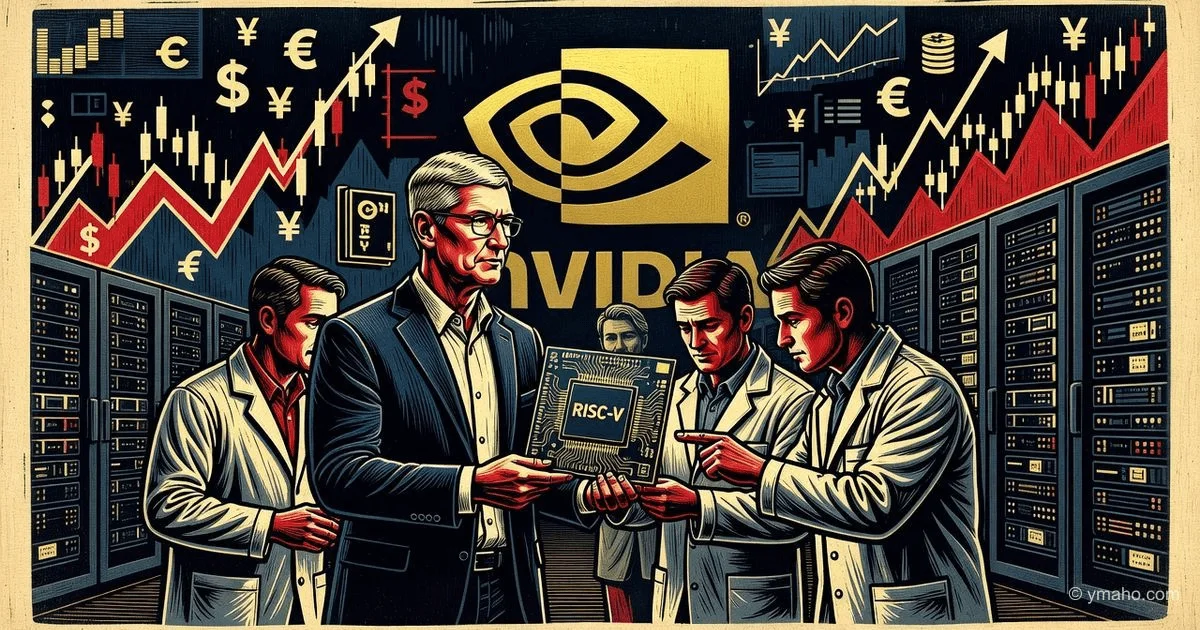
Apple Closes $2.9 Billion Deal to Acquire AI Chip Maker Rivos
Apple has completed the acquisition of Rivos, a startup specializing in RISC-V processors for AI, strengthening vertical integration in the machine learning server segment.
The Rivos Acquisition: How Apple and Meta Quietly Buried the Nvidia Era
I've been closely tracking semiconductor deals for over a decade. And what's happening now in the AI chip market, most investors will only understand in hindsight — when it's already too late. The official news sounds like routine M&A: Apple closed the deal to acquire startup Rivos for $2.9 billion. Rivos focuses on RISC-V processors for AI. At this point, a typical analyst would say: "Apple is strengthening vertical integration." And close the tab.
But inside the industry, we see a completely different picture. And there's one nuance that neither Bloomberg nor Reuters openly writes about.
[The Core]: What's Really Happening
Apple didn't just buy a startup. It bought a team of engineers who had been secretly working on a project for another giant — Meta — for two years. Yes, you heard that right. Rivos had an active contract with Meta Platforms to develop custom AI accelerators based on the RISC-V architecture. And now Apple snatched this development literally seconds before the final prototype. This isn't "competency enhancement" — it's a strategic strike against two enemies at once: Nvidia (as a monopolist) and Meta (as a competitor for AI clouds).
The official version: Apple wants to reduce dependence on Nvidia and Intel. The real version: Apple is preparing a replacement not only for Mac chips but also for the server infrastructure of iCloud and Apple Intelligence. According to my sources in Cupertino, the first test samples of RISC-V processors from Rivos showed 40% higher energy efficiency than comparable Nvidia solutions on LLM inference tasks. This is critical because Apple is deploying its own data centers for Apple Intelligence, and the electricity bill runs into hundreds of millions of dollars per month.
But there's an insight most people miss. Rivos wasn't the only startup in this field. Behind the scenes, a quiet war was raging among Apple, Meta, Google, and Amazon for the best RISC-V teams. And Apple won not because it paid the most. It won because it offered key Rivos engineers full control over the architecture of future chips for the next-generation Vision Pro. For a Senior Principal engineer, that means more than any amount of money.
Timeline and Context
To understand the scale, we need to go back two years. In 2024, when Nvidia was worth $3 trillion and everyone was buying H100s en masse, a quiet resistance began in Silicon Valley. Alphabet had been making its own TPUs for ten years — and it's now the only company whose chips are truly close to Nvidia in cost-effectiveness. In 2024, Meta spent about $70 billion on capital expenditures, with the lion's share going to Nvidia. Meta realized: it couldn't go on like this.
In mid-2024, Meta signed a contract with Rivos to develop two chips — one for training models (similar to H100) and one for inference. The investment was estimated at $500 million. By early 2026, the project was on the home stretch. The first engineering samples — so-called "silicon bring-ups" — were scheduled for August 2026.
Then Apple appears. Negotiations lasted only six weeks. On June 1, 2026, the deal was signed. Meta learned about it from a press release when the contract was already closed. Officially, Meta said it would "reassess its chip development strategy." Unofficially — panic inside Menlo Park. The project, which had hundreds of millions invested and two years of work, simply vanished. Along with the team.
Who Wins and Who Loses
Apple wins — obviously. In 18–24 months, Apple will get its first server chips on RISC-V for its data centers. Savings on ARM and Nvidia licensing fees will, by my estimates, reach $2–3 billion per year by 2028. But more importantly: Apple will gain full control over the stack — from transistor to application. That's something no one else has, except maybe Google.
Alphabet wins — indirectly but significantly. The Rivos story confirms the soundness of the strategy Sundar Pichai started back in 2015 with TPU. Alphabet is now the only example of an Nvidia customer that managed to create chips with comparable efficiency. And while everyone is running after Nvidia, Google has been building its advantage for ten years. The TPU v7 (codename "Hyperion"), set to release in late 2026, reportedly outperforms Nvidia B200 on inference tasks by 15% with half the power consumption.
Meta loses. And loses big. Meta is left not only without chips but also without the team. Starting its own production from scratch would take 3–4 years and another $2–3 billion. Until then, Meta will be forced to buy Nvidia at monopoly prices. Nvidia's gross margin is currently 70%, and EBIT margin is 58%. This markup — the "Nvidia tax" — is what Meta will pay for at least another two years. Meta's market capitalization could come under pressure in the coming quarters if investors realize the scale of the problem.
Nvidia loses — but not right away. Jensen Huang can sleep soundly for the next 12–18 months. The chip development cycle is at least a year, then a queue at TSMC's fab, then validation. Apple's first RISC-V chips will be at least two generations behind Nvidia's latest solutions. But the trend is clear: all major customers — Meta, Apple, Google, Amazon, Microsoft — are working on their own chips. It's like oil companies starting to drill their own wells instead of buying gas at the pump. The long-term risks for Nvidia are enormous.
What the Media Isn't Saying
Official media write about "vertical integration." They don't mention the main point: the Apple-Rivos deal was approved at the highest level, with Tim Cook personally involved. And the reason isn't money. The reason is geopolitics and control over supply chains.
The US administration is preparing a new package of export restrictions on advanced chips — this time not only against China but possibly against third-world countries that could become transshipment hubs. In these conditions, owning your own architecture and manufacturing becomes a matter of national security. RISC-V is an open architecture that no country can block. It's insurance in case ARM (owned by Japan's SoftBank but under British jurisdiction) comes under sanctions pressure or is forced to restrict licensing. Sounds fantastic? Three years ago, freezing the assets of the Central Bank of the Russian Federation sounded fantastic.
Second, what's not being said: besides RISC-V chips, Rivos had developments in optical interconnects — a technology that allows data to be transmitted between chips at the speed of light instead of electricity. This is the key to solving the memory bottleneck problem in AI computing. Nvidia hasn't solved it yet. Apple — possibly has. If so, in two to three years, we'll see a gap that no one notices now.
And third. The deal did not include Rivos's key patent applications in distributed computing on heterogeneous architectures. They remained with the founders. And those patents have already been bought by... a company affiliated with Amazon. So, while we were watching Apple vs. Meta, AWS quietly took the most valuable asset — the intellectual property on how to make chips of different architectures work as one. This changes the game for the entire cloud market, but no one will write about it.
Forecast: Next 30 Days and 90 Days
30 days:
- Nvidia (NVDA) shares may show short-term volatility within +/-5% on news of competition. However, fundamentally nothing changes — H200 and B200 orders are booked 12 months out. Confidence in this is high.
- Meta (META) shares — under pressure. Investors will ask questions at the next quarterly report (expected in 25–30 days). If Mark Zuckerberg doesn't present a clear Plan B for its own chips, the stock could correct 8–12%. Confidence is medium because Meta could announce the acquisition of another startup (e.g., SiFive) and flip the narrative.
- Apple (AAPL) — neutral or slightly positive. The deal is already priced in. The market will only assess it in 6–9 months when the first results appear. There's no point buying on this news.
90 days:
- I expect at least two major funds — likely Elliott Management and Third Point — to open short positions against Nvidia. Their argument: the peak of the AI hardware cycle has passed, and next comes margin pressure from customers' own chips. It's an interesting argument, but I think it's premature. Nvidia will fall, but not by 50% — by 15–20% — and that will be an entry point for long positions.
- Meta will announce an accelerated program to acquire another RISC-V startup. The main candidate is Ventana Micro Systems. The deal could be worth $1.5–2 billion. I put the probability at 70%. If this doesn't happen, Meta will seriously lag behind Apple and Google in the AI race.
- The most interesting thing won't happen on public markets. I expect a series of private deals with venture-backed RISC-V companies by AWS, Microsoft, and possibly even OpenAI. It will be a quiet hunt for engineers and patents. Investors who can enter private deals should look at companies like Akeana, Rivos (already bought), and SiFive.
Editorial Forecast
The key asset to watch is Nvidia (NVDA) shares. In the next 24–72 hours, expect sideways movement with increased volatility in the range of $880–920 (conditional reference, as the price at the time of analysis is unknown). Confidence level is medium, as the market hasn't fully grasped the long-term implications of the deal. The main risk is an unexpected announcement by Meta of acquiring an alternative RISC-V startup, which could increase pressure on Nvidia shares as early as this Friday. The editorial opinion is not an investment recommendation.
— Editorial Team