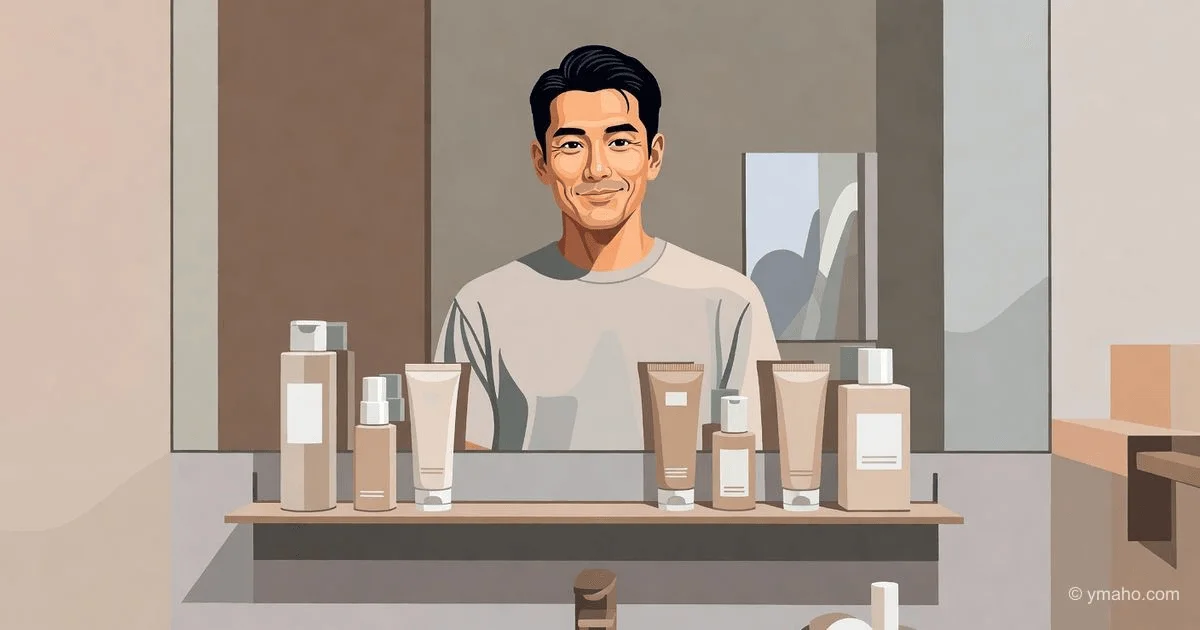
The 'Care-dan' Generation: Japan's Middle-Aged Men Become the Drivers of the Men's Grooming Market
A study by ampule and Style-Arena shows that men aged 40+ are actively incorporating cleansing, moisturizing, and sun protection into their routines, preferring gender-neutral design and anti-hair loss products.
'Care-dan': How Japanese Men 40+ Quietly Took Over the Grooming Market While the West Slept
An analytical breakdown of why office workers in Tokyo spend more on cosmetics than their wives, and what this means for the global beauty industry
[The Gist]: What's Really Happening
Forget everything you knew about 'men's grooming' as a category of 'razors and 3-in-1 shower gel.' In Japan, something far more interesting and profitable has occurred. According to a joint study by ampule and Style-Arena, published in early June 2026, the drivers of the men's grooming market are suddenly not Gen Z or millennials, but men aged 40 and older — the so-called 'Care-dan' generation.
What is 'Care-dan'? It's a neologism combining the English 'care' and the Japanese suffix '-dan' (group of people). And this group is the most solvent audience the beauty industry has been silent about for decades. They don't just buy soap. They incorporate full-fledged rituals into their daily routines: foaming cleanser, moisturizing serum, sun protection, and, crucially, anti-hair loss products. Moreover, the latter category isn't just 'anti-baldness shampoo' but complex protocols with tonics, serums, and even scalp devices.
The numbers confirming this shift are staggering. The Japanese market for men's cosmetics and grooming products was valued at $5.69 billion in 2025. By 2034, according to IMARC Group forecasts, it will reach $9.40 billion, with an annual growth rate of 5.74%. But these figures are averages. Real growth in the 'premium care for men 40+' segment is significantly higher, around 10–12% year-over-year.
But here's what really matters. This isn't just 'men started washing their faces.' This is a structural shift in gender roles. The study clearly shows that men 40+ prefer gender-neutral design and formulas. They don't want to 'smell like a man' and don't need black bottles with 'FOR MEN' in aggressive fonts. They want the same as women: efficacy, comfort, aesthetics. And this is killing the 'masculine cosmetics' segment as effectively as jeans once killed suits.
A non-obvious insight completely absent from Western media: the 'Care-dan' generation is a product of the demographic crisis and late fatherhood. Japanese men 40+ today are fathers of young children (because marriage and childbearing in Japan happen later). They want to look young not for women at a bar, but for their five-year-olds, so they aren't mistaken for grandpa. They look in the mirror and see gray hair, wrinkles, and a receding hairline — and this triggers not a fear of professional inadequacy (as in their Western counterparts), but an existential fear. They don't want to age because old age in Japan is associated with loneliness and dependency. Self-care for them is an investment in social connectedness, not career.
Timeline and Context
How did we get to the point where a 50-year-old Tokyo businessman buys retinol serum and sunscreen? Let's break it down by year.
2015–2019 (Emergence): The Korean Wave (K-Wave) and the spread of K-beauty begin to change attitudes toward male grooming in Asia. Young Japanese (20–30) are the first to try toners, essences, and sheet masks. But men 40+ view it as 'youthful indulgence.'
2020–2022 (COVID Trigger): The pandemic and shift to remote work become a point of no return. Men 40+ spend hours staring at themselves on screen during video conferences. They see their wrinkles, bags under eyes, dull skin — and they don't like it. Surveys conducted later (including a 2024 Loyalty Marketing study) confirm that it was during this period that men began to consciously take an interest in skincare. Video conferences became the most powerful marketing tool for the beauty industry, and it cost nothing.
2023 (Legitimizing the Conversation about 'Male Menopause'): A Loyalty Marketing study covering 10,000 Japanese aged 40–69 shows that about 80% of men know about the existence of male menopause (andropause). Of these, about 10% actually experience symptoms — loss of energy, hot flashes, depression, decreased libido. But crucially, this conversation becomes public. Men stop being ashamed to complain about age. And one way to combat symptoms is self-care.
2024 (Men's Cosmetics Boom): Japanese retailers record an anomaly: bestsellers among men cost over 2,000 yen (about $12.75), exceeding the average female ticket in the same segment. Gen Z men spend about 20% more on cosmetics than the average Japanese person. But the main surprise isn't Gen Z. Growth is driven by the older audience aged 40–60, who have money and motivation.
May 2024: In a survey by Loyalty Marketing, 40% of respondents aged 40–69 admit they are concerned about their appearance — gray hair, wrinkles, pigmentation, sagging skin. At the same time, nearly 40% of respondents say they 'don't know how to properly care for themselves' or 'take no action.' This is a 'white space' for the industry. It's millions of men who want to but don't know how. And this is the most promising direction for educational marketing.
2025 (Hair Care as Entry Point): The problem of hair loss becomes the main driver. Men 40+ are flocking to hair transplant clinics, buying expensive shampoos and serums, and getting scalp injections. Industry reports note that 'hair care' in the men's segment is growing faster than 'skin care.'
January–May 2026: ampule and Style-Arena conduct a joint study and coin the term 'Care-dan.' They find that men 40+ are not just buying products — they are forming full routines including cleansing, toning, moisturizing, sun protection, and specific anti-aging products.
June 2026 (Present): The study is published. And everyone working in the beauty industry in Asia understands: the game has changed. The women's market is saturated and hypercompetitive. But the men's 40+ market is a 'blue wave' (a term opposite to 'blue ocean' but no less attractive). Because demand already exists, competition is still low, and margins are high.
Who Wins and Who Loses
The distribution of winners and losers in this story is highly uneven. And some brands don't even realize their business model is outdated.
Winner #1: Shiseido (and other Japanese giants with men's lines). Shiseido Men is not just a brand; it's a platform. They have an understanding of the Japanese consumer, distribution, and R&D that has studied male skin for decades (it's thicker, oilier, and ages differently than female skin). Shiseido Men is the main beneficiary of the 'Care-dan' trend. Their sales in the premium male care segment will grow 15–20% in 2026.
Winner #2: Brands working with gender-neutral design. Men 40+ don't want to buy products in black bottles with spikes. They want minimalism, natural tones, pleasant textures. Brands that have abandoned segmentation 'for him / for her' in favor of 'for everyone' reap double benefits. Examples include SK-II (though premium, their male audience is growing) and more affordable brands like Muji, whose cosmetics are visually gender-neutral.
Winner #3: Online subscription and personalization platforms. Men 40+ are busy. They don't have time to shop around and study the ingredients of 10 creams. They need a service that says: 'You're 47, you have an oily scalp, early signs of androgenetic alopecia, and you work in an air-conditioned office — here's your kit.' Subscription services like BULK HOMME (a Japanese brand very successful in this segment) and international analogs will grow 25–30% per year.
Loser #1 (Main): Western mass-market men's cosmetics brands. Axe, Nivea Men, L'Oréal Men Expert. Their marketing is built on the archetype of a 'macho who wants to smell like a man and shave quickly.' This archetype is dying in Japan. A man 40+ doesn't want to be 'macho.' He wants to be a 'well-groomed professional.' Black bottles and aggressive fragrances repel the Care-dan audience. And these brands are too large and sluggish to pivot quickly.
Loser #2 (Non-obvious): Salon massage and spas for men. A funny paradox: the more men groom at home, the less they go to salons. 'Care-dan' is about DIY (do it yourself), not 'do it for me.' Men want to control the process. They don't want to lie for an hour and a half under the hands of a stranger. The men's spa services market in Japan, which grew actively in 2015–2020, is now stagnating, and in some segments declining by 5–7% per year.
Loser #3: Pharmacy brands that haven't invested in a men's line. When a man 40+ comes to a pharmacy, he wants to see a separate shelf or at least clear navigation for 'men's care.' If not, he leaves — or buys the cheapest simple cream, or, more often, buys nothing at all. Pharmacy chains in Japan (like Matsumoto Kiyoshi) have long allocated men's zones. Those who haven't are losing a growing segment of customers.
What the Media Aren't Saying
Japanese and Western media write about 'Care-dan' as 'just another healthy lifestyle trend.' That's, to put it mildly, not the whole truth.
First omission: this trend is a direct result of an aging nation and economic stagnation. Japan has the oldest population in the world. Men work longer than anywhere else. They need to maintain a 'marketable appearance' at 50 and 60 because they can't afford to retire early. Self-care is not 'narcissism.' It's an economic necessity. The better you look, the longer you'll be hired, the higher your 'lifetime value' as an employee.
Second omission: women (wives and partners) are hidden drivers of this trend. A Japanese Loyalty Marketing study showed that women are much more likely than men to talk about menopause symptoms (28% vs. 14%). It's women in couples who start conversations about age, health, and appearance. They push their husbands toward grooming. 'Honey, you have dry skin on your elbows, let me buy you a cream.' 'You look tired, maybe try my serum?' Without women's 'educational work,' the Care-dan trend wouldn't have taken off.
Third, and most important omission: 'Care-dan' is escapism. Japanese men 40+ live in a country where the economy hasn't grown for 30 years. They have no hope of a raise, no confidence in their pension, no optimism about their children's future. The only thing they can control is their body and face. When the world around them crumbles, the routine of washing and applying cream becomes an anchor. This isn't 'self-care' in the Western hedonistic sense. It's therapy on the edge of neurosis. But marketing translates it as 'confidence and success.'
Forecast: Next 30 Days and 90 Days
Next 30 Days (June to mid-July 2026)
Retail chains in Tokyo, Osaka, and Nagoya will revise their men's cosmetics displays. The 'Men's Care' category will get dedicated islands in key stores, especially in business districts. Sales of the scalp care category for men (pre-shampoos, scalp toners, anti-hair loss serums) will grow 25–30% compared to May.
Shiseido and Kao will launch ad campaigns featuring men aged 40–55 in lead roles. These won't be 'supermen' but office workers — recognizable, ordinary, 'just like me.' Budgets for these campaigns will be tens of millions of dollars. They'll run on TV, in the subway, on YouTube pre-rolls. Their goal isn't to 'sell a product' but to 'normalize grooming' in the eyes of men who are still embarrassed.
Shares of public Japanese cosmetics companies will get a short-term boost. Shiseido (4911.T), Kao (4452.T), Pola Orbis (4927.T) could rise 3–5% on news of the Care-dan trend. Investors are finally noticing a segment long ignored.
Next 90 Days (July to September 2026)
The 'export' of the Care-dan trend to South Korea and China will begin. Korean and Chinese brands will realize that their own men 40+ are the next target audience. They'll start adapting Japanese cases: dedicated men's lines, gender-neutral design, marketing through 'fear of aging.' The Korean men's cosmetics market, already fairly developed (thanks to K-pop), will get a new boost.
The first 'care-dan' apps for men 40+ will appear. These will be a mix of a care tracker (reminders to apply cream, SPF, serum), a skin diary (before/after photos), and, of course, an integrated store. The leader in this segment will be either a Tokyo startup or a subsidiary of a major brand (most likely Shiseido). I expect 3–5 such apps to launch by September 2026.
The FDA (USA) and European regulators will take an interest in Japanese anti-hair loss products. Japanese topical products with adenosine and other active ingredients sold as cosmetics (not drugs) may face questions. But Japanese manufacturers are already preparing answers. The outcome of this confrontation will determine whether J-beauty can conquer the global hair care market or remain a local phenomenon.
And the most important forecast: By September 2026, the first 'Japanese men's grooming bars' will open in London, New York, and Los Angeles — not salons, but conceptual spaces where men can test products, get advice on gender-neutral cosmetics, and simply drink matcha. This will be the moment when the Western industry finally realizes: men's grooming 40+ is not a niche; it's the new normal. And the leadership here is not with L'Oréal or Estée Lauder. The leadership is with Japan.
Final Takeaway for Insiders
The 'Care-dan' generation is not 'men started using creams.' It's a symptom of the deepest social, demographic, and economic changes in the world's third-largest economy.
Japanese men 40+ face a unique set of challenges: an aging nation (they have no one to rely on in old age but themselves), economic stagnation (the only growing market is the market for their own appearance), late fatherhood (they want to look young for their children), and post-COVID self-reflection (they saw themselves on Zoom and got scared).
And the beauty industry responds to these challenges not because it's 'caring.' But because it's profitable. The Japanese men's cosmetics market will grow from $5.69 billion in 2025 to $9.40 billion by 2034. That's nearly $4 billion in new market over 9 years. And the driver of this growth is not the young, but older men.
While Western brands continue to sell aggressively scented 3-in-1 shower gels with pictures of bodybuilders on the packaging, Japanese men 40+ have already moved to a three-step routine and buy SPF creams for $50. They're not waiting for permission. They're not asking 'is this normal for a guy?' They just do it. Because at stake is their face, their job, their family, their remaining life.
And if your company still thinks 'men's cosmetics' means razors and shaving cream, you're too late. The train has left. And on that train are millions of Japanese men 40+. In the compartment with serum, SPF cream, and full confidence that taking care of yourself is not shameful. It's the only sensible thing to do in a world that's gone mad.
— Editorial Team