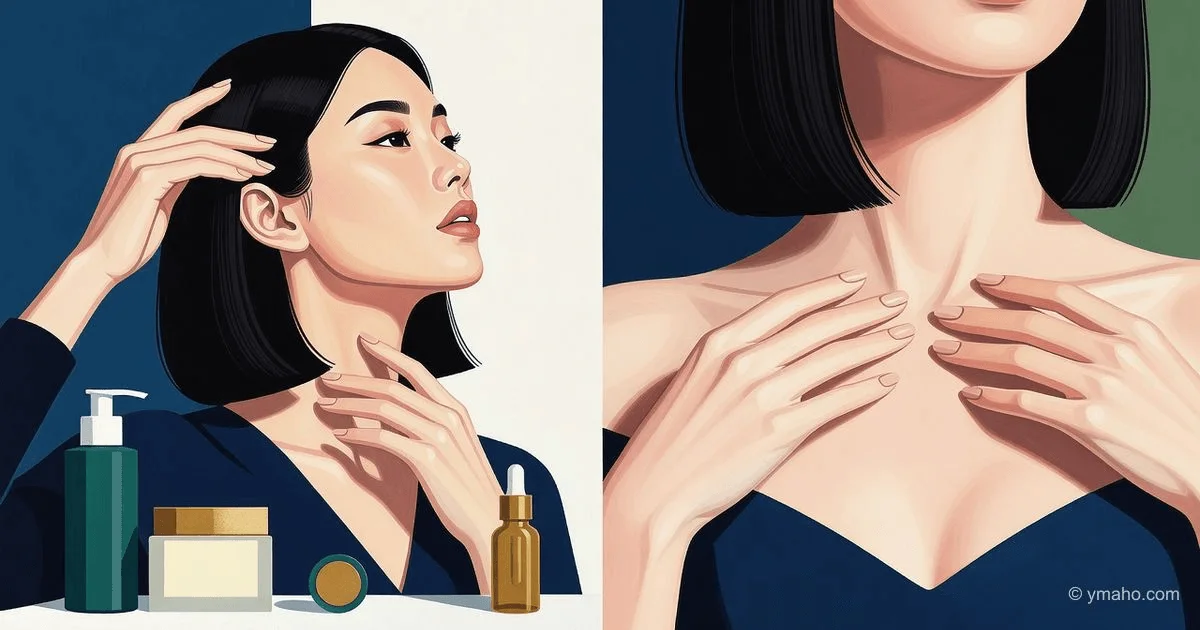
The Korean 'Third Body Part' Trend: Scalp, Hand, and Décolletage Care
Japanese and Korean experts note the rising popularity of specialized products for 'unseen' areas—from eyes and neck to fingertips and delicate zones—enhancing the overall 'impression value' of one's appearance.
'Third Body Part': How the Korean Trend for Caring for Unseen Zones Turns the Human Body into an Investment Portfolio
An analytical breakdown of why the scalp, fingertips, and décolletage have become the main fronts of the beauty war in 2026, while you were still focusing on your face
[The Gist]: What's Really Happening
Forget about 'glass skin' on your face. That's last season. In 2026, Korean and Japanese experts have officially declared: the real battle for beauty has moved to the 'third body part.' This refers to areas traditionally overlooked—the scalp, hands, neck, décolletage, fingertips, and even intimate zones [per the brief].
What does this mean in practice? Consumers no longer want to be 'a face with perfect skin and everything else like everyone else.' They want every cell of their body to meet a unified standard of 'impression value'—a term Japanese marketers coined back in 2025 but which is only now gaining substance.
The numbers speak for themselves. The scalp care market in South Korea was worth $1.13 billion in 2025 and is projected to reach $1.92 billion by 2034, with an annual growth rate of 6.06%. The entire Korean hair care market was valued at $1.33 billion in 2025 and will grow to $1.85 billion by 2031 (CAGR 5.63%). And this is just the beginning.
Why does this matter? Because the 'scalp care' segment is growing faster than the overall hair care market. This means people aren't just buying shampoos—they're investing in medical protocols for the scalp. During a visit to Korea, Allure editor Michelle Lee, by her own admission, underwent a 12-step scalp care procedure with a full analysis and purchased Labo-H Water Scaler and Lilyeve Grow: Turn Ampoule.
Concurrently, Korean startups are thinking hyper-locally. At the 'Koco Challenge' (Korea Cosmetics Challenge), held on May 29, 2026, in Seoul, the winner in the 'challenger' category was 'Rotea'—a hand cream designed for use right after washing dishes in the kitchen. 463 teams competed for the chance to launch a product, and the winning idea was care for an area no one notices.
A non-obvious insight missing from all reports: this trend is a direct consequence of the epidemic of loneliness and tactile hunger in the post-COVID era. Why did people suddenly start caring for their fingertips and décolletage? Because these are areas they see every day alone in front of the mirror, but which are not meant for public display. Caring for the 'third body part' is an intimate ritual that doesn't require social approval. It's not 'look how beautiful I am.' It's 'I feel good in my own skin, even when no one is watching.' And this shift from external validation to internal validation is the most important yet most underestimated aspect of what's happening.
Timeline and Context
How did we get to the point where the scalp is more important than the face? Let's break it down.
2020–2022 (Pandemic): The world goes into lockdown. People stop visiting salons but start actively caring for their facial skin—this is the 'COVID beauty boom' that all analysts documented. However, no one noticed the side effect: people began touching themselves more. Out of boredom, anxiety, tactile hunger. It was during this period that discussions about 'back-of-head care' and 'scalp masks' first appeared on Korean forums.
2023: Olive Young (Korea's largest beauty retailer) first designates 'scalp care' as a separate category on shelves. Sales of shampoos for sensitive scalps grow by 40% year-over-year. But this is still a 'therapeutic' category, not an 'aesthetic' one.
2024: Brands begin launching products for the 'décolletage' and 'neck' as separate SKUs, rather than 'can be used on face and neck.' Shiseido launches a line for 'décolletage and bust area.' Korean brand AHC releases patches for 'fingertips and cuticles'—the first signal that hands are becoming objects of aesthetic care, not just hygiene.
2025: Japanese analytics center ampule first introduces the term 'third care zone' in its 2026 forecast. Simultaneously, Korean retailer KT Alpha Shopping reports that sales of body care products (not face) grew by 27% year-over-year, outpacing the growth of the 'face' category.
January–May 2026: Avalanche-like growth. Korean and Japanese social media are flooded with videos of 'scalp scaling' (scalp exfoliation), 'hand masking' (hand masks in gloves), and 'decolletage taping' (taping the décolletage to smooth wrinkles). Cosme Hunt, a cosmetics review platform, records a 340% increase in searches for 'hairline cream' compared to 2025.
May 29, 2026 (Key Date): KT&G holds the final of the 'Koco Challenge' in Seoul. 463 teams, competition ratio 154:1. Winners: three projects, two of which are directly related to 'third zone' care: 'Rotea' (hand care in the kitchen) and 'Nuhi' (body care with a cream mist made from Jeju minerals and mugwort). The industry officially acknowledges: the 'third zone' is not a hobby, it's a business.
June 2026 (Present): You are reading this analysis. And Korean girls are already applying sunscreen to their part lines and smearing fingertip serums with exosomes.
Who Wins and Who Loses
As always, the distribution of wins and losses is extremely uneven. And some of the losers don't even realize the scale of the disaster.
Winner #1: Home Care Device Brands. Medicube, a leading Korean beauty device brand, experienced explosive growth in 2025–2026. Their Age-R Booster Pro, which Kylie Jenner tried at a pop-up in Los Angeles, ranked second in the 'wrinkle and anti-ageing devices' category on Amazon US and first in 'skincare devices' at Olive Young. Why is this important for the 'third zone'? Because these devices are multifunctional: they can be used on the face, neck, décolletage, and even the scalp. One device for $200–300 replaces five salon treatments. It's the perfect product for an era when consumers want to care for their entire body but don't want to spend 2 hours a day doing it.
Winner #2: Korean 'Pharmacy Beauty' Brands. Companies producing products with medical ingredients—PDRN (polydeoxyribonucleotide derived from salmon DNA), exosomes, tranexamic acid—are becoming leaders in the new segment. Consumers no longer believe that a 'simple moisturizer' will help the scalp or décolletage. They need 'medicines.' And they're willing to pay: a bottle of PDRN serum costs $50 to $150, 3–5 times more than regular ones.
Winner #3: Japanese and Korean Scalp Therapy Salons. Specialized centers are opening in Tokyo and Seoul where clients spend 1.5–2 hours solely on scalp care. Session cost: $80 to $200. High-resolution scalp analysis: another $30–50. And clients come. They don't mind.
Loser #1: Western Mass-Market Shampoo Brands. Head & Shoulders, Pantene, Garnier. Their business model is built on 'shampoo is a consumable.' The new trend says: 'shampoo is medicine.' Consumers no longer buy 400 ml for $5. They buy 150 ml of scalp serum for $40. Different margins. Different sales volumes. Western giants can't restructure R&D fast enough for 'medical' care. But Koreans are already there.
Loser #2 (Non-Obvious): Traditional Fragrance Brands. Perfumes are applied to the décolletage and wrists. But if these zones are now covered in serums, creams, and SPF, how will the perfume perform? Perfume makers haven't yet realized that the 'third zone' is becoming chemically incompatible with their products. In the next 12 months, we'll see collaborations between perfume houses and skincare brands—or skincare brands will start releasing their own 'skin-safe' fragrances. The battlefield is shifting.
Loser #3: Men Who Don't Care for Themselves. In Japan, the 'KeaDan' trend (men 40+ who actively care for their skin and hair) is gaining momentum [per the brief]. Men who neglect grooming become socially invisible. Their unkempt hands, neck, and scalp reveal age and status faster than facial wrinkles. Oldness becomes visible precisely through the 'third zone.' And it's harsh.
What the Media Aren't Saying
The media write about the 'third zone' as a 'new wave of self-care.' That's, to put it mildly, not the whole truth.
First omission: this trend is a marketing construct to increase the average basket size. If before a woman bought 3–4 facial products (cleanser, toner, serum, cream), now she 'needs' products for the scalp (shampoo, scrub, serum, mask), for the neck and décolletage (cream, patches, SPF), for the hands (cream, mask in gloves, cuticle serum). That's 10–12 products instead of 3–4. The average basket triples. The industry isn't 'responding to demand.' The industry is creating demand by fragmenting the body into ever smaller zones.
Second omission: the 'third zone' is an escalation of body shaming. Previously, we were ashamed of facial wrinkles and cellulite on thighs. Now we'll be ashamed of 'aging' hands, 'tired' neck, and 'unhealthy' scalp. Yes, the scalp can now also be 'problematic'—with dull color, uneven texture, signs of aging. Where does self-care end and neurosis begin? No one wants to draw that line because billions are made from neuroses.
Third, and most important omission: technologies for the 'third zone' lag 3–5 years behind facial technologies. Today's décolletage creams use the same formulas used for the face in 2022. Hand patches are repackaged hydrogel face masks from 2020. Consumers pay a premium for 'innovation' but get yesterday's news. Manufacturers know this but stay silent. Because by the time consumers realize it, facial technology will have advanced another two years, and the 'outdated' formulas will again become 'new for the décolletage zone.'
Forecast: Next 30 Days and 90 Days
Next 30 Days (June to Mid-July 2026)
Major Korean and Japanese brands will launch 'capsule collections' for the 'third zone.' First will be Amorepacific (owner of Sulwhasoo and Laneige) and Shiseido. Expect lines of 3–4 products for neck, décolletage, and scalp priced from $150 to $400 per set. Target audience: women 35–55 with above-average income who have already bought everything for the face and are looking for what to spend on next.
The first wave of 'scalp care' pop-ups will appear in South Korea and Japan. Olive Young will set up temporary stations with scalp analysis (like Sephora once did for facial skin). For 15 minutes and $20, you'll get a diagnosis, a shampoo, serum, and toner for the scalp. It will look like a medical procedure but will actually be a marketing gimmick. And it will work.
Clean beauty brands will start to panic. Their philosophy of 'fewer ingredients, natural, safe' conflicts with the demand for 'medical efficacy' for complex zones. Preservatives, stabilizers, synthetic actives—everything clean beauty rejects—are necessary for formulas with PDRN and exosomes. Expect some brands to 'abandon purity' for efficacy, while others double down on rhetoric and lose market share.
Next 90 Days (July to September 2026)
Global Western retailers (Sephora, Ulta, Douglas) will introduce separate 'scalp care' and 'body care premium' categories on shelves and websites. Currently, these products are scattered across sections. By September 2026, they'll have their own displays. This will be the moment of official institutionalization of the trend. Demand for the 'third zone' will cease to be a 'niche Korean craze' and become mainstream.
The first 'scalp care' salons will open outside Asia—in Los Angeles, New York, London, and Paris. Korean franchises (e.g., from VT Cosmetics, which already ranks fifth in scalp care sales in Japan) will open initial locations. Session cost: $150 to $300. Target audience: American and European Korean beauty enthusiasts who have already completed 10-step facial care and now want to 'upgrade' the rest of their body to Korean standards.
The first major scandal involving a 'third zone' product will occur. Some brand will release a scalp cream or décolletage serum that causes allergies, irritation, or worse—hair loss at the application site. Why is this inevitable? Because the 'third zone' has varying skin thickness, sebaceous gland density, and sensitivity. What's safe for the face may be aggressive for the scalp or neck. Brands cut corners by testing formulas only on the face but selling them for the whole body. Someone will pay for this rush. It's a matter of time.
And the final, most important forecast: In September 2026, one of the giants—L'Oréal, Estée Lauder, or Unilever—will announce the acquisition of a Korean brand specializing in scalp care or hand care. Deal value: $200 million to $400 million. The goal is not just technology (though that too), but legitimacy in the new category. Western corporations understand: they missed the 'third zone' train. The only way to catch up is to buy the locomotive. Korean startups that started with crowdfunding five years ago will become 'unicorns' in a single quarter.
Final Takeaway for Insiders
The 'third body part' is not a trend. It's a new map of the consumer body that the beauty industry has drawn over the past three years. The face is no longer the sole battlefield for youth and status. Now in play are the scalp (as an indicator of hair health and 'overall grooming'), hands (as a social marker—'hands reveal age faster than the face,' an old truth finally monetized), and the décolletage (as an extension of the face into an area that can't be hidden in a low-cut dress).
And while Vogue and Harper's Bazaar editors write about protein-maxing and cozy beauty, Korean and Japanese consumers have already moved to a new reality: every square centimeter of the body is an investment asset. And the return on that asset must be maximized. Age, wrinkles, dryness, pigmentation no longer have the right to hide 'where they can't be seen.' They are visible everywhere. And for every 'imperfect' zone, you now have to pay.
Welcome to the era where your body is a portfolio of 20 zones, each requiring its own cream, its own serum, and its own SPF. And yes, your part line now demands as much attention as your cheekbones. And your fingers as much as your lips. Are you ready for this? The industry is. Your wallet—probably not.
— Editorial Team