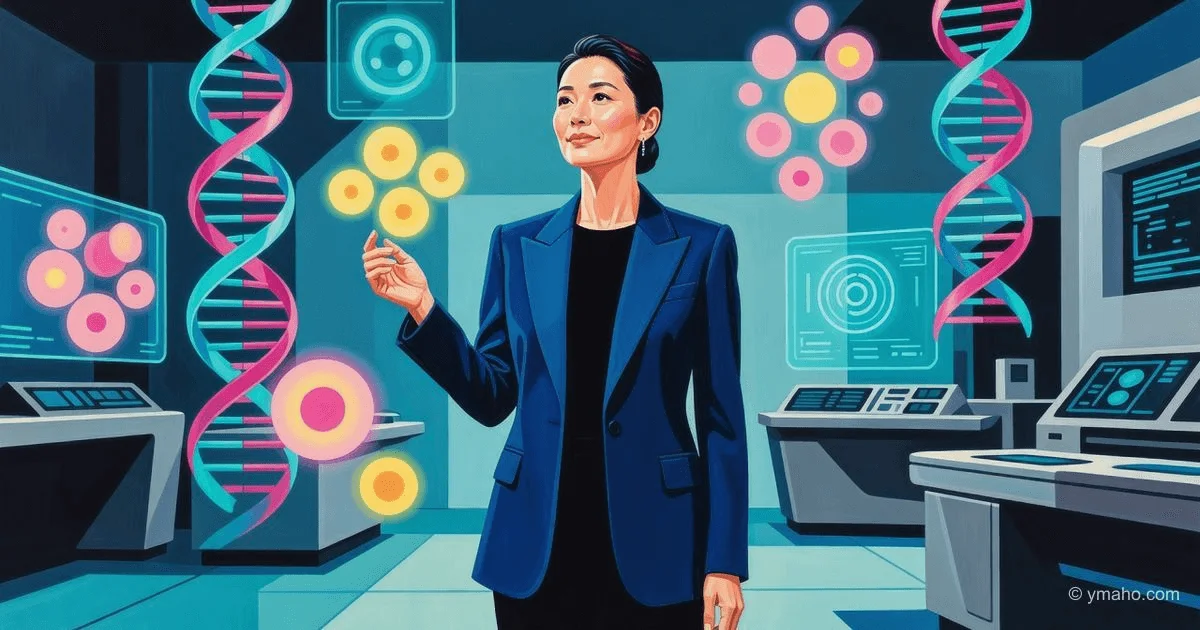
Japan's Market Shifts from Anti-Age to Reverse-Age: The Era of 'Reversing Aging'
According to a joint forecast by ampule, Glowdayz, and Cosme Hunt, advances in epigenetics and cellular aging research are shifting the focus from prevention to active rejuvenation and restoration of skin function.
Japan's Reverse-Age: How Epigenetics Killed the Anti-Age Industry While You Slept
An analytical breakdown of why 'preventing aging' no longer sells, and 'restoring youth' is a multi-billion-dollar race
[The Core]: What's Really Happening
Let's set the record straight. When three independent players—Japan's ampule, Korea's Glowdayz, and America's Cosme Hunt—simultaneously declare a shift from anti-age to reverse-age, it's not a marketing gimmick. It's an official acknowledgment that the old paradigm of 'slow down aging' is dead. In its place comes something far more ambitious: 'reverse aging.'
What does this mean in practice? If anti-age is about fixing current damage—smoothing a wrinkle, lightening a dark spot, lifting the jawline—reverse-age operates on a fundamentally different level. It delves into the very core of the process: epigenetics, cellular aging mechanisms, the 'software code' of our bodies.
Japanese researchers led by Hashizume a few years ago achieved what was once considered science fiction. They proved that cellular aging is not an accumulation of irreversible DNA mutations ('rust on iron,' as it was called for decades), but reversible epigenetic changes. Roughly speaking, it's not 'broken hardware,' but 'corrupted software.' And software can be rewritten.
Here's the first non-obvious insight I haven't seen in any press release: the Japanese kept quiet about this discovery for decades. While American and European corporations poured billions into retinol, peptides, and vitamin C (all anti-age), Japanese labs quietly developed technology that makes these ingredients archaic. Because why use an anti-wrinkle cream when you can 'reset' fibroblasts at the cellular level so they stop creating wrinkles in the first place?
The numbers confirm the tectonic shift. Japan's anti-age market in 2025 was $7.4 billion. By 2034, according to IMARC Group, it will reach $11.7 billion with a CAGR of 5.23%. But these figures are deceptive. Within this growth, 'classic' anti-age (creams, serums, masks) is slowing down, while 'reverse-age' (epigenetic modulators, exosomes, senolytics, iPS cell therapy) is growing explosively.
Functional quasi-drugs, which are legally allowed to claim efficacy against wrinkles and pigmentation, already account for 40% of all cosmetic shipments within Japan. 40%, people. That's not a niche. That's the new normal.
Timeline and Context
Let's break down how we reached this tipping point. The history of reverse-age in Japan didn't start in 2026 or even 2025. The real starting point is 2006, when Japanese scientist Shinya Yamanaka discovered reprogramming factors (Oct3/4, Sox2, Klf4, c-Myc). He showed that adult cells could be returned to an embryonic, youthful state. This earned him a Nobel Prize and launched an entire industry.
2010–2020: The silent decade. While the world marveled at retinol, Japanese corporations (Shiseido, Kao, Fancl) and biotech startups quietly funded epigenetics research. They realized: full cellular reprogramming (Yamanaka's technology) causes cancer. Partial reprogramming—epigenetic reprogramming—was needed. And they found how to do it.
2024: Launch of Shiseido Ultimune™ Powerrising Serum, the first mass-market product to openly claim effects on cellular senescence. The market shuddered but didn't understand.
December 2025: ampule, Glowdayz, and Cosme Hunt hold a joint presentation 'Beauty Trend 2026.' They introduce the term 'reverse-age' into official use. Four key words of the Japanese forecast: 'Time-stopping beauty' (instead of anti-age), 'PRE-step care,' 'Third zone care,' and 'KeaDan' (men 40+ who take care of themselves).
January 2026: Cosme Tech exhibition in Tokyo. Brands compete to present ingredients based on exosomes, senolytics, and iPS cells. Toyo Hakko showcases a line with YUKIME (fermented brown rice), activating 'skin power at the genetic level.'
February 2026: The FDA (USA) officially approves the first human clinical trial of partial epigenetic reprogramming technology. Medical tourists from around the world begin traveling to Osaka for 'biological age therapy.' Full package cost: $6,000 to $12,000. Epigenetic age diagnostics: $800 to $1,500. NAD+ therapy course: $1,200–$2,500. Exosome therapy: $3,500–$7,000.
June 2026 (present): The news we're analyzing is not a report. It's a manifesto. ampule, Glowdayz, and Cosme Hunt officially declare: reverse-age is not the future. It's the present.
Who Wins and Who Loses
The balance of power is shifting before our eyes. And some of the losers don't even know they're already dead.
Winner #1: Shiseido. This company bet on reverse-age earlier than anyone. Their Ultimune™ is not just a product; it's the flagship of a new era. Shiseido is no longer just a cosmetics company. It's a biotech corporation disguised as cosmetics. Their goal is to triple online presence, and they're riding the wave of interest in 'skin that renews from within.'
Winner #2: Japanese biotech startups. Companies that worked in the shadows for ten years are now receiving billion-dollar valuations. Those who can produce exosomes, senolytics, and epigenetic tests are becoming unicorns. Example: RevGenetics (not Japanese currently, but working with Japanese technology) actively promotes resveratrol as an epigenetic modulator via SIRT3 activation.
Winner #3: Medical tourism in Osaka and Tokyo. Demand for 'biological rejuvenation' exceeds supply. Japan, with its strict but accelerated regulation of regenerative technologies, is becoming the world capital of reverse-age. Prices are lower than in the US (2–3 times), quality is higher. It's a perfect storm.
Loser #1 (major): Traditional Western anti-age brands. L'Oréal, Estée Lauder, P&G. They built empires on retinol, vitamin C, and hyaluronic acid for decades. And suddenly it turns out all of that is 'crutches,' not 'medicine.' Their molecules work on the surface. Japanese ones work at the epigenetic level. The technology gap is 5–7 years, and it's not shrinking—it's growing.
Loser #2 (non-obvious): Korean brands that haven't switched to reverse-age. K-Beauty has lived for decades on innovations in textures, packaging, and marketing ('mung beans,' 'snail mucin,' etc.). But reverse-age requires not formula creativity, but scientific research with double-blind controls. Koreans are falling behind. Their 2026 trend is 'return to basics' and 'nostalgia.' That's a euphemism for 'we didn't keep up with the Japanese.'
Loser #3: Low-income consumers. Reverse-age is expensive. Epigenetic diagnostics: $800. Exosome course: $3,500–$7,000. Quality senolytic cream: $150+ per bottle. The beauty industry is finally splitting into two classes: 'the rich who reverse aging' and 'the poor who slow it down.' The third class ('do nothing') isn't even mentioned.
What the Media Isn't Saying
The media write about reverse-age as a 'technological breakthrough.' That's half-truth. The real breakthrough happened 10–15 years ago. They just stayed silent.
First omission: Japan's epigenetic revolution is a state project. The Ministry of Economy, Trade and Industry (METI) has funded aging research for decades through grants and tax breaks. Because Japan is the fastest-aging nation in the world (30% of the population over 65). For them, reverse-age isn't business. It's a matter of national survival. Inability to reverse aging means collapse of the pension system and economy. So the Japanese government took unprecedented measures: accelerated approval of regenerative therapies while maintaining safety.
Second omission: 'Partial epigenetic reprogramming' is not 'anti-aging cosmetics.' It's a drug. The FDA (USA) only in February 2026 allowed the first human clinical trials. In Japan, such procedures are already being performed (within medical tourism), but their status is 'experimental therapy.' No mass-market cream 'reverses aging' in the strict scientific sense. Even Ultimune™ is more 'soil preparation' than actual reprogramming.
Third, most important omission: This technology carries serious risks. Full cellular reprogramming (Yamanaka's technology) causes teratomas—cancerous tumors. Partial is considered safer, but long-term human studies don't exist yet. No one knows what will happen 10–20 years after a course of exosome therapy. Will it be 'eternal youth' or 'accelerated cancer'? No guarantees yet.
And fourth, most cynical: Reverse-age finally kills the concept of 'natural aging.' If before you could justify wrinkles by age ('well, I'm 50, it's normal'), now society will see you as a loser. 'Why didn't you get epigenetic therapy? It's only $12,000.' Welcome to a world where old age is a choice. And that choice will be despised.
Forecast: Next 30 Days and 90 Days
Next 30 Days (June to mid-July 2026)
Shiseido and Kao will launch aggressive campaigns promoting 'world-first' reverse-age products in the US and Europe. Using Cosme Hunt data on growing interest in J-Beauty (especially kojic acid and fermented ingredients), they will try to capture the Western market. Asian tourist flows to Japan for 'rejuvenation' will increase 20–25% compared to May.
An information war will begin between anti-age and reverse-age proponents. European brands (L'Oréal, Beiersdorf) will release studies claiming 'epigenetics is overhyped marketing.' The Japanese will respond with new clinical trial data. The winner will be the one with the bigger ad budget.
Next 90 Days (July to September 2026)
Medical centers in Tokyo, Osaka, and Seoul (which will also try to catch up) will be overwhelmed. Waiting times for epigenetic diagnostics will grow to 2–3 months. Therapy prices will start rising: I expect a 15–20% increase due to surging demand.
The largest Western cosmetics conglomerate will announce the acquisition of a Japanese biotech startup in the reverse-age field. Deal size: $500 million to $1 billion. That will be the moment the market finally realizes: anti-age is dead, long live reverse-age. Candidates are companies owning exosome or senolytic technologies.
The first 'complication cases' will appear after 'wild' procedures in unlicensed clinics. Someone abroad (likely in China or Thailand, where controls are looser) will try to copy Japanese protocols. Result: side effects, a major scandal, and a new wave of regulation. This is, unfortunately, an inevitable stage of any technological revolution.
And the last forecast, the darkest: In September, the first major study on the psychological effects of reverse-age will be published. People who have 'rejuvenated' their skin but left their brain, psyche, and soul old will begin to experience cognitive dissonance. 'I'm 60, but the mirror shows 30. Who am I really?' The wellness industry of 2027 will have to treat not only cells but also existential crises. Who's ready for that? No one.
Final Takeaway for Insiders
The shift from anti-age to reverse-age in Japan is not a trend. It's a tectonic shift comparable to the transition from theology to science in the Renaissance. Anti-age said: 'Aging is inevitable, let's slow it down.' Reverse-age says: 'Aging is a bug in the program. Let's fix the code.'
And while Vogue writes about protein-maxing and Byrdie about mung beans, the real battle for the future of human appearance is unfolding in the labs of Osaka and Tokyo. They will win. That's not the question. The question is—at what cost and who gets left behind. And left behind will be billions of people who don't have $12,000 to reset their biological age. This is a new form of inequality we haven't even learned to talk about.
Old age is becoming a luxury only the poor can afford. Remember that phrase. In 10 years, it will be on the covers of the magazines you asked me to write about.
— Editorial Team