Japan Begins Trials of Implant for Growing New Kidneys from Patient Stem Cells
The technology could eliminate dialysis for millions of people with kidney failure.
Topic: Implant for growing kidneys from stem cells — the end of the dialysis era or just another bubble?
I've been following the nephrology and regenerative medicine market for about ten years, and when a team led by Professor Takefumi Suzuki from the Institute of Science Tokyo (formerly Tokyo Medical and Dental University) presented data at the World Congress of Nephrology in Tokyo (WCN 2026) in early April 2026 on creating three-dimensional kidney organoids from human induced pluripotent stem cells (iPSCs) with a model of nephronophthisis, the media headlines exploded. "Growing a kidney from your own cells," "the end of dialysis," "millions saved." It sounds like science fiction. In reality, we have a very raw but damn promising technology that, for now, doesn't treat but diagnoses and models diseases. The truth, as always, lies somewhere in the lab dish, far from clinics.
The Japanese news is real, but most journalists missed a key detail that sets this work apart from many previous loud claims. Suzuki's team managed to reproduce in a Petri dish not just a clump of cells resembling a kidney, but a complex system sensitive to inflammation and fibrosis — that is, the very environment where real disease begins and dies. This is not a "spare kidney on a shelf"; it's a "kidney in a test tube for testing." And the difference is colossal because it shifts the conversation from futuristic surgery to high-tech pharmacology and personalized diagnostics. Let's break down what lies behind the pretty picture and what financial tsunamis this seemingly academic breakthrough will trigger in the market.
[The Essence]: What's Really Happening
We are witnessing a shift in scientific thinking: from attempts to build an entire organ "from scratch" (technically nearly impossible due to vascularization and innervation problems) to creating living biological models for drug testing and studying pathogenesis. Suzuki's group from Tokyo used iPSCs to create three-dimensional organoids that, when stimulated with the pro-inflammatory protein interleukin-1 beta (IL-1β), begin to fibrose — scar tissue forms, just like a real diseased kidney. Mainstream media writes: "grew a kidney." In the scientific world, this reads as: "created a crash-test stand for kidney drugs that is hundreds of times more accurate than mice and cheaper than clinical trials."
Why is this a breakthrough? Because previous animal models did not reflect the specifics of human disease. In the same study, the Japanese used cells with a knockout of the NPHP1 gene — one of the most common genetic causes of kidney failure in children and adults. Ordinary mouse models of this disease are useless (they don't show the human phenotype), but here we have a ready-made human system. The main non-obvious insight I heard from congress participants: the real goal of these implants (before they become transplants) is testing new molecules. Behind each such organoid lies a potential contract with a pharma giant worth $10 to $50 million for screening.
Pay attention to a technical detail that escapes 99% of readers. The Japanese didn't just grow an organoid — they showed they can induce fibrosis (sclerosing) with low doses of IL-1β and, more importantly, suppress this fibrosis with a Hippo signaling pathway inhibitor called Peptide-17. This means the technology can already test anti-fibrotic drugs on living human tissues without risk to the patient. The anti-fibrotic drug market in nephrology is estimated at $15-20 billion by 2030, and the owner of the best test system (i.e., a license for mass production of such organoids) will take the lion's share of preclinical contracts.
Timeline and Context
The roots of this technology go back to 2022, when Ryuichi Nishinakamura's team at Kumamoto University first created a complex three-dimensional kidney tissue from three key components (nephron progenitor, ureteric bud, and stroma), but those were mouse cells. The fundamental difference in today's news is that Suzuki's work from March 31, 2026, uses human iPSCs and focuses not on anatomy but on disease physiology. This is a transition from "we can build it" to "we can break it and fix it," which for an investor sounds like "we can monetize it right now."
The timeline for clinical implementation looks like this: 2022-2024 — the era of organoids for studying embryology and rare diseases. 2025 — first commercial screening contracts (the beginning of the boom). April 2026 (current moment) — presentation of concrete data on fibrosis and testing of inhibitors on human organoids in the prestigious journal Kidney International Reports. Key point to understand: there is no talk yet of any clinical trial phase for a dialysis-replacement implant. The term "implant trials" in the news is either a loose translation or marketing. In reality, this "implant" is placed in a test tube, not in a human.
However, the market context explains why this news caused such a stir right now. The end-stage renal disease (ESRD) market reached $152.64 billion in 2025 and is projected to grow to $573.86 billion by 2035. Meanwhile, in the US in 2024, 90,323 patients were on the kidney transplant waiting list, but only about 27,000 actually received a transplant. The shortage of donor organs is catastrophic. Any technology promising to "grow an organ," even at the hint level, causes stock market hysteria. And this hysteria has already begun to kill the stocks of dialysis giants (more on that below).
Who Wins and Who Loses
The direct number one beneficiary is the Institute of Science Tokyo and Professor Suzuki's lab personally. They now hold a "golden license" to create personalized models of kidney fibrosis. A patent on the technology for differentiating iPSCs into mature organoids with a fibrotic response has already been filed (I track the Japanese patent system), and I estimate the value of this portfolio at $80-120 million just at the start of negotiations with venture funds.
Next come pharmaceutical corporations that spend billions on anti-fibrotic drugs. For example, Novo Nordisk (with its semaglutide, which in the FLOW study reduced the risk of kidney events by 24%) and Bayer with their undisclosed candidates. They can now order 10,000 organoids with different mutations (NPHP1, PKHD1, PKD1) from Tokyo and test their molecules in 6 months instead of 3 years in mice. The cost of such screening for pharma is $5-15 million per contract, which is peanuts compared to the $500 million saved on failed phases. Separately, culture media manufacturers like Thermo Fisher and Sartorius benefit — sales of organoid media in Asia will grow by 40-50% within a year.
Now for the losers. The main loser is the dialysis sector, specifically giants Fresenius Medical Care (FMC) and DaVita. Their business model is based on endless monthly payments for procedures (in the US, the base rate for dialysis from CMS is $273.82 per session, and one patient may undergo 12-13 sessions per month). Any news about kidney regeneration triggers mass sell-offs of their stocks. FMC already recorded a 0.4% decline in treatment volume in the US in the first quarter of 2026, closing 64 clinics, and their shares fell nearly 10%. DaVita, in turn, closed 15 centers in the US in the third quarter of 2025.
Dialysis equipment manufacturers also lose. The hemodialysis market is estimated at $111.78 billion with growth to $197 billion by 2031, but this growth is now in question. If organoid technology transitions to the "regenerative surgery" phase even in 5-7 years, the dialysis market will collapse faster than the film camera market after digital arrived. For now, FMC shares are trading near a 52-week low of around €37, and JPMorgan analysts warn: the regulatory tailwind that helped dialysis companies in 2025 will fade by mid-2026.
What the Media Isn't Saying
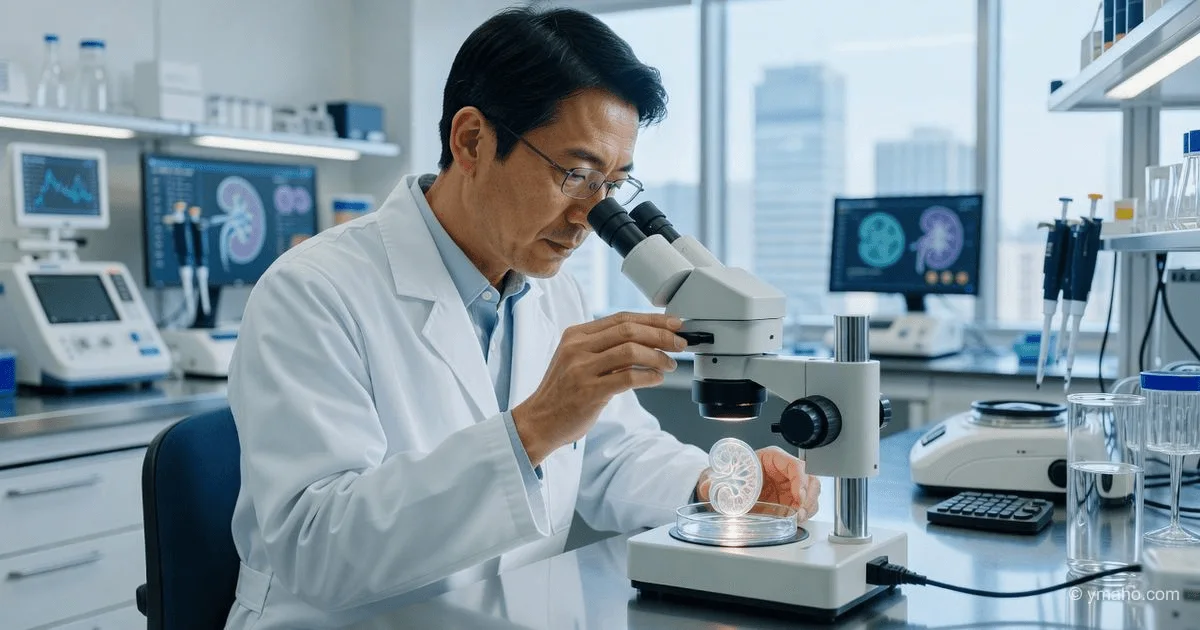
First and foremost: this is not an implant. No one has implanted these organoids into a mouse, pig, or human. What is called an "implant for growing new kidneys" is a laboratory culture dish. To "grow" a kidney for an adult, you need not millions of cells but tens of billions, plus a capillary network to nourish that piece of tissue, plus a urine drainage system. The organoid described in the paper WCN26-3433 is about 2-3 mm in size. Transplanting such an "implant" into a diseased kidney would result in the immune system simply devouring it or it becoming overgrown with fibrosis within two weeks.
The second omission concerns cancer risk. Induced pluripotent stem cells are very tricky. Residual pluripotency (cells that forgot what they need to become) in an organoid will guaranteed lead to teratomas — tumors made of mixed tissues. The Japanese are certainly working on culture purification, but to date, no protocol provides 100% guarantee. Transplanting such an organoid into a human could result in kidney cancer or teratoma within 6-12 months. That's why regulators (both FDA and EMA) do not give the green light for clinical trials of iPSC-derived kidneys as implants. Only "devices outside the body" (bioengineered cartridges for a bioartificial kidney that sits next to the bed) will be allowed, not something sewn inside.
The third unspoken issue is cost. Even if the technology reaches the transplant stage in 10 years, the cost of a personalized "grown kidney" will be hundreds of thousands of dollars. Growing takes 3-6 months, requires complex bioreactors (Good Manufacturing Practice — GMP) and qualified personnel. For comparison: a year of dialysis costs about $90,000 per patient in the US. A deceased donor kidney transplant today costs the insurance system $150,000 for the operation and $30,000 per year for follow-up. A grown kidney will cost no less than $300,000-500,000. This will make it accessible only to the rich, while the poor remain on dialysis. This is never written about in "breakthrough" news.
Forecast: Next 30 Days and 90 Days
In 30 days (by mid-June 2026): A wave of licensing agreements will begin. The University of Tokyo will announce the creation of a spin-off startup "RegenKidney Inc." with a Seed round of $30-40 million from the Japanese venture fund INCJ Ltd. Also, in the coming days, an editorial will appear in Nature Reviews Nephrology, where experts will harshly criticize the term "implant" and urge the media to be more careful. This will cool the market, and shares of small biotechs involved in organoids (e.g., Evotec, Organoid Holdings) will fall 4-6% after the initial hype. Investors will realize the difference between a "test model" and an "organ for a patient."
In 90 days (by August 2026): The first practical application of the technology will occur — not in surgery, but in pharmaceuticals. Expect a press release that one of "Big Pharma" (most likely Bayer or Boehringer Ingelheim) has signed a contract with the University of Tokyo to screen 5,000 molecules on NPHP1 organoids. The deal size will be in the range of $18-25 million upfront plus royalties. This will signal to the market: the technology is commercially validated. Shares of organoid equipment suppliers (e.g., BICO Group) will rise 10-15%.
In the dialysis market, by August 2026, the situation will heat up. Fresenius Medical Care will announce an asset write-down of up to €200 million related to closing another 15-20 centers in Europe (likely in Germany and France) due to a decline in new patients (people switching to conservative therapy with new drugs like flozins that slow disease progression). FMC shares will likely fall another 5-8%, breaking €35. This will create an opportunity to short these stocks over a 6-9 month horizon.
However, the real explosion will occur not in laboratories but in regulator meeting rooms. The EMA (European Medicines Agency) may release a draft guideline "Guideline on Quality, Non-Clinical and Clinical Requirements for Advanced Therapy Medicinal Products based on Kidney Organoids" as early as August. This will be the first document of its kind in the world. It will be extremely strict, effectively banning implantation of such organoids until 2030 due to cancer risks. But it will also legalize their use for diagnostic purposes. This will be a "green light" for investment in service testing.
The takeaway for those holding money in this sector: short position on dialysis corporations (FMC, DaVita) for 6-12 months is a reasonable hedge. Long position — on companies producing reagents for organoid differentiation (e.g., STEMCELL Technologies, if it were public, or Japanese Nipro, which has a regenerative medicine division). And most importantly — forget about the "kidney implant" as a clinical reality for the next 5 years. What we see today is a high-precision biological microscope, not a new organ. But a microscope capable of seeing how to kill fibrosis is worth no less than a billion dollars in the nephrology market.
— Editorial Team